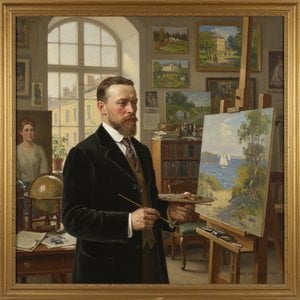
A Life Divided Between Soil and Canvas
Wilhelm Casper Magnus August Wrede lived a life of dualities, split between the quiet responsibilities of a landowner and the restless impulses of a painter. Born in Kaarina, Finland, his early years were marked by a formal education in drawing, beginning at the Suomen Taideyhdistys Drawing School and continuing at the Turku Drawing School. He was a man of significant talent, once viewed as a peer to the great Albert Edelfelt during his formative years in Paris. Yet, the life of an artist is rarely a straight line. After studying in Munich and Paris, Wrede chose to return to the Finnish landscape, not merely to paint it, but to inhabit it as an estate owner.
The pull of the land was strong. After graduating from the Mustiala Agricultural Institute, he acquired the Wrede family estate, Gästerby, in Kimito. For many years, the brush was set aside in favor of the practicalities of farming and the duties of a landowner. He became a man of the soil, managing his holdings and participating in the political life of the nobility. It was only in his later years that he returned to his first passion with a renewed and singular focus.
The Evolution of a Painter
Wrede’s artistic output was defined by a shift in focus and a late-blooming dedication to his craft. While his early training suggested a wide range of possibilities, his mature work settled into two primary modes of expression:
- Landscapes that captured the specific character of the Finnish terrain.
- Portraits that sought to document the human presence with precision.
His technical development was shaped by the rigorous training he received in the major European art centers. The influence of his studies in Munich and Paris provided a foundation that allowed him to navigate both the natural world and the complexities of the human face. His ability to capture a subject was recognized early on through several prizes in the Suomen Taideyhdistys competitions.
A Quiet Legacy in Finnish Art
Though he spent much of his life tending to the Gästerby estate, Wrede’s contribution to the Finnish visual record remains preserved in the national collections. His work, such as the oil on cardboard titled Girl's head, resides within the Finnish National Gallery. These works offer a glimpse into the sensitivity of a man who spent his life observing the subtle shifts of light and form, whether in the furrowed fields of his estate or the quiet profile of a sitter. He died in Kimito, leaving behind a body of work that reflects a life lived between the demands of the earth and the requirements of the spirit.
Klausimai ir atsakymai
Kuriame istoriniame laikotarpyje kūrė Casper Wrede?
Casper Wrede kūrė 19th Century laikotarpiu. Šis laikotarpis leidžia įvertinti kūrybinę veiklą istoriniame kontekste.
Kurių spalvų Casper Wrede naudojo dažniausiai?
Casper Wrede Paletės genomas – tai puslapis, kuriame pateikiamas kūrybos efortų spalvų profilis.
Kaip rasti visas Casper Wrede kūrinius tam tikra technika?
Visi mediai puslapio darbai Casper Wrede kūryboje suskirstyti pagal technikas.
Kur galiu pamatyti Casper Wrede kūrybą, sugrupuotą pagal atmosferą?
Autoriaus Nuotaudų kambarys puslapio kūriniai yra sugrupuoti pagal Casper Wrede darbų atmosferą.