


The picture follows your choices: , .
Kolekcinio objekto aprašas
A vibrant still life of nature's bounty featuring colorful fruits and flowers by Japanese modernist pioneer Narashige Koide, offering a timeless glimpse into 1927 avant-garde beauty for your collection.
 Skaityti daugiau
Autoriaus biografija
Discover Narashige Koide (1887-1931), a pioneer of Hanshinkan Modernism in Japanese yōga painting. Explore evocative portraits, striking nudes & his innovative approach bridging Nihonga tradition and Western styles.
Rankų darbo aliejinės reprodukcijos
Rankiniu būdu tapytas aliejus ant droblio jūsų pageidaujamame dydį ir rėmuose – tai mūsų menininkų pagal užsakymą sukurtas darbas. ( Perjungti į spausdinamus版作品 Perejti prie skaitmeninių vaizdų)
More about this painting
 Peržiūrėti realaus dydžio版
 Pasidalinti
 Dalintis
 Išsamiau
 Vadovas

 Atsisiųsti
 Panašūs eksponatai
 Rentgeno spindulių nuotrauka
 Automatinė diorama
 Q&A
Q&A Statistika
Order your painting in four simple steps
Take your time. You can change any answer; the price in your order card follows each choice.
1 Step one of four
Which size would you like?
These sizes keep the proportions of the original painting. The drawing shows your choice on a wall, above a two-metre sofa.
Or give your own measurements
Pasirinkite iš mūsų nustatytų dydžių, atitinkančių originalaus meno kūrinio proporcijas.

Įveskite jums reikiamą plotį ir aukštį, kad paveikslas atitiktų jūsų rėmą ar sieną. Kadangi šis darbas yra rankinio darbo, siekiant išgauti kitokios formos dydį, paveikslas gali būti šiek tiek didesnis (nuo kraštų bus palikta daugiau erdvės) arba mažesnis – pasirinkite jums patogiausią variantą. Prieš pradedant tapyti, atsiųsime jums skaitmeninį maketą patvirtinimui. Šioje puslapio nuotraukoje matomas vaizdas nėra galutinis rezultatas – jį parodys tik sukurtas maketas.
2 Step two of four
How should it be prepared: rolled, stretched or framed?
The prices below are for the size you chose in step one.
Choose the edges of the stretched canvas
Choose your frame

White €1

Blurside €1

Extended €1

P118B €10

P118H €10

P118W €10

P438Z €10

P508JH €12

P508YH €12

P805H €10

P805Z €10

P919BZ €10

P919G €10

P919XJ €10

P959ZH €10

P968JZ €12

W106C €8

W218G €10

W218JH €8

W218Y €10

W307PJ €10

W316G €10

W316PJ €8

W316Y €10

W398PJ €8

W4111J €10

W500HY €15

W500JH €15

W692G €12

W849H €8

W940BG €15

W953PJ €8

H24-GOLD €30

H24-SILVER €30

H36-GOLD €45

H36-SILVER €45
Įrėmintas
Moulding: . Overall size with the frame: .
3 Step three of four
Would you like anything changed in the painting?
Most people answer no. Because each painting is made by hand, our artist can also adapt it for you.
After order, ArtsDot.com team will email client for instructions and provide a mockup preview
4 Step four of four
A few finishing options
All of them are optional. The answers already selected cost nothing extra.
Who paints it?
Pristatymas visame pasaulyje () per 3–4 savaites, o ne įprastai – per 5 savaites. (2 lapkritis). Kokybė lieka nepakeičiama.
A nameplate, as in a museum?
Išgraviruotos bronzinės plokštelės detalės
This elegant plaque features the artist's name and the title of the artwork, finely engraved for a timeless presentation.
It is made from bronze with a refined, elegant finish. The text is precisely laser-engraved for a sharp and permanent result. Measuring 9x2 cm, the plaque is compact yet easy to read. It's built to be durable and scratch-resistant, offering a professional, museum-quality look. Mounting is simple thanks to the included adhesive backing.
Skaidrios akrilo plokštelės informacija
The plaque includes essential engraved details such as the artist's name, the title of the artwork, the date it was created, the type of media used-like oil on canvas or watercolor-a brief description of the piece, and a QR code that links to the complete artwork information.
It is crafted from clear acrylic, offering a sleek, modern appearance. The text is UV-engraved in black to ensure strong visual contrast. With a size of 10x15 cm, it ensures optimal readability. It comes equipped with two metal hooks for secure wall mounting. The plaque is designed to be weather-resistant, making it suitable for various environments, and it includes interactive features that work seamlessly with smartphone scanning.
Juodos akrilo plokštelės informacija
This elegant plaque includes engraved information such as the artist's name, the title of the artwork, the date it was created, the type of media used (like oil on canvas or watercolor), a short description of the artwork, and a QR code for quick access to more information.
The plaque itself is made from refined black acrylic with a premium finish. The text is laser-engraved in white for high contrast and readability. Its size is 10x15 cm, designed to be easy to read. It comes with two metal hooks for professional mounting. The design is sleek and fits any interior style. It is also weather-resistant and durable, with built-in digital integration for mobile compatibility.
A protective varnish?
When do you need it?
✓ Check and order
Your painting, as you ordered it

Vegetables on the Table
Reprodukcijos technika
Reprodukcijos matmenys
-

Aukščiausios klasės meistras
Daugiau detalių, meistriškumo ir papildomo gamybos laiko
-

Reprodukcijos rėmėjimo parinktys
-
-
Dėl meno kūrinių ar reprodukcijų, kurių bet kuri pusė yra didesnė nei 105 cm (apie 41 inch), rėmas bus siunčiamas kaip išskaidytas surinkimo rinkinys. Šis metodas užtikrina saugų pristatymą ir apsaugo nuo transportavimo metu galimos žalos.
Reikalingas profesionalus surinkimas – tai nėra „pasidaryk pats“ (DIY) produktas.
Rinkinys turi būti surinktas, o drobė išplėsta naudojant patyrį profesionalų rėmininką, medžio klijus (nėra įtraukti į rinkinį), drobės plėšimo kleslę bei presas, kad rėmo rėžiai išliktų tiesūs, kol klijai išdžiūvus. Netinkamas surinkimas arba netolydus drobės įtampa gali negrįžtamai sugadinti meno kūrinį, todėl šie atvejai nėra užtraukiami mūsų garantijos.
 Dėl meno kūrinių ar reprodukcijų, kurių bet kuri pusė yra didesnė nei 105 cm (apie 41 inch), rėmas bus siunčiamas kaip išskaidytas surinkimo rinkinys. Šis metodas užtikrina saugų pristatymą ir apsaugo nuo transportavimo metu galimos žalos.
Į komplektą įeina visi vientisos medienos elementai, tiksliai išpjauti pagal dydį.
Surmontinama naudojant pridėtus varžtus bei papildomai reikalingą medžio kliją kampų jungtims, kuris nėra pridėtas ir turi būti parinktas rėmininkui.
Reikalingi profesionalūs įrankiai, kurie nėra įtraukti į rinkinį: drobės kėlimo plytelės (stiprintuvai) ir klemiai, laikantys rėmo strygius tiesiu kampu, kol džiūsta lipas.
Svarbu:
Kampų jungtims reikalingi medžio klijai, barams reikia laikyti naudojant presas, kol klijai visiškai išdžiūvės, o surinktam rėmui įtempiamai privilgti būtinos drobės įtempimo plytযুক্ত. Šios priemonės į rinkinį neįtrauktos. Prieš užsakydami šio dydžio rinkinį, rekomenduojame pasimalkoti patyrusiu rėmų meistru.

Pavadinimo lentelė
-
-

Apsauginis lakas
Blizgus lakas (ryškina spalvas, saugo nuo šviesos ir drėgmės)
-

Personalizuoti kūrinį
Ką galima pakeisti (pavyzdžiui): pakeisti veidą klientui skirta nuotrauka; pridėti augintinį (pvz., katę pakeisti šuniu); įtraukti paslėptą žinutę fone; pakeisti fono kraštovaizdį ar elementus.
-

Skubiai
Pristatymas visame pasaulyje () per 3–4 savaites, o ne įprastai – per 5 savaites. (2 lapkritis). Kokybė lieka nepakeičiama.
-
Skubus pristatymas
Pristatymas visame pasaulyje () per 5 weeks. (9 lapkritis).
Įskaičiuota
Bendroji kaina
€ 234
Stiklo variantas prieinamas tik pasirinkus dydį iki 110 cm
Included with every order
- Nemokamas greitasis pristatymas visame pasaulyje
- Aukštos kokybės lininis drobė
- Pilnas siuntimo draudimas
- Muitinės mokesčių grąžinimo garantija
- Tikro spalvų atitikimo garantija
- 100 dienų grąžinimo politika (tik esant įtaigoms)
- 100% pinigų grąžinimo garantija
- Nuolaida dideliems užsakymams


A Symphony of Stillness: The Bounty of Narashige Koide
In the quiet corners of early 20th-century modernism, few works capture the humble elegance of daily life as poignantly as Narashige Koide’s 1927 masterpiece, Vegetables on the Table. This evocative still life serves as a profound meditation on texture, color, and the simple abundance of nature. At first glance, the viewer is greeted by a vibrant arrangement of life: the sun-kissed curves of oranges and apples, the elongated grace of bananas, and a central vase of flowers that acts as the composition's beating heart. Set against a deep, atmospheric blue background, the subjects do not merely sit upon the table; they emerge from the shadows with a sculptural presence that commands the room.
The brilliance of this piece lies in Koide’s ability to bridge the gap between the delicate sensibilities of Nihonga—the traditional Japanese style he studied in his youth—and the bold, structural experimentation of Western Yōga painting. There is a rhythmic balance at play here, where the placement of two humble bowls and a solitary cup creates a sense of domestic harmony. For the discerning collector or interior designer, this painting offers more than just visual interest; it provides a focal point of stability and warmth. The interplay between the cool, receding blue backdrop and the warm, tactile fruits creates a chromatic tension that breathes life into any sophisticated space.
Beyond its aesthetic charm, Vegetables on the Table carries a deeper symbolic weight, reflecting the era's fascination with finding beauty in the mundane. During a period of intense cultural transition in Japan, Koide utilized the still life genre to explore form and light, stripping away the unnecessary to focus on the essential. The arrangement feels both spontaneous and meticulously curated, suggesting that even in the most ordinary objects, there exists an eternal, artistic truth. Each brushstroke contributes to a sense of weight and volume, inviting the viewer to reach out and touch the velvety skin of a peach or the smooth surface of a ceramic bowl.
For those seeking to infuse their homes with a sense of historical depth and quiet luxury, a high-quality reproduction of this work offers an unparalleled opportunity. It is a piece that transcends mere decoration, acting as a window into the soul of Japanese modernism. Whether placed in a sunlit dining room to echo its themes of nourishment or in a contemporary study to provide a classical counterpoint to modern furniture, Koide’s vision remains timeless. To possess this image is to hold a fragment of 1927—a moment of stillness captured forever in a dance of color and light.
Klausimai ir atsakymai
Kiek žmonių žiūri į „Vegetables on the Table“?
Eksistuoja Statistika puslapis kūriniui „Vegetables on the Table“. Jame pateikiama mėnesio apžiūrų diagrama, apimanti šį kūrinį bei kitus šio kūrybinio veikėjo darbus, su skirstymu pagal šalis ir kalbas.
Kaip „Vegetables on the Table“ spalvos dera vienas su kitu?
„Vegetables on the Table“ – Narashige Koide spalvos于demonstruoja Strong Color Unity harmoniją. Harmonija apibūdina, kaip spalvos dera viena su kita.
Kada ir kokiais medžiagomis buvo sukurta „Vegetables on the Table“?
„Vegetables on the Table“ sukurtas 1927 m. naudojant Oil techniką. Medžiaga ir data nurodo, kaip ir kada buvo sukurtas originalas.
panašūs kūriniai


Narashige Koide
1887 - 1931, Japan
Autoriaus biografija
A Pioneer of Modern Japanese Painting: The Life and Art of Narashige Koide
Narashige Koide, born in Osaka in 1887, emerged as a pivotal figure in the evolution of early 20th-century Japanese art. His brief but intensely productive career bridged the traditions of Nihonga – traditional Japanese painting – with the burgeoning influence of Western artistic styles, particularly in portraiture and the daring exploration of the nude form. Koide’s story is one of a restless innovator, constantly seeking to define a uniquely Japanese modernism, grappling with both aesthetic heritage and the allure of European avant-garde movements.
From his youth, an inclination towards art was evident, leading him to study Nihonga during his elementary and middle school years. However, Koide harbored a deep fascination with Western painting techniques, a desire that initially led to rejection from the Western Arts department of the Tokyo School of Fine Art in 1907. Accepted into the Nihonga program instead, he continued to pursue oil painting independently, recognizing its potential for expressing modern sensibilities. This duality – a grounding in Japanese artistic principles coupled with an ambition to master Western methods – would become a defining characteristic of his oeuvre.
The Rise of Hanshinkan Modernism and Early Success
After graduating from the Tokyo School of Fine Art in 1914, Koide returned to Osaka, immersing himself in the artistic ferment of the Kansai region. This period saw the emergence of what would become known as Hanshinkan Modernism – a movement characterized by its embrace of Western styles while retaining a distinctly Japanese aesthetic sensibility. Koide quickly became a leading voice within this burgeoning scene. His breakthrough came with “N’s Family” (1919), a yōga-style portrait that garnered significant attention and ultimately won the prestigious Chōgyū Prize at the Sixth Nikakai Exhibition. This work, now recognized as an Important Cultural Property of Japan, showcased Koide's ability to synthesize Western compositional techniques with Japanese themes and emotional depth.
The success of “N’s Family” propelled Koide into the spotlight, securing commissions and allowing him further artistic exploration. His subsequent works, such as "Boy with a Lamp" (1923), displayed a growing mastery of light and shadow, influenced by Impressionism and Post-Impressionism, yet imbued with a uniquely Japanese sensitivity to form and atmosphere. He wasn’t merely imitating Western styles; he was adapting them, filtering them through his own cultural lens.
Experimentation and the Pursuit of Form
Koide's artistic curiosity extended beyond traditional painting mediums. He experimented with various techniques, including painting on glass, demonstrating a willingness to push boundaries and challenge conventional norms. A trip to France from 1921-1922 further broadened his horizons, exposing him to the latest developments in European art. Upon his return, he established an atelier in Osaka in 1924, fostering a creative environment that attracted other artists and contributed to the vibrant artistic community of the region.
However, it was in his later years, particularly after moving to Ashiya in 1926, that Koide truly distinguished himself. He became renowned for his depictions of the female nude – a subject considered daringly modern for its time in Japan. Paintings like “Nude with White Cloth” (1929) and “Nude on a Bed” (1930) were not simply exercises in anatomical study; they were explorations of form, light, and emotion, imbued with a subtle sensuality that set them apart from their Western counterparts. He earned the nickname "Rafu no Narashige" – Narashige of the Nudes – reflecting his prominence in this genre.
Legacy and Lasting Influence
Tragically, Narashige Koide’s life was cut short by illness in 1931 at the age of just 43. Despite his relatively brief career, he left an indelible mark on Japanese art history. He played a crucial role in establishing Hanshinkan Modernism as a significant force and paved the way for future generations of artists to explore Western styles while remaining rooted in their own cultural heritage.
Koide’s work continues to resonate today, captivating viewers with its blend of technical skill, emotional depth, and innovative spirit. His paintings are held in prestigious collections such as the National Museum of Modern Art, Tokyo, and the Ohara Museum of Art, ensuring that his legacy will endure for years to come. He remains a testament to the power of artistic vision and the enduring quest to forge a uniquely modern Japanese aesthetic.
Notable Works
- N’s Family (1919), Ohara Art Museum, National Important Cultural Property
- Boy with a Lamp (1923), National Museum of Modern Art, Tokyo, Japan
- Nude with White Cloth (1929), National Museum of Modern Art, Tokyo, Japan
- Nude on a Bed (1930), Ohara Museum of Art, Tokyo, Japan
Susiję straipsniai

Slate Blue Masterpieces: 10 Iconic Paintings & Timeless Home Decor Ideas
Immerse yourself in the captivating world of slate blue! Explore 10 iconic paintings by Monet, Van Gogh & Renoir. Discover their stories, techniques & find museum-quality art reproductions for your home at .

Paul Cézanne: 25 Šedevrai, Keičiantys Meno Pasaulį | ArtsDot.lt
Atraskite 25 Paul Cézanno šedevrus! Išsami analizė, istorijos ir įkvėpimas interjero dekorui. Modernus menas, impresionizmas, natiurmortai – viskas ArtsDot.com. Explore the full collection online!
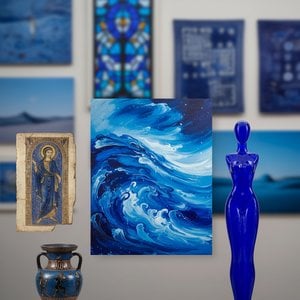
The Allure of Azure: Exploring the Symbolic & Aesthetic Depths of Blue in Art History
Explore the rich history of blue in art! Discover its symbolism, from ancient pigments to modern masterpieces by Kandinsky & Seurat. Uncover the psychological impact and cultural meanings behind this captivating hue.