


 Peržiūrėti realaus dydžio版
 Siųsti
 Dalintis
 Išsamiau
 Vadovas

 Atsisiųsti
 Panašūs eksponatai
 Rentgeno spindulių nuotrauka
 Diaporama
 Statistika
Joking Couple
 Acrylic On Canvas
- WallArt
- Mannerist Painting
 25.0 x 20.0 cm
 Kunsthistorisches Museum
 Rodyti daugiau
Rankų darbo aliejinės reprodukcijos
Rankiniu būdu tapytas aliejus ant droblio jūsų pageidaujamame dydį ir rėmuose – mūsų menininkų darbas pagal užsakymą. ( Perjungti į spausdinimą Perejti prie skaitmeninių vaizdų)




P118B $10

P118H $10

P118W $10

P438Z $10

P508JH $12

P508YH $12

P805H $10

P805Z $10

P919BZ $10

P919G $10

P919XJ $10

P959ZH $10

P968JZ $12

W106C $8

W218G $10

W218JH $8

W218Y $10

W307PJ $10

W316G $10

W316PJ $8

W316Y $10

W398PJ $8

W4111J $10

W500HY $15

W500JH $15

W692G $12

W849H $8

W940BG $15

W953PJ $8




Pasirinkite iš mūsų nustatytų dydžių, atitinkančių originalaus meno kūrinio proporcijas.

Galite įvesti savo matmenis, kad jie atitiktų konkretų rėmą ar erdvę. Jei pasirinktas dydis neatitinka originalaus paveikslėlio proporcijų, mes arba apkropsime meno kūrinį, arba papildysime tapybą rankomis dažytい elementais. Prieš pradėdami gamybą, jūsų patvirtinimui atsiųsime skaitmeninį maketą.
Atkreipkite dėmesį, kad ekrane rodomas vaizdas neatspindi tikrojo apkarpymo ar papildymo. Tik maketas tiksliai parodys galutinę kompoziciją.
Nors galima rinktis ir individualius dydžius, rekomenduojame pasirinkti matmenis iš nustatytos sąrašo, kad būtų išlaikytos originalios proporcijos.
Gavus užsakymą, ArtsDot.com komanda susisieks su klientu el. paštu dėl instrukcijų ir pateiks maketo pavyzdį
Pristatymas visame pasaulyje () per 3–4 savaites, o ne įprastai – per 5 savaites. (25 rugsėjis). Kokybė lieka nepakeičiama.

Nemokamas greitasis pristatymas visame pasaulyje

Aukštos kokybės lininis drobė

Pilnas siuntimo draudimas

Muitinės mokesčių grąžinimo garantija

Tikro spalvų atitikimo garantija

100 dienų grąžinimo politika (tik esant įtaigoms)

100% pinigų grąžinimo garantija

Nuolaida dideliems užsakymams
 Stiklo variantas prieinamas tik pasirinkus dydį iki 110 cm

Joking Couple
Reprodukcijos technika
Reprodukcijos dydis
-


Visų pasirinktų variantų kaina
$ 263
The Enigmatic Charm of “Joking Couple”
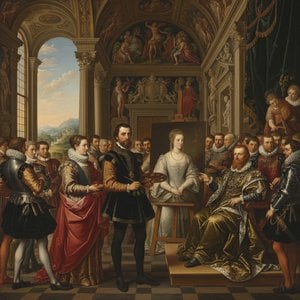
Hans von Aachen’s “Joking Couple,” a captivating painting from the late 16th century, isn't merely a portrait; it’s a carefully constructed tableau brimming with subtle humor and an undercurrent of aristocratic intrigue. Executed in the vibrant style characteristic of Mannerism – a movement that prized elegance, artificiality, and psychological complexity over strict realism – this work offers a glimpse into the refined world of the Habsburg court at Prague, where Emperor Rudolf II fostered a remarkable confluence of artistic talent.
The painting depicts a man and woman standing close together, their postures suggesting an intimate yet playful exchange. The man, dressed in richly embroidered velvet and adorned with a jeweled belt, holds aloft a small mirror, reflecting the woman’s image back at herself. Her expression is one of amused contemplation as she observes her reflection, while the man appears to be enjoying his role as a mischievous observer. A single, elegant bird perches near the top left corner, adding a touch of unexpected detail and perhaps hinting at themes of fidelity or observation.
Mannerist Techniques: A Dance of Illusion
Von Aachen’s mastery lies in his skillful deployment of Mannerist techniques. Notice the elongated figures, a hallmark of the style, which contribute to an air of heightened drama and theatricality. The composition is deliberately unbalanced, creating a sense of dynamism and movement – the mirror's reflection pulling the viewer into the scene. The use of color is particularly noteworthy; rich reds, deep blues, and shimmering golds dominate the palette, reflecting the opulence associated with the imperial court. Von Aachen employs a technique known as *sfumato*, subtly blurring lines and edges to create an atmospheric haze, adding depth and mystery to the figures.
The painting’s surface is rendered with meticulous detail, particularly in the rendering of fabrics and jewelry – evidence of the artist's training in Venice, where he spent a significant portion of his career. Von Aachen’s style was influenced by Italian masters like El Greco, incorporating dramatic lighting and expressive gestures to convey emotion and psychological states.
Symbolism and Courtly Context
Beyond its immediate visual appeal, “Joking Couple” is laden with symbolic meaning. The mirror itself represents vanity, self-reflection, and perhaps even the complexities of relationships. The man’s gesture – holding up the mirror – can be interpreted as a playful challenge or an invitation to engage in witty banter. The woman's amused expression suggests she is aware of this dynamic, adding another layer of intrigue to the scene.
Considering the historical context, it’s important to remember that Rudolf II’s court was renowned for its patronage of the arts and its embrace of unconventional ideas. The painting reflects this atmosphere of intellectual curiosity and artistic experimentation. Von Aachen's work served as a visual representation of the courtly life – filled with elaborate rituals, witty conversation, and subtle power plays.
A Timeless Portrait of Human Connection
“Joking Couple” endures not simply as a beautiful painting but as a poignant meditation on human connection, vanity, and the art of social interaction. Its skillful composition, vibrant colors, and nuanced symbolism continue to captivate viewers centuries after its creation. Reproductions offer an accessible way to appreciate this remarkable work of Mannerist art, bringing its enigmatic charm into any space.
Susiję kūriniai


Autoriaus biografija
Rašutis gyvenimas ir mokymas
Hans von Aachen, vokiečių dailininkas, gimė 1552 m. vietoje Cologne. Mari apie jo ankstyvą gyvenimą žinoma nebe daug. Tačiau manoma, kad jis gaúdo savo meninį mokymą iš vietinio dailininko Leonardus Sievenhoven dirbtuvėje.Dailinis stilius ir įtakos
Von Aachen kūriniai išsiskiria jais, kad jie apima ryškių spalvų bei dramatiškų kompozicijų naudojimą, kas yra tipiška manirizmo stiliui. Jo tapyni dažnai buvo pildyti iškartotinių figūrų, sudėtingų detalių ir įt주고 tensijos jausmo, kurios buvo įkvėptos El Greco (Domenikas Teotokopoulos) kūriniais. Tarp jo išsienių darbų yra:- Kryžio įspėjimai (1585) – tapytė, demonstruojanti jo ryškių spalvų ir dramatiško apšvietimo naudojimą.
- Galutinis teismas (1590) – kūrinys, atrodstantis jo gebėjimą išbalansuoti kelias figūras vienoje kompozicioje.
- Nežinostaros damaros portretas (1595) – portretas, pabrėžiantis jo įgūdžį užfiksuoti žmogaus išreiškos subtilumų.
Žymūs kolekcijos ir vystavimai
Von Aachen kūriniai galima rasti įvairiose muziejuose, įskaitant:- Gemäldegalerie Alte Meister Dresden, Vokietija – su išsamia kolekcija Europos tapyni XV–XVIII amčiulis.
- Museum Ostdeutsche Galerie Regensburg, Vokietija – rodoma unikalus ūkų vokiečių meno kolekcija.
Palikta medžiaga
Hans von Aachen mirė 1615 m., palikdamas saugą sudėtingų ir emocingai įkrauntarykų tapyni palikimą. Jo kūriniai nuolat įkvepia dailininkus ir meninio mėgėjų, suteikiant unikalią žvilgsį į maniristinio meno pasaulį. Susimkite daugiau apie Hans von Aachen gyvenimą ir kūrinius svetainėje ArtsDot.com: [https://ArtsDot.com/@@/a@d3aquv](https://ArtsDot.com/@@/a@d3aquv) | aptikti Museum Ostdeutsche Galerie (Vokietija)
Hans Von Aachen
1552 - 1615 , Vokietija
Trumpa informacija apie kūrėją
- Artistic Movement Or Style: Manierizmo dailė
- Artists Or Movements Influenced By This Artist: ['Renesanso mena']
- Artists Who Influenced This Artist: ['El Greco']
- Date Of Birth: 1552 Cologne, Vokietija
- Date Of Death: 1615
- Full Name: Hans von Aachen
- Nationality: Vokietijai
- Notable Artworks:
- Kryžioje
- Paskutinis sądėjimas
- Nežinoma damaros portretas
- Place Of Birth: Cologne
Susiję straipsniai

Eugen von Blaas: Capturing Alpine Life & Sentiment in 19th-Century Austrian Painting
Discover the captivating world of Eugen von Blaas! Explore his exquisite 19th-century paintings capturing Venetian life & Alpine beauty. Learn about his Academic Classicism style and find museum-quality reproductions at ArtsDot.
Hans von Aachen: Mannerism's Courtly Visionary & Imperial Portraiture
Explore the captivating world of Hans von Aachen, a leading Mannerist painter renowned for his exquisite imperial portraits & mythological scenes. Discover his legacy and influence on 16th-century European art.

Mannerism's Masters: 10 Artworks That Redefined Renaissance Style | ArtsDot
Explore 10 defining Mannerism masterpieces – from Pontormo to El Greco. Discover the stories behind these Renaissance paintings, their unique style & symbolism. Find museum-quality art reproductions at ArtsDot.com and elevate your home decor.

The Mirror Stage of Art History: Exploring Reflection & Identity in Painting
Explore the captivating history of reflection in art! Discover symbolism, technique & psychological depth in masterpieces from Renaissance self-portraits to modern works. Expert insights for discerning collectors.

Mannerism: Bridging Renaissance Harmony & Baroque Drama – A Study of Style & Affectation
Explore the fascinating world of Mannerism! Discover its key characteristics, pioneering artists like Pontormo & Bronzino, and its pivotal role in bridging Renaissance harmony to Baroque drama. A comprehensive guide for art enthusiasts.