

 Peržiūrėti realaus dydžio版
 Pasidalinti
 Dalintis
 Išsamiau
 Vadovas

 Atsisiųsti
 Panašūs eksponatai
 Rentgeno spindulių nuotrauka
 Automatinė diorama
 问答
问答 Statistika
Curiosity

- 76.0 x 62.0 cm


 Skaityti daugiau
Gaukite spausdinimui paruoštą failą, kurio kokybė gerokai viršija internetinę peržiūrą. Kiekvienas mūsų parduodamas skaitmeninis vaizdas yra ištrauktas iš aukštos raiškos pagrindinio failo mūsų duomenų bazėje — paprastai jis siekia nuo 5 000 iki 15 000 pikselių plotio — todėl galite drąsiai spausdinti didelius formatus, apkirpti vaizdą ar reprodukcija užtikrins visas smulkias detales.
Mūsų studijoje nė viena kopija nelieka neapdorota. Skaitmeninio vaizdo ekspertas, lygiu su originaliu paveikslu, patikrina spalvas ir, jei reikia, jas koreguoja, o tada profesionaliais retušavimo įrankiais padidina aiškumą bei detales — visada išlaikydamas ištikimybę autoriaus teptuko traukoms ir stiliui. Rezultatas – vaizdas, kuris atrodo kaip tikras paveikslas, o ne kaip su filtrais apdorotas skenavimas.
Patvirtinate prieš užsakymo pabaigą: mūsų ekspertas per 72 valandas el. laišku atsiųsta vaizdą jūsų peržiūrai. Nepasitenkinate rezultatu? Paprašykite patobulinimų ar pataisymų arba prašykite pinigų grąžinimo, jei kokybė neatitinka jūsų lūkesčių.
Ši kokybė yra patikima leidybos įstaigoms, dizaino studijoms, galerijoms ir spaudos įmonėms.
Skaitmeninis vaizdas
Atsisiųskite didelės raiškos failą asmeniniam naudojimui, spausdinimui ir kūrybiniams projektams. ( Perjungti į spausdinamus版作品 Pirkti rankų darbo tapybą)
Kiekvieną skaitinio vaizdo užsakymą papildė
Profesionalus skaitmeninis vaizdų pristatymas, garantuotas
Pasirinkę ArtsDot.com, jūs ne tik gaunate paveikslėlį – jūs gaunate profesionaliai patobudintą skaitmeninį kūrinį, sukurtą itin tikniai ir užtikrinantį pasitenkinimą. Štai viską, kas automatiškai pritékia jūsų užsakymui:

Greitas pristatymas el. paštu
Jūsų aukštos raiškos skaitmeninis vaizdo failas bus išsiųstas el. paštu per 72 valandas nuo užsakymo – jis bus paruoštas naudoti be jokių papildomų veiksmų.

Dirbtiniu intelektu tobulintas skaitmeninis failas
Jūsų meno kūrinys profesionaliai optimizuojamas naudojant pažangius dirbtinio intelekto įrankius ir rankinį redagavimą, užtikrinant maksimalią detalę, aiškumą ir spalvų tikslumą.

Nemokamas visam laikui pakartotinis siuntimas
Atsitiktinai ištrytikote ar praradote savo failą? Nebijokite – bet kuriuo metu atsiųsime jį jums vėl nemokamai.

Jokio importo mokesčio – niekada
Mėgaukitės savo meno kūrynu be jokių muitinės mokesčių, įkainų ar pristatymo išlaidų – skaitiniai failai visada yra neapmokestinami.

Spalvų tikslumo garantija
Naudodami profesionalią įrangą ir spalvų valdymo sistemas, užtikriname, kad jūsų skaitmeninis vaizdas kuo tiksliau atspindėtų originalias spalvas.

100 dienų patikimumo garantija
Jei nebuvosite patenkinti įsigyto skaitmeninio vaizdo, mes jį tališkai koreguosime arba grąžinsime 100% sumą per 100 dienų – be jokių klausimų.

100% pinigų grąžinimo garantija
Nesitenkinate? Gaukite visą sumokėtą sumą per 100 dienų nuo skaitmeninio failo gavimo – be jokių papildomų klausimų.

Nuolaidos dideliems užsakymams
Pirkti 3 nuotraukas – 10% nuolaida – Pirkti 5 – 15% nuolaida – Pirkti 10 ir daugiau – 20% nuolaida. Puikiai tinka kūrybiniams projektams, galerijoms bei agentūroms.
The Enigmatic Gaze: Gerard ter Borch’s ‘Curiosity’
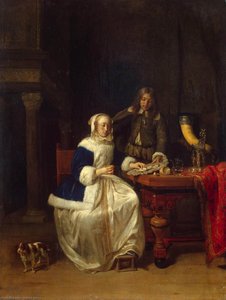
Gerard ter Borch's “Curiosity,” painted around 1660-62, isn’t a grand historical scene or a dramatic portrait; instead, it offers a profoundly intimate glimpse into the quiet domesticity of the Dutch Golden Age. This remarkable work, measuring just 76 x 62 cm, immediately draws the viewer in with its masterful use of light and shadow, creating an atmosphere of subtle tension and unspoken connection. The painting depicts three women – a seamstress meticulously working at her needle, a lady absorbed in a book, and a third figure observing them from a distance – within a modestly furnished room. It’s a scene brimming with understated observation, capturing the nuances of human interaction with remarkable psychological depth.
Ter Borch was a pioneer of Dutch genre painting, renowned for his ability to portray everyday life with an unparalleled level of realism and emotional sensitivity. Unlike many of his contemporaries who favored heroic subjects or elaborate compositions, Ter Borch focused on the ordinary – the moments of quiet contemplation, the subtle gestures, and the unspoken relationships that define human experience. “Curiosity” exemplifies this approach perfectly; it’s not about showcasing wealth or status but rather exploring the complexities of female companionship and the quiet drama of domestic life.
A Symphony of Light and Texture
The painting's power lies in Ter Borch’s extraordinary technical skill. He employs a technique known as ‘chiaroscuro,’ dramatically contrasting areas of light and shadow to create a sense of depth and volume. Notice how the soft, diffused light illuminates the women’s faces and hands, while the background remains shrouded in darkness, drawing our attention to their immediate presence. The textures are equally compelling – the delicate weave of the seamstress's dress, the smooth surface of the book, the rough fabric of the chair—all rendered with painstaking detail.
Ter Borch’s meticulous approach is evident in his rendering of fabrics and drapery. He doesn’t simply depict them; he captures their tactile quality, allowing us to almost feel the weight and texture of each garment. This attention to detail extends to every element of the scene, creating a remarkably immersive experience for the viewer. The subtle variations in tone and shading contribute significantly to the painting's overall sense of realism and immediacy.
Symbolism and Psychological Resonance
The composition itself is laden with symbolic meaning. The seamstress, focused on her work, represents diligence and industry – a valued trait in 17th-century Dutch society. The lady reading suggests intellectual pursuits and a connection to the wider world beyond the domestic sphere. And the woman observing them from afar—a figure often interpreted as the artist’s wife, Gesina ter Borch—hints at a subtle power dynamic and perhaps a hint of melancholy. Her averted gaze invites speculation about her thoughts and feelings.
The inclusion of the dog adds another layer of complexity to the scene. It represents loyalty, companionship, and the simple pleasures of domestic life. The dog’s presence further emphasizes the intimacy of the setting and the close-knit relationships between the women. “Curiosity” isn't merely a portrait; it’s a carefully constructed tableau that invites us to contemplate the mysteries of human connection and the quiet beauty of everyday moments.
Bringing ‘Curiosity’ Home
ArtsDot offers exquisite, hand-painted reproductions of Gerard ter Borch’s “Curiosity,” meticulously crafted by our team of skilled artists using traditional techniques. Each reproduction captures the original painting's luminous quality and psychological depth, allowing you to bring this remarkable work into your home or office. Available in a range of sizes, our high-quality prints are perfect for collectors, interior designers, and anyone who appreciates the beauty and artistry of Dutch Golden Age painting. Explore our selection today and experience the timeless allure of “Curiosity.”
Klausimai ir atsakymai
Kiek intensyvios yra spalvos kūryboje „Curiosity“ – Gerardas Ter Borchas?
„Curiosity“ – Gerardas Ter Borchas pasižymi Monochromatic spalvų intensyvumu.
Kokio dydžio „Curiosity“ – Gerardas Ter Borchas spausdinimas tinka rekomenduojamai patalpai?
Rekomenduojamas „Curiosity“ – Gerardas Ter Borchas spausdinimo dydis Living Room erdvei yra Medium.
Kokia yra „Curiosity“ – Gerardas Ter Borchas dominuojanti spalva?
„Curiosity“ linksta į Amber to Saffron atspalvį.
panašūs kūriniai




Autoriaus biografija
**a pioneer of dutch genre painting**
gerard ter borch, a prominent figure in the dutch golden age, left an indelible mark on the art world with his genre paintings. born in december 1617 and passing away on december 8, 1681, ter borch's life was a testament to his artistic prowess.**early life and influences**
ter borch's early life is not well-documented, but it is known that he traveled extensively throughout europe, including london, germany, france, spain, and italy. this exposure broadened his artistic horizons, influencing his unique style. his sister, gesina ter borch, also pursued a career in painting, further solidifying the family's artistic inclinations.**notable works and achievements**
- **the letter**: a masterpiece showcasing ter borch's skill in capturing texture and light. - **the gallant conversation**: engraved by johann georg wille, this piece exemplifies the artist's ability to convey nuanced emotions. - **man on horseback (1634)**: an early work demonstrating ter borch's emerging talent. - **adrian pauw's arrival in münster (1646)**: a significant piece that highlights the artist's narrative capabilities.**museums and collections featuring ter borch's work**
- the hermitage: with six of his works, it boasts one of the largest collections. - berlin museum: features six pieces, showcasing ter borch's international appeal. - getty center: three of his paintings are part of this esteemed collection.**legacy and impact**
ter borch's influence on dutch painters like gabriel metsu, gerrit dou, eglon van der neer, and johannes vermeer is well-documented. his innovative approach to genre painting has made him a pivotal figure in the history of art.- for more on ter borch's life and works, visit https://ArtsDot.com/@/gerard-ter-borch
- explore the museum boijmans van beuningen rotterdam, netherlands, featuring some of ter borch's contemporaries at https://ArtsDot.com/@@/a@d3arrk-museum-boijmans-van-beuningen-rotterdam-netherlands
- learn more about the dutch golden age and its notable artists at https://en.wikipedia.org/wiki/dutch_golden_age

Gerardas Ter Borchas
1617 - 1681 , Nyderlandai
Trumpa informacija
- Artinis Judėjimas Arba Stilius: Žanrinė tapybra
- Gimimo Data: 1617 m. gruodis
- Gimimo Vieta: Zwolle, Nyderlandai
- Menininkai, Paveikę Šį Menininką:
- Gabriel Metsu
- Gerrit Dou
- Eglon van der Neer
- Johannes Vermeer
- Mirties Data: 1681 m. gruodžio 8 d.
- Movitai Arba Menininkai, Paveikšti Šio Menininko: ['Diego Velázquez']
- Tautybė: Olandas
- Visas Vardas Ir Pavardė: Gerard ter Borch
- Žinomos Kūriniai:
- Laiškas
- Galingas pokalbis
- Vyras ant žirgo
- Adriano Pauw pr आगमन Münsterį