


 Peržiūrėti realaus dydžio版
 Siųsti
 Dalintis
 Išsamiau
 Vadovas

 Atsisiųsti
 Panašūs eksponatai
 Rentgeno spindulių nuotrauka
 Diaporama
 Statistika
The Studio (IX)


 Rodyti daugiau
Šiame puslapyje rodomas meno kūrinys yra saugomas autorių teisių įstatymais, todėl neturime teisės legaliai kurti ar parduoti jo identiškos reprodukcijos. Ši apsauga užtikrinama remiantis tokiais tarptautiniais susitarimais kaip Bernės konvencija ir pagal nacionalines įstatymų nuostatas, įskaitant tas, kurias nurodo JAV autoriškos teisės įstatymas – 17-asis skyrius.
Šis metodas visiškai atitinka autorių teises, nes jame nėra kūrinio kopijavimo ar dubliavimo. Tai yra kūrybinė reinterpretacija – naujas paveikslas, kurį įkvėpė originalas, tačiau kuris nėra jo identiškas.
Giclée / Meno spausdinimas
Muziejų lygio „giclée“ arba drobos spausdinimas: greita gamyba ir lankstios apdailos parinktys. ( Pirkti rankomis tapytą reprodukciją Perejti prie skaitmeninių vaizdų)




P118B €10

P118H €10

P118W €10

P438Z €10

P508JH €12

P508YH €12

P805H €10

P805Z €10

P919BZ €10

P919G €10

P919XJ €10

P959ZH €10

P968JZ €12

W106C €8

W218G €10

W218JH €8

W218Y €10

W307PJ €10

W316G €10

W316PJ €8

W316Y €10

W398PJ €8

W4111J €10

W500HY €15

W500JH €15

W692G €12

W849H €8

W940BG €15

W953PJ €8




Pasirinkite iš mūsų nustatytų dydžių, atitinkančių originalaus meno kūrinio proporcijas.

Įveskite jums reikiamą plotį ir aukštį, kad atvaizdas derėtų prie jūsų rėmo ar sienos. Spausdiną galima tik sumažinti, bet nepadidinti virš originalaus paveikslėlio dydžio, todėl keičiant proporcijas, dalis vaizdo prarandama. Prieš spausdinimą atsiųsime jums skaitmeninį maketą patvirtinimui. Šioje puslapio nuotraukoje matomas pjūvis nėra tikslus – jį rodo tik maketas.
Pristatymas visame pasaulyje () per 2 weeks, o ne įprastas 4/5 savaičių laikotarpis. (22 spalis)

Nemokamas greitasis pristatymas visame pasaulyje

Aukštos kokybės lininis drobė

Pilnas siuntimo draudimas

Muitinės mokesčių grąžinimo garantija

Tikro spalvų atitikimo garantija

100 dienų grąžinimo politika (tik esant įtaigoms)

100% pinigų grąžinimo garantija

Nuolaida dideliems užsakymams
 Stiklo variantas prieinamas tik pasirinkus dydį iki 110 cm

The Studio (IX)
Giclée / Meno spausdinimas
Reprodukcijos dydis
-


Visų pasirinktų variantų kaina
€ 54
A Glimpse into Braque’s Intimate World: “The Studio (IX)”
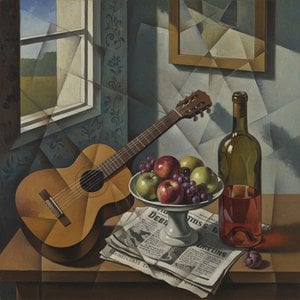
Georges Braque's “The Studio (IX),” painted in 1954, offers more than just a depiction of an artist’s workspace; it is a profound meditation on the act of creation itself. This work, part of a series exploring his studio environment, isn’t about presenting a realistic view but rather dissecting and reassembling the very essence of artistic inspiration. The canvas hums with a quiet energy, centered around a guitar – an instrument often associated with harmony and emotional expression – which becomes a focal point amidst a carefully arranged collection of objects. Vases stand sentinel, their forms echoed in the curves of unseen instruments or perhaps simply representing vessels of potential, waiting to be filled with creative force. Scattered birds, some taking flight, others perched within the composition, introduce an element of freedom and fleeting inspiration, suggesting ideas constantly flitting through the artist’s mind.The Echoes of Cubism in Later Years
While firmly rooted in Braque's mature style, “The Studio (IX)” reveals a fascinating evolution from his earlier pioneering work with Pablo Picasso in developing Cubism. Though the radical fragmentation and multiple perspectives characteristic of Analytic Cubism are less pronounced here, the underlying principles remain visible. Forms are simplified, planes intersect, and space is compressed, creating a sense of depth that isn’t achieved through traditional perspective but rather through a masterful manipulation of shape and color. The muted palette—dominated by browns, grays, and ochres punctuated by subtle highlights—contributes to an atmosphere of introspection and quiet contemplation. This wasn't merely a stylistic choice; it reflected Braque’s increasing desire to move beyond purely intellectual explorations of form towards a more emotionally resonant expression. He sought to capture not just *how* he saw the world, but *what* it felt like to be within his creative space.Symbolism and the Artist's Sanctuary
The objects within “The Studio (IX)” are not arbitrary; they function as symbolic representations of Braque’s artistic life. The guitar, a recurring motif in his work, can be interpreted as a symbol of music, poetry, and the harmonious interplay of form and sound. The vases suggest beauty, fragility, and the potential for growth. Even the birds, often associated with freedom and inspiration, contribute to the overall sense of creative energy. But perhaps the most significant element is the studio itself – a sanctuary where ideas are born, experiments are conducted, and artistic visions take shape. By depicting his workspace, Braque invites us into his inner world, offering a glimpse into the source of his creativity. It’s an intimate portrayal, less about showcasing finished masterpieces and more about revealing the messy, complex process that lies beneath them.A Lasting Legacy: Braque's Enduring Influence
Georges Braque, born in 1882, was a pivotal figure in 20th-century art. Initially influenced by Impressionism and Post-Impressionism, he quickly embraced the vibrant colors of Fauvism before embarking on his groundbreaking collaboration with Picasso that would redefine painting forever. His contributions to Cubism were immense, challenging traditional notions of representation and paving the way for countless artistic innovations. “The Studio (IX),” created towards the end of his life, demonstrates a continued commitment to experimentation and a deepening exploration of personal themes. It stands as a testament to Braque’s enduring legacy—a legacy built on intellectual rigor, technical mastery, and an unwavering dedication to the pursuit of artistic truth. Owning a reproduction of this work isn't simply acquiring a beautiful image; it is inviting a piece of art history into your space, a subtle reminder of the power of creativity and the beauty of introspection.问答 (or more naturally for a website heading): Klausimai ir atsakymai
Koks yra rekomenduojamas „The Studio (IX)“ spausdinimo formatas – koks dydis ir orientacija?
Rekomenduojama spausdinti „The Studio (IX)“, autorius – Žoržas Brakas reprodukciją Large dydį, Square formatu.
Kokia technika sukurta „The Studio (IX)“, autorius – Žoržas Brakas?
„The Studio (IX)“ sukurta naudojant Acrylic On Canvas.
Ar „The Studio (IX)“, autorius – Žoržas Brakas naudoja ryškius kontrastus ar švelnias harmonijas?
„The Studio (IX)“, autorius – Žoržas Brakas spalvų kompozicija sujungia Bold kontrastą su Strong Color Unity harmonija.
Susiję kūriniai


Autoriaus biografija
Early Life and Artistic Foundations
Georges Braque, gimęs Argenteuil mieste Francijoje 1882 metais, įvykdė kelionę į meno pasaulį, kurią iš tikrųjų simbolizavo XX amžiaus meno vystymosi kraštovaizdis. Jo vaikystė šeimoje, kurioje veikė namų dažytojai ir dekoratorių meistrai, ne tik suteikė jam praktinę meistriškumą medžiagoms, bet ir ankstyvą įvertinimą formasiai ir struktūrai. Nepaisant pradėti vykti savo tėvo keliu, Braque’s šlovingos kūrybinės instinkcijos greitai vedė jį į akademinę mokslą Argenteuil mieste Francijoje 1882 metais.
Pervažiuodamas Paryžiui 1902 metais, Braque tęsė savo studijas Humberto akademijoje, prisijungdamas prie Paryžiaus meno gyvenimo šlovingos aplinkos. Čia jis susitikęs su artistas Marie Laurencin ir Francis Picabia, kuriuos įvykdė šlovingą kūrybinę instinkciją Francijoje 1882 metais.
The Embrace of Fauvism and the Dawn of Cubism
Braque’s pasirinkimas fauvistinių principų – išraiškos spalvos ir emocijų – yra įvykdė šlovingą kūrybinę instinkciją Francijoje 1882 metais. Šis laikotarpis buvo pažymiškas eksperimentais su spalvomis Paryžiui 1902 metais.
Švietimo akademijoje Humberto Paryžiui 1902 metais, Braque tęsė savo studijas Paryžiaus meno gyvenimo šlovingą aplinkos. Čia jis susitikęs su artistas Marie Laurencin ir Francis Picabia, kuriuos įvykdė šlovingą kūrybinę instinkciją Francijoje 1882 metais.
Innovation Through Fragmentation and Collage
Švietimo akademijoje Humberto Paryžiui 1902 metais, Braque tęsė savo studijas Paryžiaus meno gyvenimo šlovingą aplinkos. Čia jis susitikęs su artistas Marie Laurencin ir Francis Picabia, kuriuos įvykdė šlovingą kūrybinę instinkciją Francijoje 1882 metais.
Švietimo akademijoje Humberto Paryžiui 1902 metais, Braque tęsė savo studijas Paryžiaus meno gyvenimo šlovingą aplinkos. Čia jis susitikęs su artistas Marie Laurencin ir Francis Picabia, kuriuos įvykdė šlovingą kūrybinę instinkciją Francijoje 1882 metais.
Later Years and Enduring Legacy
Švietimo akademijoje Humberto Paryžiui 1902 metais, Braque tęsė savo studijas Paryžiaus meno gyvenimo šlovingą aplinkos. Čia jis susitikęs su artistas Marie Laurencin ir Francis Picabia, kuriuos įvykdė šlovingą kūrybinę instinkciją Francijoje 1882 metais.
Švietimo akademijoje Humberto Paryžiui 1902 metais, Braque tęsė savo studijas Paryžiaus meno gyvenimo šlovingą aplinkos. Čia jis susitikęs su artistas Marie Laurencin ir Francis Picabia, kuriuos įvykdė šlovingą kūrybinę instinkciją Francijoje 1882 metais.

Žoržas Brakas
1882 - 1963 , Prancūzija
Trumpa informacija apie kūrėją
- Artistic Movement Or Style: Kubizmo ir Fauvizmo
- Artists Who Influenced This Artist:
- Henri Matisse
- André Derain
- Pablo Picasso
- Date Of Birth: 1882-05-13
- Date Of Death: 1963
- Full Name: Georges Braque
- Nationality: Prancūzas
- Notable Artworks:
- Žinomas namai L'Estaque
- Kantrybė
- Violonas ir Paletė
- Place Of Birth: Argenteuil, Prancūzija
Susiję straipsniai

Georges Braque: Pioneering Cubism & the Evolution of Modern Form
Explore the revolutionary art of Georges Braque, a pioneer of Cubism alongside Picasso. Discover his artistic evolution, key works, and lasting impact on modern art. A guide for discerning collectors.
Deconstructing Reality: A Comprehensive Exploration of Cubist Still Life
Explore the revolutionary world of Cubist Still Life with ArtsDot. Discover Picasso & Braque's groundbreaking techniques, its philosophical roots, and lasting impact on modern art. Expert insights for collectors.

Georges Seurat: 25 Šedevrai, Apšviečiantys Modernaus Meno Takus | ArtsDot
Atraskite 25 Georges Seurat šedevrus! Išsami analizė, istorijos ir įkvėpimas interjero dizainui. Pointilizmo meistras, impresionizmas ir chromoluminarizmas – viskas ArtsDot.com. Explore the full collection online!

Georges Braque: 25 Šedevrai, Keičiantys Jūsų Interjerą | ArtsDot
Atraskite 25 Georges Braque šedevrus! Kubizmo meistro paveikslai, interjero dekoras ir meno istorija. Meno reprodukcijos aukščiausia kokybe – ArtsDot.com. Išsamesnės informacijos rasite internetu.

Deconstructing Reality: Cubism's Revolutionary Impact on 20th-Century Art
Explore the revolutionary world of Cubism with ArtsDot. Discover Picasso & Braque's groundbreaking techniques, its philosophical roots, and lasting impact on modern art. Expert insights for collectors.


