


 Peržiūrėti realaus dydžio版
 Siųsti
 Dalintis
 Išsamiau
 Vadovas

 Atsisiųsti
 Panašūs eksponatai
 Rentgeno spindulių nuotrauka
 Diaporama
 Statistika
Pot, Serviette, Prunes


 Rodyti daugiau
Šiame puslapyje rodomas meno kūrinys yra saugomas autorių teisių įstatymais, todėl neturime teisės legaliai kurti ar parduoti jo identiškos reprodukcijos. Ši apsauga užtikrinama remiantis tokiais tarptautiniais susitarimais kaip Bernės konvencija ir pagal nacionalines įstatymų nuostatas, įskaitant tas, kurias nurodo JAV autoriškos teisės įstatymas – 17-asis skyrius.
Kaip pagarbią ir teisėtą alternatyvą, mes siūlome pagal užsakymą rankomis dažytus paveikslus, įkvėptus originalo. Mūsų įgudę ir profesionalūs menininkai kruopščiai tiria originalo stilių, nuotaiką ir meninę esmę, kad sukurtų naują, unikalią kūrinį, kuris sukelia tą paties jausmą – išlikdamas tuo tarciau originaliu, savarankišku kūrybiniu darbu.
Šis metodas visiškai atitinka autorių teises, nes jame nėra kūrinio kopijavimo ar dubliavimo. Tai yra kūrybinė reinterpretacija – naujas paveikslas, kurį įkvėpė originalas, tačiau kuris nėra jo identiškas.
Rankų darbo aliejinės reprodukcijos
Rankiniu būdu tapytas aliejus ant droblio jūsų pageidaujamame dydį ir rėmuose – mūsų menininkų darbas pagal užsakymą. ( Perjungti į spausdinimą Perejti prie skaitmeninių vaizdų)




P118B €10

P118H €10

P118W €10

P438Z €10

P508JH €12

P508YH €12

P805H €10

P805Z €10

P919BZ €10

P919G €10

P919XJ €10

P959ZH €10

P968JZ €12

W106C €8

W218G €10

W218JH €8

W218Y €10

W307PJ €10

W316G €10

W316PJ €8

W316Y €10

W398PJ €8

W4111J €10

W500HY €15

W500JH €15

W692G €12

W849H €8

W940BG €15

W953PJ €8




Pasirinkite iš mūsų nustatytų dydžių, atitinkančių originalaus meno kūrinio proporcijas.

Įveskite jums reikiamą plotį ir aukštį, kad paveikslas atitiktų jūsų rėmą ar sieną. Kadangi šis darbas yra rankinio darbo, siekiant išgauti kitokio formos dydį, paveikslas gali būti šiek tiek didesnis (nuo kraštų bus palikta daugiau erdvės) arba mažesnis – pasirinkite jums patogiausią variantą. Prieš pradedant tapyti, atsiųsime jums skaitmeninį maketą patvirtinimui. Šioje puslapio nuotraukoje matomas vaizdas nėra galutinis rezultatas – jį parodys tik sukurtas maketas.
Gavus užsakymą, ArtsDot.com komanda susisieks su klientu el. paštu dėl instrukcijų ir pateiks maketo pavyzdį
Pristatymas visame pasaulyje () per 3–4 savaites, o ne įprastai – per 5 savaites. (25 spalis). Kokybė lieka nepakeičiama.

Nemokamas greitasis pristatymas visame pasaulyje

Aukštos kokybės lininis drobė

Pilnas siuntimo draudimas

Muitinės mokesčių grąžinimo garantija

Tikro spalvų atitikimo garantija

100 dienų grąžinimo politika (tik esant įtaigoms)

100% pinigų grąžinimo garantija

Nuolaida dideliems užsakymams
 Stiklo variantas prieinamas tik pasirinkus dydį iki 110 cm

Pot, Serviette, Prunes
Reprodukcijos technika
Reprodukcijos dydis
-


Visų pasirinktų variantų kaina
€ 231
A Quiet Moment of Still Life: Delving into Braque’s “Pot, Serviette, Prunes”
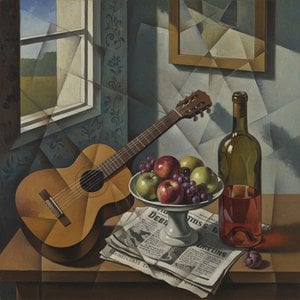
Georges Braque, a name synonymous with the revolutionary spirit of Cubism, also possessed an extraordinary talent for intimate still life compositions. “Pot, Serviette, Prunes,” painted around 1924, offers a compelling glimpse into this quieter facet of his artistic practice. While often celebrated for deconstructing form and challenging traditional perspective alongside Pablo Picasso, Braque consistently returned to the observation of everyday objects, imbuing them with a subtle yet profound sense of contemplation. This painting isn’t a dramatic statement; rather, it's an invitation to pause and appreciate the beauty in simplicity – a carefully arranged tableau of a pot, a serviette, and a bowl of prunes, rendered with Braque’s characteristic sensitivity to light and texture. The composition is deliberately restrained, focusing on the interplay between these humble objects and the surface they rest upon. Two apples take center stage, their forms subtly modeled, drawing the eye into the heart of the scene. A cup positioned to the left and a bowl to the right provide balance, while a vase in the upper left corner adds a vertical counterpoint.The Evolution of a Master: From Fauvism to Synthesized Forms
To truly appreciate “Pot, Serviette, Prunes,” it’s essential to understand Braque's artistic journey. Born in 1882, he initially trained as a house painter, a background that instilled in him a deep understanding of materials and surface. His early work flirted with Impressionism before embracing the vibrant palette of Fauvism around 1905, influenced by artists like Matisse and Derain. However, it was his encounter with the works of Paul Cézanne that proved pivotal. Cézanne’s exploration of geometric forms and multiple perspectives ignited a new direction in Braque's art, leading him towards the groundbreaking innovations of Cubism. “Pot, Serviette, Prunes” represents a later phase in Braque’s career, after his intensive period of analytical Cubism with Picasso. Here, we see a move toward *Synthetic Cubism*, where forms are simplified and reassembled, often incorporating collage elements – though not explicitly present here, the influence is felt in the flattened planes and deliberate construction of space. The objects aren't dissected into fragmented facets as they were during his earlier cubist explorations; instead, they’re presented with a renewed sense of solidity and presence, yet still retain a subtle ambiguity that challenges conventional representation.Technique and Symbolism: A Study in Subtlety
Braque’s technique in “Pot, Serviette, Prunes” is masterful in its restraint. The painting is executed in oil on panel, allowing for precise control of texture and color. His brushwork is delicate, creating a sense of quiet intimacy. The muted palette – earthy browns, soft grays, and subtle greens – contributes to the overall mood of serenity. While seemingly straightforward, the arrangement of objects isn’t arbitrary. Still life painting has a rich history steeped in symbolism. The prunes themselves might allude to themes of mortality or the passage of time, while the simple domesticity of the scene evokes notions of comfort and everyday life. However, Braque avoids overt symbolic declarations; instead, he allows the viewer to bring their own interpretations to the work. The painting’s small scale further enhances its intimacy, drawing the viewer into a close encounter with these ordinary objects, elevating them to subjects worthy of careful consideration.A Lasting Legacy: Bringing Braque's Vision Home
“Pot, Serviette, Prunes” is more than just a depiction of inanimate objects; it’s a testament to Braque’s ability to find beauty in the mundane and transform it into something extraordinary. Its enduring appeal lies in its quiet elegance and subtle complexity. For collectors and interior designers alike, a reproduction of this painting offers an opportunity to introduce a touch of sophisticated calm into any space. The muted tones and balanced composition make it incredibly versatile, complementing a wide range of décor styles – from modern minimalist interiors to more traditional settings. Owning a hand-painted reproduction allows you to connect with Braque’s artistic vision on a deeper level, appreciating the skill and sensitivity that went into creating this timeless masterpiece. It's an invitation to slow down, observe, and find beauty in the simple things – a sentiment as relevant today as it was when Braque first put brush to panel.问答 (or more naturally for a website heading): Klausimai ir atsakymai
Kaip „Pot, Serviette, Prunes“ stilius susijęs su kūrėjo laikmečiu?
„Pot, Serviette, Prunes“, autorius – Žoržas Brakas priskiriamas Cubist Still Life stiliui, kūrėjo prekiaujantem į Modernizmas laikotarpį.
Kokie kiti pseudonimai arba alternatyvūs vardai priklauso Žoržas Brakas?
Kiti Žoržas Brakas, „Pot, Serviette, Prunes“ kūrybos autoriaus, vardai apima Žoržas Brakė, Браке Жорж.
Kokiam stiliui priklauso „Pot, Serviette, Prunes“?
„Pot, Serviette, Prunes“ yra Cubist Still Life kūrinys. Šis stilius nurodo meninę tradiciją, kurios šis darbas yra dalis.
Susiję kūriniai


Autoriaus biografija
Early Life and Artistic Foundations
Georges Braque, gimęs Argenteuil mieste Francijoje 1882 metais, įvykdė kelionę į meno pasaulį, kurią iš tikrųjų simbolizavo XX amžiaus meno vystymosi kraštovaizdis. Jo vaikystė šeimoje, kurioje veikė namų dažytojai ir dekoratorių meistrai, ne tik suteikė jam praktinę meistriškumą medžiagoms, bet ir ankstyvą įvertinimą formasiai ir struktūrai. Nepaisant pradėti vykti savo tėvo keliu, Braque’s šlovingos kūrybinės instinkcijos greitai vedė jį į akademinę mokslą Argenteuil mieste Francijoje 1882 metais.
Pervažiuodamas Paryžiui 1902 metais, Braque tęsė savo studijas Humberto akademijoje, prisijungdamas prie Paryžiaus meno gyvenimo šlovingos aplinkos. Čia jis susitikęs su artistas Marie Laurencin ir Francis Picabia, kuriuos įvykdė šlovingą kūrybinę instinkciją Francijoje 1882 metais.
The Embrace of Fauvism and the Dawn of Cubism
Braque’s pasirinkimas fauvistinių principų – išraiškos spalvos ir emocijų – yra įvykdė šlovingą kūrybinę instinkciją Francijoje 1882 metais. Šis laikotarpis buvo pažymiškas eksperimentais su spalvomis Paryžiui 1902 metais.
Švietimo akademijoje Humberto Paryžiui 1902 metais, Braque tęsė savo studijas Paryžiaus meno gyvenimo šlovingą aplinkos. Čia jis susitikęs su artistas Marie Laurencin ir Francis Picabia, kuriuos įvykdė šlovingą kūrybinę instinkciją Francijoje 1882 metais.
Innovation Through Fragmentation and Collage
Švietimo akademijoje Humberto Paryžiui 1902 metais, Braque tęsė savo studijas Paryžiaus meno gyvenimo šlovingą aplinkos. Čia jis susitikęs su artistas Marie Laurencin ir Francis Picabia, kuriuos įvykdė šlovingą kūrybinę instinkciją Francijoje 1882 metais.
Švietimo akademijoje Humberto Paryžiui 1902 metais, Braque tęsė savo studijas Paryžiaus meno gyvenimo šlovingą aplinkos. Čia jis susitikęs su artistas Marie Laurencin ir Francis Picabia, kuriuos įvykdė šlovingą kūrybinę instinkciją Francijoje 1882 metais.
Later Years and Enduring Legacy
Švietimo akademijoje Humberto Paryžiui 1902 metais, Braque tęsė savo studijas Paryžiaus meno gyvenimo šlovingą aplinkos. Čia jis susitikęs su artistas Marie Laurencin ir Francis Picabia, kuriuos įvykdė šlovingą kūrybinę instinkciją Francijoje 1882 metais.
Švietimo akademijoje Humberto Paryžiui 1902 metais, Braque tęsė savo studijas Paryžiaus meno gyvenimo šlovingą aplinkos. Čia jis susitikęs su artistas Marie Laurencin ir Francis Picabia, kuriuos įvykdė šlovingą kūrybinę instinkciją Francijoje 1882 metais.

Žoržas Brakas
1882 - 1963 , Prancūzija
Trumpa informacija apie kūrėją
- Artistic Movement Or Style: Kubizmo ir Fauvizmo
- Artists Who Influenced This Artist:
- Henri Matisse
- André Derain
- Pablo Picasso
- Date Of Birth: 1882-05-13
- Date Of Death: 1963
- Full Name: Georges Braque
- Nationality: Prancūzas
- Notable Artworks:
- Žinomas namai L'Estaque
- Kantrybė
- Violonas ir Paletė
- Place Of Birth: Argenteuil, Prancūzija
Susiję straipsniai

Georges Braque: 25 Šedevrai, Keičiantys Jūsų Interjerą | ArtsDot
Atraskite 25 Georges Braque šedevrus! Kubizmo meistro paveikslai, interjero dekoras ir meno istorija. Meno reprodukcijos aukščiausia kokybe – ArtsDot.com. Išsamesnės informacijos rasite internetu.

Georges Braque: Pioneering Cubism & the Evolution of Modern Form
Explore the revolutionary art of Georges Braque, a pioneer of Cubism alongside Picasso. Discover his artistic evolution, key works, and lasting impact on modern art. A guide for discerning collectors.
Deconstructing Reality: A Comprehensive Exploration of Cubist Still Life
Explore the revolutionary world of Cubist Still Life with ArtsDot. Discover Picasso & Braque's groundbreaking techniques, its philosophical roots, and lasting impact on modern art. Expert insights for collectors.

Deconstructing Reality: Cubism's Revolutionary Impact on 20th-Century Art
Explore the revolutionary world of Cubism with ArtsDot. Discover Picasso & Braque's groundbreaking techniques, its philosophical roots, and lasting impact on modern art. Expert insights for collectors.

Georges Seurat: 25 Šedevrai, Apšviečiantys Modernaus Meno Takus | ArtsDot
Atraskite 25 Georges Seurat šedevrus! Išsami analizė, istorijos ir įkvėpimas interjero dizainui. Pointilizmo meistras, impresionizmas ir chromoluminarizmas – viskas ArtsDot.com. Explore the full collection online!


