


 Peržiūrėti realaus dydžio版
 Siųsti
 Dalintis
 Išsamiau
 Vadovas

 Atsisiųsti
 Panašūs eksponatai
 Rentgeno spindulių nuotrauka
 Diaporama
 Statistika
Teesdale
 Hudson River School
 51.0 x 61.0 cm
 Rodyti daugiau
Šiame puslapyje rodomas meno kūrinys yra saugomas autorių teisių įstatymais, todėl neturime teisės legaliai kurti ar parduoti jo identiškos reprodukcijos. Ši apsauga užtikrinama remiantis tokiais tarptautiniais susitarimais kaip Bernės konvencija ir pagal nacionalines įstatymų nuostatas, įskaitant tas, kurias nurodo JAV autoriškos teisės įstatymas – 17-asis skyrius.
Šis metodas visiškai atitinka autorių teises, nes jame nėra kūrinio kopijavimo ar dubliavimo. Tai yra kūrybinė reinterpretacija – naujas paveikslas, kurį įkvėpė originalas, tačiau kuris nėra jo identiškas.
Giclée / Meno spausdinimas
Muziejų lygio „giclée“ arba drobos spausdinimas: greita gamyba ir lankstios apdailos parinktys. ( Pirkti rankomis tapytą reprodukciją Perejti prie skaitmeninių vaizdų)




P118B €10

P118H €10

P118W €10

P438Z €10

P508JH €12

P508YH €12

P805H €10

P805Z €10

P919BZ €10

P919G €10

P919XJ €10

P959ZH €10

P968JZ €12

W106C €8

W218G €10

W218JH €8

W218Y €10

W307PJ €10

W316G €10

W316PJ €8

W316Y €10

W398PJ €8

W4111J €10

W500HY €15

W500JH €15

W692G €12

W849H €8

W940BG €15

W953PJ €8




Pasirinkite iš mūsų nustatytų dydžių, atitinkančių originalaus meno kūrinio proporcijas.

Įveskite jums reikiamą plotį ir aukštį, kad atvaizdas derėtų prie jūsų rėmo ar sienos. Spausdiną galima tik sumažinti, bet nepadidinti virš originalaus paveikslėlio dydžio, todėl keičiant proporcijas, dalis vaizdo prarandama. Prieš spausdinimą atsiųsime jums skaitmeninį maketą patvirtinimui. Šioje puslapio nuotraukoje matomas pjūvis nėra tikslus – jį rodo tik maketas.
Pristatymas visame pasaulyje () per 2 weeks, o ne įprastas 4/5 savaičių laikotarpis. (21 spalis)

Nemokamas greitasis pristatymas visame pasaulyje

Aukštos kokybės lininis drobė

Pilnas siuntimo draudimas

Muitinės mokesčių grąžinimo garantija

Tikro spalvų atitikimo garantija

100 dienų grąžinimo politika (tik esant įtaigoms)

100% pinigų grąžinimo garantija

Nuolaida dideliems užsakymams
 Stiklo variantas prieinamas tik pasirinkus dydį iki 110 cm

Teesdale
Giclée / Meno spausdinimas
Reprodukcijos dydis
-


Visų pasirinktų variantų kaina
€ 54
Susiję kūriniai


Autoriaus biografija
A Legacy of Light and Landscape: The Life of Frederick John PyM Gore
To step into the world of Frederick John PyM Gore is to enter a realm where the boundaries between movement, color, and terrain dissolve into a singular, poetic vision. Born in Edinburgh in 1913, Gore was destined for an artistic life, cradled in the influence of his father, Spencer Frederick Gore, a pivotal figure and president of the Camden Town Group. This early immersion in a household defined by vibrant palettes and expressive brushwork laid the foundation for a career that would eventually bridge the gap between the static beauty of canvas and the rhythmic grace of the ballet. While his academic pursuits at Trinity College, Oxford, initially leaned toward the contemplative depths of philosophy, it was the tactile reality of paint and light that truly captured his soul, leading him to refine his craft at the Ruskin School of Art and later the prestigious Slade School of Fine Art.
Gore’s artistic development was a fascinating tapestry woven from diverse disciplines. In London, he found himself at the intersection of fine art and theatrical spectacle, collaborating with luminaries such as Mark Gertler and Natalia Goncharova. It was here that he mastered the "flat-on-the-floor" technique for backdrop painting, a skill that would become indispensable during his tenure with the Balalaika Dance Group. His ability to translate visual grandeur into theatrical settings allowed him to contribute not just as a painter, but as a storyteller of movement. His most celebrated choreographic achievement, The Weaver, stands as a testament to this unique synthesis, capturing the very essence of rural English life through a masterful blend of color and motion.
Travels, Triumph, and the English Fauve
The trajectory of Gore’s career was profoundly shaped by his encounters with the Mediterranean sun. Before the shadows of World War II descended upon Europe, a generous Greek patron recognized the burgeoning brilliance in Gore's work, sponsoring an extended period of exploration throughout Greece and France. These travels were transformative; the stark, brilliant light of the Greek islands and the lush, textured landscapes of Provence breathed new life into his compositions. It was during this era of discovery that his talent garnered international acclaim, most notably at the Galerie Borghese in Paris in 1938, where critics famously bestowed upon him the evocative title of "the English Fauve." This moniker reflected his ability to utilize bold, emotive colors to convey the emotional temperature of a landscape.
However, the tranquility of his artistic wanderlust was interrupted by the necessity of war. During the Second World War, Gore transitioned from capturing landscapes to protecting them, serving as a camouflage officer for the south-east of England. His meticulous eye for detail and understanding of terrain were utilized to prepare troops for the monumental D-Day invasion, proving that his artistic sensibilities possessed a vital, practical utility in times of global crisis. This period of service added a layer of profound gravity to his later works, as he returned to the canvas with a deepened appreciation for the enduring stability of the natural world.
A Lasting Impression on British Art
Beyond his personal canvases, Gore’s historical significance is cemented by his monumental role as an educator and mentor. From 1946, he became a cornerstone of Saint Martin's School of Art, eventually serving as the Head of Painting from 1951 until 1979. As Vice-Principal, he steered the institution through decades of creative evolution, nurturing a generation of artists who would go on to redefine twentieth-century art. His legacy is not merely found in his own landscapes—which remain celebrated for their evocative charm and technical mastery—but in the enduring spirit of innovation he instilled in his students.
The breadth of Gore's contribution can be summarized through several key pillars of his life:
- Artistic Lineage: Carrying forward the vibrant traditions of the Camden Town Group through his father’s influence.
- Interdisciplinary Mastery: Successfully merging the visual arts with ballet choreography and theatrical design.
- Global Inspiration: Utilizing the light of Greece and Provence to evolve a uniquely British Impressionist style.
- Educational Leadership: Shaping the future of British art through decades of dedicated teaching at Saint Martin's School of Art.
Today, the works of Frederick John PyM Gore continue to resonate with collectors and enthusiasts alike. Whether through his sweeping vistas of the English countryside or his sun-drenched Mediterranean scenes, his paintings remain a profound celebration of the light that illuminates our world.

Frederick John Pym Gore
1913 - 2009
Trumpa informacija apie kūrėją
- Artistic Movement Or Style: Post-Impressionism
- Artists Or Movements Influenced By This Artist: ['Balalaika Dance Group']
- Artists Who Influenced This Artist: ['Henry Tonks']
- Date Of Birth: 1913
- Date Of Death: 2009
- Full Name: Frederick John Pym Gore CBE RA Kerr
- Nationality: British
- Notable Artworks: ['Puig Mayor from Fornalutx']
- Place Of Birth: Edinburgh, Scotland
Susiję straipsniai
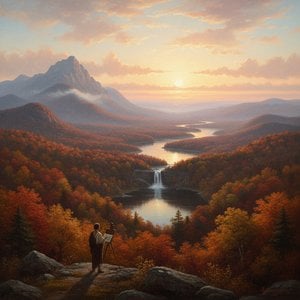
The Sublime Landscape: Exploring the Hudson River School Movement
Explore the captivating world of the Hudson River School! Discover the history, artists, and defining characteristics of this iconic American art movement. Learn about Romanticism's influence & find inspiration for your collection.

John Frederick Kensett: Luminosity, Landscape & the American Identity
Explore the luminous landscapes of John Frederick Kensett, a master of Luminism and key figure in the Hudson River School. Discover his serene paintings & enduring legacy with ArtsDot.

Echoes of Arcadia: Nostalgia & Transformation in Vintage Landscape Art
Explore the evocative world of vintage landscape art! Discover the history, artists & emotional power behind masterpieces from the Hudson River School & beyond. Expert insights for collectors & enthusiasts.

Hudson River School: 10 Šedevrai, Apibrėžę Amerikos Peizažo Meną
Atraskite 10 legendinių Hudson River School kūrinių! Thomas Cole, Frederic Church ir kiti meistrai sukuria nepakartojamą gamtos grožio vaizdą. Išmokite apie jų techniką ir įkvėpkite savo interjerą aukštos kokybės reprodukcijomis iš ArtsDot.com!

Robert Spencer: Luminism, Narrative & the American Landscape Tradition
Explore the captivating world of Luminism & the Hudson River School with our expert analysis. Discover the history, artists, and enduring beauty of 19th-century American landscape painting. Find museum-quality reproductions at ArtsDot.