
 Impressionism
 1870
1870 12.0 x 20.0 cm

The picture follows your choices: , .
Kolekcinio objekto aprašas
Discover 'Breakers' by Colin Hunter (1870), an evocative Impressionist seascape featuring turbulent waves & rocky shores. Thick impasto and dynamic brushwork capture nature’s power. A stunning piece for art collectors.
Autoriaus biografija
Colin Hunter (1841-1904) was a Scottish Victorian artist renowned for his evocative seascapes, depictions of Scottish fishing life, and landscapes including Niagara Falls. Explore his contributions to 19th-century art.
 Skaityti daugiau
Rankų darbo aliejinės reprodukcijos
Rankiniu būdu tapytas aliejus ant droblio jūsų pageidaujamame dydį ir rėmuose – tai mūsų menininkų pagal užsakymą sukurtas darbas. ( Perjungti į spausdinamus版作品 Perejti prie skaitmeninių vaizdų)
More about this painting
 Peržiūrėti realaus dydžio版
 Pasidalinti
 Dalintis
 Išsamiau
 Vadovas

 Atsisiųsti
 Panašūs eksponatai
 Rentgeno spindulių nuotrauka
 Automatinė diorama
 Q&A
Q&A Statistika
Order your painting in four simple steps
Take your time. You can change any answer; the price in your order card follows each choice.
1 Step one of four
Which size would you like?
These sizes keep the proportions of the original painting. The drawing shows your choice on a wall, above a two-metre sofa.
Or give your own measurements
Pasirinkite iš mūsų nustatytų dydžių, atitinkančių originalaus meno kūrinio proporcijas.

Įveskite jums reikiamą plotį ir aukštį, kad paveikslas atitiktų jūsų rėmą ar sieną. Kadangi šis darbas yra rankinio darbo, siekiant išgauti kitokios formos dydį, paveikslas gali būti šiek tiek didesnis (nuo kraštų bus palikta daugiau erdvės) arba mažesnis – pasirinkite jums patogiausią variantą. Prieš pradedant tapyti, atsiųsime jums skaitmeninį maketą patvirtinimui. Šioje puslapio nuotraukoje matomas vaizdas nėra galutinis rezultatas – jį parodys tik sukurtas maketas.
2 Step two of four
How should it be prepared: rolled, stretched or framed?
The prices below are for the size you chose in step one.
Choose the edges of the stretched canvas
Choose your frame

White €1

Blurside €1

Extended €1

P118B €10

P118H €10

P118W €10

P438Z €10

P508JH €12

P508YH €12

P805H €10

P805Z €10

P919BZ €10

P919G €10

P919XJ €10

P959ZH €10

P968JZ €12

W106C €8

W218G €10

W218JH €8

W218Y €10

W307PJ €10

W316G €10

W316PJ €8

W316Y €10

W398PJ €8

W4111J €10

W500HY €15

W500JH €15

W692G €12

W849H €8

W940BG €15

W953PJ €8

H24-GOLD €30

H24-SILVER €30

H36-GOLD €45

H36-SILVER €45
Įrėmintas
Moulding: . Overall size with the frame: .
3 Step three of four
Would you like anything changed in the painting?
Most people answer no. Because each painting is made by hand, our artist can also adapt it for you.
After order, ArtsDot.com team will email client for instructions and provide a mockup preview
4 Step four of four
A few finishing options
All of them are optional. The answers already selected cost nothing extra.
Who paints it?
Pristatymas visame pasaulyje () per 3–4 savaites, o ne įprastai – per 5 savaites. (30 spalis). Kokybė lieka nepakeičiama.
A nameplate, as in a museum?
Išgraviruotos bronzinės plokštelės detalės
This elegant plaque features the artist's name and the title of the artwork, finely engraved for a timeless presentation.
It is made from bronze with a refined, elegant finish. The text is precisely laser-engraved for a sharp and permanent result. Measuring 9x2 cm, the plaque is compact yet easy to read. It's built to be durable and scratch-resistant, offering a professional, museum-quality look. Mounting is simple thanks to the included adhesive backing.
Skaidrios akrilo plokštelės informacija
The plaque includes essential engraved details such as the artist's name, the title of the artwork, the date it was created, the type of media used-like oil on canvas or watercolor-a brief description of the piece, and a QR code that links to the complete artwork information.
It is crafted from clear acrylic, offering a sleek, modern appearance. The text is UV-engraved in black to ensure strong visual contrast. With a size of 10x15 cm, it ensures optimal readability. It comes equipped with two metal hooks for secure wall mounting. The plaque is designed to be weather-resistant, making it suitable for various environments, and it includes interactive features that work seamlessly with smartphone scanning.
Juodos akrilo plokštelės informacija
This elegant plaque includes engraved information such as the artist's name, the title of the artwork, the date it was created, the type of media used (like oil on canvas or watercolor), a short description of the artwork, and a QR code for quick access to more information.
The plaque itself is made from refined black acrylic with a premium finish. The text is laser-engraved in white for high contrast and readability. Its size is 10x15 cm, designed to be easy to read. It comes with two metal hooks for professional mounting. The design is sleek and fits any interior style. It is also weather-resistant and durable, with built-in digital integration for mobile compatibility.
A protective varnish?
When do you need it?
✓ Check and order
Your painting, as you ordered it

Breakers
Reprodukcijos technika
Reprodukcijos matmenys
-

Aukščiausios klasės meistras
Daugiau detalių, meistriškumo ir papildomo gamybos laiko
-

Reprodukcijos rėmėjimo parinktys
-
-
Dėl meno kūrinių ar reprodukcijų, kurių bet kuri pusė yra didesnė nei 105 cm (apie 41 inch), rėmas bus siunčiamas kaip išskaidytas surinkimo rinkinys. Šis metodas užtikrina saugų pristatymą ir apsaugo nuo transportavimo metu galimos žalos.
Reikalingas profesionalus surinkimas – tai nėra „pasidaryk pats“ (DIY) produktas.
Rinkinys turi būti surinktas, o drobė išplėsta naudojant patyrį profesionalų rėmininką, medžio klijus (nėra įtraukti į rinkinį), drobės plėšimo kleslę bei presas, kad rėmo rėžiai išliktų tiesūs, kol klijai išdžiūvus. Netinkamas surinkimas arba netolydus drobės įtampa gali negrįžtamai sugadinti meno kūrinį, todėl šie atvejai nėra užtraukiami mūsų garantijos.
 Dėl meno kūrinių ar reprodukcijų, kurių bet kuri pusė yra didesnė nei 105 cm (apie 41 inch), rėmas bus siunčiamas kaip išskaidytas surinkimo rinkinys. Šis metodas užtikrina saugų pristatymą ir apsaugo nuo transportavimo metu galimos žalos.
Į komplektą įeina visi vientisos medienos elementai, tiksliai išpjauti pagal dydį.
Surmontinama naudojant pridėtus varžtus bei papildomai reikalingą medžio kliją kampų jungtims, kuris nėra pridėtas ir turi būti parinktas rėmininkui.
Reikalingi profesionalūs įrankiai, kurie nėra įtraukti į rinkinį: drobės kėlimo plytelės (stiprintuvai) ir klemiai, laikantys rėmo strygius tiesiu kampu, kol džiūsta lipas.
Svarbu:
Kampų jungtims reikalingi medžio klijai, barams reikia laikyti naudojant presas, kol klijai visiškai išdžiūvės, o surinktam rėmui įtempiamai privilgti būtinos drobės įtempimo plytযুক্ত. Šios priemonės į rinkinį neįtrauktos. Prieš užsakydami šio dydžio rinkinį, rekomenduojame pasimalkoti patyrusiu rėmų meistru.

Pavadinimo lentelė
-
-

Apsauginis lakas
Blizgus lakas (ryškina spalvas, saugo nuo šviesos ir drėgmės)
-

Personalizuoti kūrinį
Ką galima pakeisti (pavyzdžiui): pakeisti veidą klientui skirta nuotrauka; pridėti augintinį (pvz., katę pakeisti šuniu); įtraukti paslėptą žinutę fone; pakeisti fono kraštovaizdį ar elementus.
-

Skubiai
Pristatymas visame pasaulyje () per 3–4 savaites, o ne įprastai – per 5 savaites. (30 spalis). Kokybė lieka nepakeičiama.
-
Skubus pristatymas
Pristatymas visame pasaulyje () per 5 weeks. (6 lapkritis).
Įskaičiuota
Bendroji kaina
€ 232
Stiklo variantas prieinamas tik pasirinkus dydį iki 110 cm
Included with every order
- Nemokamas greitasis pristatymas visame pasaulyje
- Aukštos kokybės lininis drobė
- Pilnas siuntimo draudimas
- Muitinės mokesčių grąžinimo garantija
- Tikro spalvų atitikimo garantija
- 100 dienų grąžinimo politika (tik esant įtaigoms)
- 100% pinigų grąžinimo garantija
- Nuolaida dideliems užsakymams


panašūs kūriniai


Colin Hunter
1841 - 1904
Autoriaus biografija
The Visionary of the Scottish Shore
Born in Glasgow in 1841, Colin Hunter emerged as one of the most evocative voices of the Victorian era, a painter whose soul seemed inextricably linked to the rhythmic pulse of the sea. His early years were shaped by the coastal atmosphere of Helensburgh, where the Firth of Clyde provided a natural classroom for a young boy captivated by the interplay of light and water. Before dedicating himself to the brush, Hunter worked as a clerk in a shipping office, a role that perhaps deepened his intimate understanding of maritime life and the vital connection between humanity and the ocean. This period of observation would later manifest in his canvases as a profound, lived-in realism, far beyond mere academic imitation.
Hunter’s artistic journey was marked by a transition from the structured world of commerce to the boundless freedom of the studio. After leaving his clerical post at twenty, he sought formal training, eventually finding himself in the Parisian studio of Leon Bonnat. While the French influence introduced him to new perspectives on form and light, Hunter remained fundamentally anchored to his Scottish roots. His style evolved into a masterful blend of Luminism and atmospheric realism, where the primary subject was not just the physical landscape, but the very air that moved across it. He possessed a rare ability to capture the ephemeral—the mist clinging to a rugged cliffside, the spray of a breaking wave, or the soft, melancholic glow of dawn over a quiet bay.
Mastery of Light and Maritime Life
The true heart of Hunter’s oeuvre lies in his celebrated seascapes and his tender depictions of coastal communities. He did not merely paint the ocean; he painted the struggle and the serenity of those who lived by its grace. His works often feature the hardworking fisher-folk of the Scottish coast, rendered with a dignity that elevates their daily labors to the level of epic drama. Through subtle gradations of tone and delicate blending, he achieved a sense of movement that makes the water feel alive, capturing both the terrifying dynamism of a storm and the tranquil stillness of a summer morning.
Beyond the shores of Scotland, Hunter’s curiosity led him to explore diverse landscapes, including the breathtaking majesty of Niagara Falls. This versatility demonstrated his ability to adapt his atmospheric technique to different scales of grandeur. His technical prowess was recognized on the global stage, as he exhibited his works in major international arenas such as Berlin, Vienna, and Philadelphia. These exhibitions solidified his reputation as an artist capable of communicating universal emotions through specific, localized scenes.
Legacy and Artistic Circle
Hunter’s significance extends beyond his individual canvases to his role within the vibrant artistic community of late 19th-century London. Residing in the prestigious Melbury Road enclave in Kensington, he lived among a circle of esteemed contemporaries, including:
- Lord Leighton, whose academic excellence complemented Hunter's atmospheric approach.
- George Frederic Watts, a fellow master of symbolic and emotive painting.
- Luke Fildes, with whom he shared a commitment to narrative and social realism.
His ascent within the prestigious Royal Academy, becoming an Associate Member in 1884, stands as a testament to his enduring influence and technical mastery. When Colin Hunter passed away in 1904, he left behind a legacy of paintings that serve as windows into a vanished era of maritime tradition. His work remains a profound meditation on the relationship between man and nature, reminding us that even in the most rugged landscapes, there exists a delicate, luminous beauty waiting to be discovered by those who know how to look.
Susiję straipsniai

The Enduring Legacy of Oil on Canvas: Technique, History & Aesthetic Impact
Explore the rich history & techniques of oil painting – from Renaissance masters to Impressionism. Discover pigments, layering methods, and why this timeless medium endures. Expert insights for artists & art enthusiasts.

Oil on Canvas: A Historical & Technical Exploration of a Timeless Artistic Medium
Explore the rich history & enduring techniques of oil painting on canvas. Discover the science behind its longevity, conservation practices, and contemporary relevance. Expert insights for art enthusiasts.
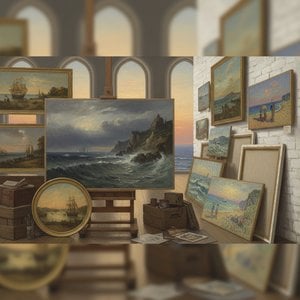
Evoking the Horizon: A Historical & Artistic Exploration of Coastal Scenes in Painting
Explore the rich history of coastal scenes in painting! Discover Impressionist masterpieces, American realism & contemporary visions. Learn about renowned artists and find your perfect seascape at ArtsDot.