

 Peržiūrėti realaus dydžio版
 Pasidalinti
 Dalintis
 Išsamiau
 Vadovas

 Atsisiųsti
 Panašūs eksponatai
 Rentgeno spindulių nuotrauka
 Automatinė diorama
 问答
问答 Statistika
Spring - a triptych

 Skaityti daugiau
Šiame puslapyje rodomas meno kūrinys yra saugomas autorių teisių įstatymais, todėl neturime teisės legaliai kurti ar parduoti jo identiškos reprodukcijos. Ši apsauga užtikrinama remiantis tokiais tarptautiniais susitarimais kaip Bernės konvencija ir pagal nacionalines įstatymų nuostatas, įskaitant tas, kurias nurodo JAV autoriškos teisės įstatymas – 17-asis skyrius.
Šis metodas visiškai atitinka autorių teises, nes jame nėra saugomo kūrinio kopijavimo ar dubliavimo. Tai yra kūrybinė reinterpretacija – naujas paveikslas, kurį įkvėpė originalas, tačiau kuris nėra jo identiškas.
Giclée / Meno spausdinimas
Muziejų lygio „giclée“ arba drobos spausdinimas: greita gamyba ir lankstios apdailos parinktys. ( Pirkti rankų darbo tapybą Perejti prie skaitmeninių vaizdų)




P118B €10

P118H €10

P118W €10

P438Z €10

P508JH €12

P508YH €12

P805H €10

P805Z €10

P919BZ €10

P919G €10

P919XJ €10

P959ZH €10

P968JZ €12

W106C €8

W218G €10

W218JH €8

W218Y €10

W307PJ €10

W316G €10

W316PJ €8

W316Y €10

W398PJ €8

W4111J €10

W500HY €15

W500JH €15

W692G €12

W849H €8

W940BG €15

W953PJ €8




Pasirinkite iš mūsų nustatytų dydžių, atitinkančių originalaus meno kūrinio proporcijas.

Įveskite jums reikiamą plotį ir aukštį, kad atvaizdas derėtų prie jūsų rėmo ar sienos. Spausdiną galima tik sumažinti, bet nepadidinti virš originalaus paveikslėlio dydžio, todėl keičiant proporcijas, dalis vaizdo prarandama. Prieš spausdinimą atsiųsime jums skaitmeninį maketą patvirtinimui. Šioje puslapio nuotraukoje matomas pjūvis nėra tikslus – jį rodo tik maketas.
Pristatymas visame pasaulyje () per 2 weeks, o ne įprastas 4/5 savaičių laikotarpis. (14 lapkritis)

Nemokamas greitasis pristatymas visame pasaulyje

Aukštos kokybės lininis drobė

Pilnas siuntimo draudimas

Muitinės mokesčių grąžinimo garantija

Tikro spalvų atitikimo garantija

100 dienų grąžinimo politika (tik esant įtaigoms)

100% pinigų grąžinimo garantija

Nuolaida dideliems užsakymams
 Stiklo variantas prieinamas tik pasirinkus dydį iki 110 cm

Spring - a triptych
Giclée / Meno spausdinimas
Reprodukcijos matmenys
-


Bendroji kaina
€ 56
panašūs kūriniai


Autoriaus biografija
The Soul of the Lens: The Life and Legacy of Clarence Hudson White
In the soft, diffused light of the early twentieth century, a new way of seeing was being born—one that sought to elevate the camera from a mere mechanical tool to a brush capable of profound emotional expression. At the heart of this revolution stood Clarence Hudson White, an artist whose vision transformed the photographic medium into a poetic language of light and shadow. Born in 1871 amidst the idyllic landscapes of small-town Ohio, White’s early life was steeped in the quiet rhythms of rural America. This formative period, characterized by a deep connection to the natural world and the simple dignity of domestic life, would later become the cornerstone of his artistic identity. His sensibilities were further enriched by a childhood fascination with music, particularly the violin, which instilled in him a rhythmic approach to composition and a sensitivity to harmony that would define his photographic eye.
White’s journey into the world of imagery was not one of formal academic training, but rather a serendipitous encounter with the magic of light. A visit to the World's Columbian Exposition in Chicago in 1893 ignited a passion for photography that would consume his life. Though largely self-taught, he possessed an innate ability to manipulate light to achieve a painterly quality, a hallmark of the Pictorialism movement. His work moved away from the sharp, clinical documentation of reality, opting instead for soft focus and evocative textures that suggested mood rather than mere fact. This approach allowed him to capture what many called the "spirit" of his subjects—the tender interplay of sunlight through a window, the gentle contours of a loved one's face, or the melancholic beauty of a fading landscape.
A Pioneer of the Photo-Secession
As White’s reputation grew, he found himself at the center of a radical movement that sought to redefine the boundaries of art. Alongside the formidable Alfred Stieglitz, White became a founding member of the Photo-Secession, an elite group of photographers dedicated to promoting photography as a fine art. This was a period of intense creative struggle and triumph, where the very definition of "art" was being contested in galleries and salons across the globe. White’s contribution to this movement was vital; his images provided a bridge between the traditional aesthetics of painting and the emerging possibilities of the photographic print. His work often featured themes of domesticity and intimacy, utilizing his family and friends as models to create a sense of universal, quiet beauty that resonated deeply with the era's romantic sensibilities.
The technical mastery White achieved was nothing short of extraordinary. He understood that the true subject of a photograph was not merely what stood before the lens, but the artist's subjective vision of it. Through careful manipulation of exposure, printing processes, and composition, he could imbue a simple scene with profound symbolic weight. His compositions often echoed his early sketches—images of floating spheres or seated figures that hinted at a deeper, more metaphysical reality beneath the surface of the everyday. This ability to infuse the mundane with the extraordinary is what truly set him apart as a master of the Pictorialist style.
The Legacy of the Clarence H. White School
Beyond his individual achievements behind the camera, White’s impact on the trajectory of American photography was cemented through his role as an educator. In 1914, he established the Clarence H. White School of Photography in New York City, the first institution in America dedicated to teaching photography as a fine art. This school became a crucible for innovation, attracting a generation of photographers who would go on to shape the future of the medium. His students included luminaries such as:
- Dorothea Lange, whose documentary work would define the human face of the Great Depression;
- Gertrude Käsebier, a fellow pioneer of the Pictorialist movement;
- Ralph Steiner, who brought a modern, avant-garde sensibility to the craft.
Through his teaching, White ensured that his philosophy of expressive, subjective photography would endure long after his passing. Though his own photographic output declined in his later years due to the immense demands of running his school, his influence remained pervasive. His death in 1925, following a heart attack while teaching in Mexico City, marked the end of an era, yet the echoes of his vision continue to be felt. Clarence Hudson White did more than just take photographs; he taught the world how to look at the light, finding the extraordinary within the ordinary and forever changing the way we perceive the beauty of our shared existence.

Trumpa informacija
- Artistic Movement Or Style: Pictorialist Photography
- Artists Or Movements Influenced By This Artist:
- Malevich
- John White Alexander
- Artists Who Influenced This Artist: ['Alfred Stieglitz']
- Date Of Birth: April 8, 1871
- Date Of Death: July 8, 1925
- Full Name: Clarence Hudson White
- Nationality: American
- Notable Artworks:
- Morning, 1905
- Drops of Rain, 1902
- The Sea [Rose Pastor Stokes, Caritas Island, Connecticut], 1909
- Place Of Birth: West Carlisle, Ohio
Susiję straipsniai
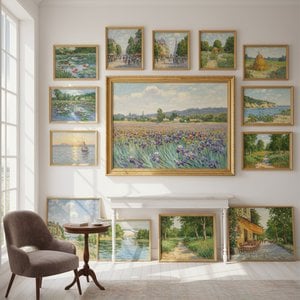
Impressionistinio Peizažo Simfonija: 10 Šedevrų, Apibrėžusių Epoją
Atraskite 10 impresionistinio peizažo šedevrų, kuriuos įkvėpė Monet, Renoir ir kiti! Sužinokite apie jų kūrybos istorijas bei spalvų magiją. Aukščiausios kokybės dailės reprodukcijos – ArtsDot.com. Išskirtinis interjero dizainas jūsų namams!

Anniversary Art Gifts: 10 Masterpieces for a Lasting Love Story |
Find the perfect anniversary gift! Explore 10 meaningful art masterpieces – from Monet to Van Gogh – & discover their romantic stories. Shop museum-quality reproductions at for a lasting tribute to your love.

The Lyrical Landscape: Finding Spiritual Depth in the Works of Savrasov and Levitan
Explore the spiritual depth of Savrasov and Levitan's Russian landscapes. Discover the mastery of lyrical realism today.

Cultivating Serenity: The Psychological Impact of Art Reproductions in Wellness Space Design
Discover how strategic art integration enhances wellness space design. Expert guidance on curating collections for serenity, improved guest experiences & ROI. Learn more!