

 Peržiūrėti realaus dydžio版
 Pasidalinti
 Dalintis
 Išsamiau
 Vadovas

 Atsisiųsti
 Panašūs eksponatai
 Rentgeno spindulių nuotrauka
 Automatinė diorama
 Q&A
Q&A Statistika
Crucifix

- 350.0 x 690.0 cm


 Skaityti daugiau
Giclée / Meno spausdinimas
Muziejų lygio „giclée“ arba drobos spausdinimas: greita gamyba ir lankstios apdailos parinktys. ( Pirkti rankų darbo tapybą Perejti prie skaitmeninių vaizdų)




P118B €10

P118H €10

P118W €10

P438Z €10

P508JH €12

P508YH €12

P805H €10

P805Z €10

P919BZ €10

P919G €10

P919XJ €10

P959ZH €10

P968JZ €12

W106C €8

W218G €10

W218JH €8

W218Y €10

W307PJ €10

W316G €10

W316PJ €8

W316Y €10

W398PJ €8

W4111J €10

W500HY €15

W500JH €15

W692G €12

W849H €8

W940BG €15

W953PJ €8




Pasirinkite iš mūsų nustatytų dydžių, atitinkančių originalaus meno kūrinio proporcijas.

Įveskite jums reikiamą plotį ir aukštį, kad atvaizdas derėtų prie jūsų rėmo ar sienos. Spausdiną galima tik sumažinti, bet nepadidinti virš originalaus paveikslėlio dydžio, todėl keičiant proporcijas, dalis vaizdo prarandama. Prieš spausdinimą atsiųsime jums skaitmeninį maketą patvirtinimui. Šioje puslapio nuotraukoje matomas pjūvis nėra tikslus – jį rodo tik maketas.
Pristatymas visame pasaulyje () per 2 weeks, o ne įprastas 4/5 savaičių laikotarpis. (2 lapkritis)

Nemokamas greitasis pristatymas visame pasaulyje

Aukštos kokybės lininis drobė

Pilnas siuntimo draudimas

Muitinės mokesčių grąžinimo garantija

Tikro spalvų atitikimo garantija

100 dienų grąžinimo politika (tik esant įtaigoms)

100% pinigų grąžinimo garantija

Nuolaida dideliems užsakymams
 Stiklo variantas prieinamas tik pasirinkus dydį iki 110 cm

Crucifix
Giclée / Meno spausdinimas
Reprodukcijos matmenys
-


Bendroji kaina
€ 55
A Bridge Between Worlds: Cimabue’s ‘Crucifix’
Cimabue's “Crucifix,” painted around 1283 in Florence, stands as a pivotal work not merely for its artistic merit but for its profound role in marking the transition from the rigid formality of Byzantine art to the burgeoning naturalism that would define the Italian Renaissance. More than just a depiction of Christ’s suffering, this painting embodies a courageous shift—a subtle yet decisive challenge to established conventions, laying the groundwork for the revolutionary changes that were about to reshape Western art. Born Cenni di Pepo around 1240 in Florence, Cimabue wasn't simply a painter; he was an innovator who dared to experiment with form and expression, a figure whose legacy resonates powerfully even today.
The painting immediately draws the eye with its monumental scale – measuring over three by two meters – reflecting the Byzantine tradition of imposing religious imagery. Yet, Cimabue’s genius lies in his ability to infuse this grandeur with a nascent sense of humanity. The Christ figure, rendered in tempera and gold on wood, is undeniably rooted in the iconography of the East: he is depicted as *Christus patiens*, or deceased, flanked by the Virgin Mary and St. John the Evangelist, both figures enveloped in sorrowful contemplation. However, subtle innovations distinguish Cimabue’s work from its Byzantine predecessors. The Christ's pose, while still conveying a sense of stillness, possesses a greater physicality—a suggestion of weight and vulnerability that hints at the human drama unfolding before us.
The Language of Symbolism
Beyond the immediate depiction of the crucifixion, “Crucifix” is rich in symbolic meaning. The inscription "HIC EST IESUS NAZARENUS REX IUDEORUM" – “Here is Jesus Christ, King of the Jews” – anchors the scene within its religious context, asserting both his divinity and his earthly sacrifice. The carefully chosen details—the draped cloth, the outstretched limbs, the sorrowful faces of the witnesses—all contribute to a powerful narrative of suffering, redemption, and hope. The use of gold leaf, particularly in highlighting Christ’s figure, further elevates the scene, connecting it to the opulent traditions of Byzantine mosaics and illuminating the divine nature of the subject.
Technique and Innovation
Cimabue's mastery is evident in his skillful manipulation of tempera paint. He employs a technique known as *distemper*, mixing pigments with a binding medium, creating rich colors and subtle gradations of tone. The painting’s monumental scale demanded careful planning and execution; the panel itself was constructed from five timber boards, meticulously joined to create a stable support for the vibrant imagery. Notably, Cimabue moved away from the purely abstract representation favored in Byzantine art, introducing a greater degree of naturalism into his depiction of Christ's body—a subtle shift that would become increasingly pronounced in the work of his successors, particularly Giotto.
A Legacy Forged in Florence
“Crucifix”’s journey through history is inextricably linked to the artistic landscape of Florence. Originally intended for “Santa Croce II,” a significant church project, it eventually found its home within the Basilica di Santa Croce, where it has remained a treasured masterpiece. The painting's survival—despite being partially damaged during the devastating 1966 flood that ravaged Florence – is itself a testament to its enduring value and the dedication of those who have preserved it. Today, this powerful image continues to inspire awe and reflection, serving as a poignant reminder of faith, sacrifice, and the transformative power of art.
Klausimai ir atsakymai
Kur ir kokiam tikslui rekomenduojamas „Crucifix“?
„Crucifix“ siūloma naudoti Statement, o rekomenduojama erdvė – Living Room.
Kokia yra „Crucifix“ paletės ryškumas?
„Crucifix“ – Čimabujė spalvų nasyginimas yra Clear Color Presence. Nasyginimas apibūdina, kokių spalvos yra ryškių arba išblukusių.
Kokią emociją perteikia „Crucifix“ – Čimabujė?
Įtvirtinta „Crucifix“ – Čimabujė nuotaika yra Dramatic, o emocinis tonas – Melancholic.
panašūs kūriniai


![Scrovegni - [23] - Baptism Of Christ — Džotas Di Bondonė, Early Renaissance](/media/artworks/images-thumb/17/af/17af47626cb93b2000ad3d13e045f189.jpg)


Autoriaus biografija
Giovanni Cimabue: Grandfather of the Italian Renaissance
Giovanni Cimabue, born Cenni di Pepo around 1240 in Florence, stands as a monumental figure—a bridge between the established artistic traditions of the Byzantine world and the burgeoning innovations that would define the Italian Renaissance. His life, though partially obscured by time and romanticized accounts – most notably those penned by Giorgio Vasari centuries later – marks an undeniable turning point in Western art history. Cimabue wasn’t simply a painter; he was a courageous innovator who dared to subtly challenge artistic conventions, laying the groundwork for the revolutionary changes that would soon sweep across Italy. Even his nickname, believed to mean “bull-headed,” hints at a strong will and perhaps a rebellious spirit—qualities demonstrably present in his willingness to experiment with form and expression. He represents a crucial moment where art began to shift from being solely devotional imagery towards something more humanistic and emotionally resonant.Early Influences and Artistic Development
Initially immersed in the Italo-Byzantine style prevalent throughout Florence, Cimabue’s early work adhered closely to established aesthetic principles: flattened figures adorned with shimmering gold leaf, symbolic rather than realistic depictions of space, and a profound focus on religious iconography. However, even within these constraints, a nascent desire for naturalism began to emerge. He wasn't content merely replicating existing forms; he sought to imbue his paintings with a greater sense of life and emotional depth. While the precise nature of his early training remains debated, it’s likely he honed his skills within Florentine workshops, absorbing the techniques and influences of the time while simultaneously developing his own unique artistic voice. The Byzantine style, characterized by its formality and spiritual focus, provided him with a solid foundation, but Cimabue began to subtly introduce elements that would foreshadow the coming Renaissance—a greater attention to volume, more expressive facial features, and a nascent understanding of spatial relationships. This wasn’t a sudden break from tradition, but rather a gradual evolution, a delicate balancing act between honoring the past and embracing new possibilities.Masterpieces and Artistic Innovations
Cimabue's legacy is cemented through a series of breathtaking works that showcase his evolving style. The *Maestà* (Louvre), originally created for the Church of San Francesco in Pisa, stands as one of his most celebrated masterpieces. This monumental altarpiece exemplifies his mastery of composition and use of color, while simultaneously hinting at the shift away from rigid Byzantine conventions. The figures, though still possessing a degree of formality, exhibit a newfound sense of volume and presence. The *Crucifixion* (San Domenico, Arezzo), dating around 1270, is particularly significant as an early demonstration of his departure from strict Byzantine norms. Here, the proportions are more realistic, and the emotional weight of the scene is palpable—a stark contrast to the often-distant depictions found in earlier religious art. Further evidence of Cimabue’s innovative spirit can be seen in works like the *Flagellation of Christ* (Frick Collection), generally attributed to his workshop. This complex composition reveals an evolving understanding of perspective and spatial relationships, showcasing a growing interest in creating more immersive and believable scenes. His contributions weren't limited to panel paintings; Cimabue also excelled as a mosaicist, contributing significantly to the decoration of the Baptistery of Florence—though these mosaics have unfortunately suffered from deterioration over time.A Pivotal Teacher: Giotto and Beyond
Perhaps Cimabue’s most enduring legacy lies in his role as the teacher of Giotto di Bondone. While historical accounts vary regarding the exact nature of their relationship, it is widely accepted that Giotto received crucial training under Cimabue's guidance. However, Giotto would ultimately surpass his master, revolutionizing Italian painting with an even more radical embrace of naturalism and emotional realism. It’s a testament to Cimabue’s skill as a teacher that he fostered such talent, even knowing it might eclipse his own achievements. The story, often recounted by Vasari, of Giotto playfully painting a fly on Cimabue's face speaks volumes about the dynamic between master and pupil—a playful rivalry that ultimately pushed both artists to greater heights. Cimabue’s influence extended beyond Giotto, impacting numerous other artists of the period. He challenged the artistic norms of his time, demonstrating that art could be more than just religious symbolism; it could also reflect human emotion and experience. His willingness to experiment with form, proportion, and expression paved the way for the innovations of the Renaissance, establishing him as a crucial transitional figure in the history of Western art.Enduring Significance
Cimabue passed away in 1302 in Pisa, leaving behind a body of work that continues to captivate and inspire. Despite his significant contributions, details surrounding his later life remain scarce. However, Cimabue’s artistic legacy resonates powerfully through the works of his students and the evolution of Italian art. He represents a crucial step in the development of Western painting, moving away from the stylized conventions of the Byzantine era towards a more humanistic and naturalistic approach. His paintings are not merely historical artifacts; they are windows into a pivotal moment in artistic history—a time when artists began to question established norms and explore new possibilities. He was a pioneer, a visionary who dared to challenge the status quo and lay the foundations for the artistic brilliance that would define the Renaissance. Cimabue’s work reminds us that even within tradition, there is always room for innovation, and that true artistry lies in the courage to push boundaries and explore new horizons.
Čimabujė
1240 - 1302 , إيطاليا
Trumpa informacija
- Artistic Movement Or Style: Byzantine & Renaissance
- Artists Who Influenced This Artist:
- Nicolo Pisano
- Giunta Pisano
- Date Of Birth: c. 1240
- Date Of Death: 1302
- Full Name: Giovanni Cimabue
- Nationality: Italian
- Notable Artworks:
- Maestà
- Crucifixion
- Flagellation of Christ
- Place Of Birth: Florence, Italy
Susiję straipsniai

Emocijų Rezonansas Interjero Freskose: Istorinis Kontekstas ir Asmeninio Patyrimo Galimybės
Atraskite freskų istoriją ir meno galimybes interjere! Profesionalios freskų tapybos paslaugos, individualūs projektai, patikima restauravimas. Sukuriame unikalų grožį Jūsų namuose.

The Enduring Legacy of Fresco: Technique, History & Artistic Expression Across Cultures
Explore the rich history & enduring legacy of fresco painting! Discover ancient techniques, Giotto's masterpieces, and modern applications. Expert insights for art lovers & professionals.

The Enduring Legacy of Fresco: Technique, History & Artistic Expression
Explore the rich history & enduring artistry of fresco painting. Discover techniques from Giotto to Michelangelo, conservation efforts, & modern applications. Learn how ArtsDot brings this timeless art form to your home.
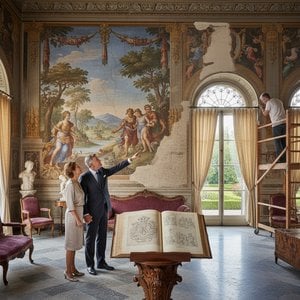
Šeimos Palikimas Tapyboje: Freskos Istorija ir Kultūrinė Reikšmė Kaip Amžina Vertybė
Atraskite freskų istoriją ir kultūrinę reikšmę! Ekspertai patars, kaip įamžinti šeimos palikimą sienų tapyboje. Aukštos kokybės restauravimas ir užsakomieji paveikslai. Investicija į ilgalaikį meno paveldą.

The Enduring Legacy of Fresco Painting: Techniques, History & Contemporary Relevance
Explore the rich history & enduring artistry of fresco painting – from Giotto to Michelangelo! Discover techniques, conservation efforts, & modern applications. Learn how ArtsDot brings this timeless art form to your home.


