


 Peržiūrėti realaus dydžio版
 Siųsti
 Dalintis
 Išsamiau
 Vadovas

 Atsisiųsti
 Panašūs eksponatai
 Rentgeno spindulių nuotrauka
 Diaporama
 Statistika
Austria


 Rodyti daugiau
Giclée / Meno spausdinimas
Muziejų lygio „giclée“ arba drobos spausdinimas: greita gamyba ir lankstios apdailos parinktys. ( Pirkti rankomis tapytą reprodukciją Perejti prie skaitmeninių vaizdų)




P118B €10

P118H €10

P118W €10

P438Z €10

P508JH €12

P508YH €12

P805H €10

P805Z €10

P919BZ €10

P919G €10

P919XJ €10

P959ZH €10

P968JZ €12

W106C €8

W218G €10

W218JH €8

W218Y €10

W307PJ €10

W316G €10

W316PJ €8

W316Y €10

W398PJ €8

W4111J €10

W500HY €15

W500JH €15

W692G €12

W849H €8

W940BG €15

W953PJ €8




Pasirinkite iš mūsų nustatytų dydžių, atitinkančių originalaus meno kūrinio proporcijas.

Įveskite jums reikiamą plotį ir aukštį, kad atvaizdas derėtų prie jūsų rėmo ar sienos. Spausdiną galima tik sumažinti, bet nepadidinti virš originalaus paveikslėlio dydžio, todėl keičiant proporcijas, dalis vaizdo prarandama. Prieš spausdinimą atsiųsime jums skaitmeninį maketą patvirtinimui. Šioje puslapio nuotraukoje matomas pjūvis nėra tikslus – jį rodo tik maketas.
Pristatymas visame pasaulyje () per 2 weeks, o ne įprastas 4/5 savaičių laikotarpis. (20 spalis)

Nemokamas greitasis pristatymas visame pasaulyje

Aukštos kokybės lininis drobė

Pilnas siuntimo draudimas

Muitinės mokesčių grąžinimo garantija

Tikro spalvų atitikimo garantija

100 dienų grąžinimo politika (tik esant įtaigoms)

100% pinigų grąžinimo garantija

Nuolaida dideliems užsakymams
 Stiklo variantas prieinamas tik pasirinkus dydį iki 110 cm

Austria
Giclée / Meno spausdinimas
Reprodukcijos dydis
-


Visų pasirinktų variantų kaina
€ 54
A Vision of Belle Époque Splendor
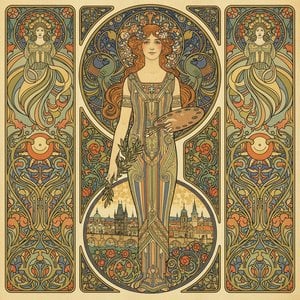
In the heart of the 1900 Paris Exposition, amidst the swirling energy of a new century, Alphonse Mucha captured a moment of pure, unadulterated elegance. His poster for the Oesterreichische Ausstellung is far more than a mere historical advertisement; it is a breathtaking window into the soul of the Art Nouveau movement. As one gazes upon this masterpiece, they are immediately swept into a world where the boundaries between fine art and decorative design dissolve into a seamless tapestry of beauty. The central figure, an idealized woman of ethereal grace, commands the viewer's attention with a regal presence that feels both timeless and deeply rooted in the romanticism of her era. Draped in a sumptuous scarlet gown that seems to glow from within, she stands as a silent sentinel of Austrian culture, her form adorned with intricate gold embroidery that catches the light like sunbeams through a cathedral window.
The composition is a masterclass in visual storytelling, utilizing a vertical orientation to evoke the grandeur of the very exhibition it celebrates. Mucha does not merely present a subject; he constructs an entire universe. Surrounding our central protagonist are delicate vignettes that act as poetic glimpses into the splendor of both Vienna and Paris. One might find oneself wandering through stylized architectural landscapes reminiscent of the majestic Schönbrunn Palace, or catching fleeting impressions of Parisian urban life. These elements are woven together with a rhythmic fluidity, where every line serves to guide the eye in a dance across the page. The influence of Japanese woodblock prints is subtly felt in the flattened perspective and the deliberate, decorative arrangement of space, creating a sense of harmony that is both sophisticated and profoundly soothing.
The Alchemy of Line and Symbolism
To understand this work is to understand the language of organic symbolism. Every curve and floral motif within Mucha’s design is a deliberate choice intended to evoke growth, vitality, and the interconnectedness of nature and humanity. The sinuous, undulating lines—often referred to as "whiplash" curves—are not merely decorative flourishes; they are the pulse of the artwork itself, imbuing the static paper with a sense of breathing movement. The lush, botanical elements that frame the central figure serve as metaphors for the blossoming of European modernity, suggesting that just as flowers bloom in their season, so too was this era of international cooperation and cultural exchange reaching its zenith.
For the discerning collector or interior designer, this piece offers an unparalleled opportunity to introduce a sense of historical opulence into a contemporary space. The interplay of rich reds, shimmering golds, and soft, muted tones creates a palette that is both commanding and versatile. Whether placed as a focal point in a grand salon or used to add a touch of vintage charm to a curated gallery wall, the poster radiates an aura of sophisticated nostalgia. It invites conversation, prompting onlookers to reflect on a time when art was woven into the very fabric of daily life, transforming even the most functional objects into vessels of aesthetic delight.
A Legacy of Hand-Painted Perfection
While originally conceived for the medium of lithographic printing, the essence of this work lies in its perceived materiality. The technique suggests a meticulous layering of color, where the depth of the pigments mimics the richness of oil on textured canvas. This sense of tactile luxury is what makes a high-quality reproduction so vital; it allows the subtle transitions of light and shadow—the soft glow on the figure's skin and the sharp brilliance of the gold accents—to be experienced with true emotional resonance. It is this dedication to hand-painted perfection that ensures Mucha’s vision remains as vibrant today as it was at the dawn of the twentieth century.
Owning a piece inspired by this era is an act of preserving a legacy of beauty. It is an invitation to surround oneself with the spirit of the Belle Époque, a period defined by optimism, artistic revolution, and an unwavering belief in the transformative power of grace. As a centerpiece for any refined collection, this artwork does not merely decorate a room; it elevates the entire atmosphere, offering a perennial celebration of the human capacity for splendor.
问答 (or more naturally for a website heading): Klausimai ir atsakymai
Koks yra „Austria“ formatas?
„Austria“, autorius – Alfonzas Muha kūrinio formatas yra Portrait. Formatas aprašo kompozicijos proporcijas.
Kaip medžiaga ir judėjimas susilieja darbe „Austria“?
„Austria“ sukurta naudojant Acrylic On Canvas, Art Nouveau stiliuje.
Kur galiu įsigyti „Austria“, autorius – Alfonzas Muha skaitmeninį vaizdą?
„Austria“ galima įsigyti kaip aukštos raiškos skaitmeninio vaizdo atsisiuntimas, tiesiogiai savo Skaitmeninis vaizdas puslapio.


Autoriaus biografija
Ankstyvas gyvenimas ir išsilavinimas
Alfonzas Marija Mucha (Alfonsas Mucha) gimė 1860 metų liepos 15 dieną Ivaničicėje, Moravijoje (dabartinėje Čekijos Respublikoje). Netrukus pasireiškė jo meninis talentas. Studijavo meno akademijoje Prahoje, tačiau nusivylęs tradiciniais metodais, 1887 metais persikėlė į Paryžių, siekdamas kurti savitu stiliumi. Šis sprendimas tapo lemtingu žingsniu jo kūrybiniame kelyje, atvėrusiu duris į naują meno erą – Art Nouveau. Jaunasis Mucha greitai susipažino su Paryžiaus bohemos gyvenimu ir ėmėsi įvairių užsakymų, kad išgyventų, tačiau jo širdyje degė troškimas rasti savitą kalbą meno pasaulyje.Meninis stilius ir reikšmingiausi darbai
Mucha greitai susiformavo ryškus Art Nouveau stilius, pasižymintis srauniomis linijomis, organinėmis formomis ir judėjimo įspūdiu. Jo kūriniuose dominuoja dekoratyvumas, simbolizmas ir moterų įvaizdžiai. Menininkas buvo paveiktas tokio menininko kaip Pierre-Auguste Renoir ir Gustave Moreau darbų. Žymiausi darbai:- Slavų sukilimas – demonstruoja tradicinių čekų motyvų derinį su moderniais Art Nouveau elementais.
- Salon des Cent - puikiai atspindi jo stiliaus eleganciją ir dekoratyviškumą.
- Tapybos darbai, įkvėpti Gustave Moreau kūrinių, pavyzdžiui, Tespio dukterys, ir Piero Dorazio La Ribambelle des Gobelins.
- Iliustracijos pagal Sir Huberto von Herkomer darbą Jauni ūkininkai skinantys linus.
Karjeros aukštumos ir svarbiausi užsakymai
- Bendradarbiavimas su Sarah Bernhardt: 1894 metais Mucha sukūrė plakatus ir dizainus aktorei Sarah Bernhardt, pradėdamas nuo Gismonda plakatų, kurie suteikė jam didžiulį populiarumą.
- Universalinė paroda Paryžiuje (1900): Jo Art Nouveau stilius sulaukė tarptautinio pripažinimo šioje parodoje. Jis dekoravo Bosnijos ir Hercegovinos paviljoną ir bendradarbiavo prie Austrijos paviljono įrengimo.
- Charles Richard Crane globa: Gavęs paramą iš Charles Richard Crane, Mucha sukūrė monumentalų ciklą Slavų epas (1912–30).
- Nepriklausomos Čekoslovakijos kūrimas: Sukūrė pašto ženklus, banknotus ir vyriausybės dokumentus naujai nepriklausomai Čekoslovakijai.
Įtakos ir palikimas
Mucha buvo paveiktas čekų meno tradicijų ir modernių Europos meno judėjimų. Jo unikalus stilius atvėrė kelią ateities kartoms Art Nouveau ir Secesijos stilistikoje. Įkvėpė kitus menininkus, pavyzdžiui, Evą Prokopcovą. Jo darbai iki šiol įkvepia dizainerius ir estetus visame pasaulyje. Muchos palikimas apima ne tik jo meno kūrinius, bet ir didelę įtaką grafikos dizainui, interjerų dekoravimui bei bendrai estetikai. Slavų epas, kaip monumentalus istorinis projektas, atspindi menininko patriotiškumą ir meilę savo šaliai.Vėlesnis gyvenimas ir mirtis
- 1906 metais vedė Maruską (Mariją/Mariyą) Chytilovą.
- Nuo 1906 iki 1910 metų apsilankė Jungtinėse Amerikos Valstijose, kur gimė dukra Jaroslava.
- Mirė 1939 metų liepos 14 dieną Prahoje, Čekoslovakijoje.

Alfonzas Muha
1860 - 1939 , Čekija
Trumpa informacija apie kūrėją
- Gimimo Data: 1860 m. liepos 15 d.
- Gimimo Vieta: Brno, Čekija
- Meninis Stilius: Art Nouveau
- Mirties Data: 1939 m.
- Pilietybė: Čekas
- Pilnas Vardas: Alphonse Maria Mucha
- Įtakoję Menininkai:
- Pierre-Auguste Renoir
- Gustave Moreau
- Įtakoti Menininkai: ['Eva Prokopcová']
- Žymiausi Darbai:
- Slavų sukilimas
- Salon des Cent
Susiję straipsniai
Alphonse Mucha: A Comprehensive Exploration of Art Nouveau's Master of Decorative Symbolism
Explore the life & art of Alphonse Mucha, master of Art Nouveau! Discover his iconic posters, stunning illustrations, and the monumental Slav Epic. A comprehensive guide for collectors & enthusiasts.

The Vienna Secession: A Rebellion of Form & Spirit in Fin-de-Siècle Art
Discover the revolutionary Vienna Secession art movement! Explore Klimt, Olbrich & more. Learn about its history, characteristics & lasting influence on modern art. High-quality reproductions available.

Raphael Kirchner: A Poetic Vision of Belle Époque Society Through Art Nouveau Lithography
Explore the captivating world of Raphael Kirchner, a master of Art Nouveau illustration during the Belle Époque. Discover his iconic 'Kirchner Girls,' pioneering pin-up art & lasting influence.

The Flowing Line & Flourishing Form: Exploring Art Nouveau's Aesthetic Legacy
Explore the captivating world of Art Nouveau! Discover its origins, key artists like Horta & Mucha, regional styles, innovative techniques, and lasting influence on architecture & design. A comprehensive guide for art enthusiasts.

Art Nouveau: 10 Šedevrai, Apibrėžę Dekoratyvinio meno Era | ArtsDot
Atraskite 10 legendinių Art Nouveau šedevrų! Gustav Klimt, Alphonse Mucha ir daugiau – meniniai pasiekimai, apibrėžę dekoratyvinio meno epochą. Pasinerkite į istorijas, spalvas ir grožį. Kokybiškos dailės reprodukcijos ir interjero idėjos ArtsDot.com.