


 Peržiūrėti realaus dydžio版
 Siųsti
 Dalintis
 Išsamiau
 Vadovas

 Atsisiųsti
 Panašūs eksponatai
 Rentgeno spindulių nuotrauka
 Diaporama
 Statistika
Study
 Abstract Expressionism
 1960
1960 44.0 x 34.0 cm
 Rodyti daugiau
Šiame puslapyje rodomas meno kūrinys yra saugomas autorių teisių įstatymais, todėl neturime teisės legaliai kurti ar parduoti jo identiškos reprodukcijos. Ši apsauga užtikrinama remiantis tokiais tarptautiniais susitarimais kaip Bernės konvencija ir pagal nacionalines įstatymų nuostatas, įskaitant tas, kurias nurodo JAV autoriškos teisės įstatymas – 17-asis skyrius.
Kaip pagarbią ir teisėtą alternatyvą, mes siūlome pagal užsakymą rankomis dažytus paveikslus, įkvėptus originalo. Mūsų įgudę ir profesionalūs menininkai kruopščiai tiria originalo stilių, nuotaiką ir meninę esmę, kad sukurtų naują, unikalią kūrinį, kuris sukelia tą paties jausmą – išlikdamas tuo tarciau originaliu, savarankišku kūrybiniu darbu.
Šis metodas visiškai atitinka autorių teises, nes jame nėra kūrinio kopijavimo ar dubliavimo. Tai yra kūrybinė reinterpretacija – naujas paveikslas, kurį įkvėpė originalas, tačiau kuris nėra jo identiškas.
Rankų darbo aliejinės reprodukcijos
Rankiniu būdu tapytas aliejus ant droblio jūsų pageidaujamame dydį ir rėmuose – mūsų menininkų darbas pagal užsakymą. ( Perjungti į spausdinimą Perejti prie skaitmeninių vaizdų)




P118B €10

P118H €10

P118W €10

P438Z €10

P508JH €12

P508YH €12

P805H €10

P805Z €10

P919BZ €10

P919G €10

P919XJ €10

P959ZH €10

P968JZ €12

W106C €8

W218G €10

W218JH €8

W218Y €10

W307PJ €10

W316G €10

W316PJ €8

W316Y €10

W398PJ €8

W4111J €10

W500HY €15

W500JH €15

W692G €12

W849H €8

W940BG €15

W953PJ €8




Pasirinkite iš mūsų nustatytų dydžių, atitinkančių originalaus meno kūrinio proporcijas.

Įveskite jums reikiamą plotį ir aukštį, kad paveikslas atitiktų jūsų rėmą ar sieną. Kadangi šis darbas yra rankinio darbo, siekiant išgauti kitokio formos dydį, paveikslas gali būti šiek tiek didesnis (nuo kraštų bus palikta daugiau erdvės) arba mažesnis – pasirinkite jums patogiausią variantą. Prieš pradedant tapyti, atsiųsime jums skaitmeninį maketą patvirtinimui. Šioje puslapio nuotraukoje matomas vaizdas nėra galutinis rezultatas – jį parodys tik sukurtas maketas.
Gavus užsakymą, ArtsDot.com komanda susisieks su klientu el. paštu dėl instrukcijų ir pateiks maketo pavyzdį
Pristatymas visame pasaulyje () per 3–4 savaites, o ne įprastai – per 5 savaites. (23 spalis). Kokybė lieka nepakeičiama.

Nemokamas greitasis pristatymas visame pasaulyje

Aukštos kokybės lininis drobė

Pilnas siuntimo draudimas

Muitinės mokesčių grąžinimo garantija

Tikro spalvų atitikimo garantija

100 dienų grąžinimo politika (tik esant įtaigoms)

100% pinigų grąžinimo garantija

Nuolaida dideliems užsakymams
 Stiklo variantas prieinamas tik pasirinkus dydį iki 110 cm

Study
Reprodukcijos technika
Reprodukcijos dydis
-


Visų pasirinktų variantų kaina
€ 231
Susiję kūriniai


Autoriaus biografija
The Architect of Color and Code
Alfred Jensen was a man whose life unfolded like a complex, multi-layered map, traversing continents and cultures before settling into the profound, structured enigmas of his canvas. Born in Guatemala City in 1903 to a Danish father and a German-Polish mother, his early years were marked by a poignant displacement. The tragic loss of his mother when he was just seven years old sent him to live with relatives in Denmark, an experience that instilled in him a lifelong appreciation for the deep traditions of Europe. This nomadic spirit—a blend of Latin American roots and Northern European discipline—would later become the bedrock of his artistic identity, allowing him to weave together disparate threads of human knowledge into a singular, cohesive visual language.
Before he ever picked up a brush with the intent to revolutionize abstraction, Jensen’s life was defined by movement and manual labor. He worked as a ship's cabin boy, a traveler through the vastness of the sea, and even spent time as a cowboy and chicken farmer in the Americas. These formative, rugged years provided him with an observational sharpness and a fascination with the rhythms of the natural world. It was not until his pursuit of formal art education—studying under the legendary Hans Hofmann in Munich and later exploring the vibrant studios of Paris—that these wandering observations began to crystallize into a rigorous, systematic approach to painting.
A Symbiosis of Science and Spirit
To look upon a Jensen painting is to enter a labyrinth of logic and light. He was far more than a mere painter; he was a cartographer of meaning, utilizing mathematical systems, color theories, and numerical grids to construct his two-dimensional worlds. His work represents a masterful bridge between the analytical and the mystical. While his technique relied heavily on the precision of geometric forms and the scientific application of Goethe’s color theory, the soul of his work remained deeply rooted in the esoteric. He drew profound inspiration from the Mayan calendar, the I Ching, and various systems of divination, seeking to find a universal pattern that connected the cosmic with the terrestrial.
This unique methodology allowed him to transcend the boundaries of traditional Abstract Expressionism. While his contemporary, Hans Hofmann, emphasized the emotional power of gestural paint, Jensen moved toward what is often termed concrete abstract art. His canvases became dense, polychromatic grids where every square and line served a purpose within a larger, interconnected system. Through these overlapping layers of signs, numbers, and colors, he created a visual shorthand for the complexities of existence, making the invisible structures of thought and time visible to the eye.
Legacy of the Grid
The trajectory of Jensen’s career was significantly shaped by his relationship with the influential art collector Saidie Adler May. As his patron and companion, May accompanied him on extensive travels through Europe, exposing him to the masterpieces of Paul Klee and Wassily Kandinsky. This exposure further enriched his palette and deepened his commitment to a structured, symbolic form of abstraction. His ability to synthesize these high-modernist influences with his own interest in pre-Columbian and Asian aesthetics positioned him as a precursor to much of the Conceptual art that would follow.
Though he lived a life of profound intellectual solitude, his impact on the art world was monumental. His work is now celebrated in the most prestigious institutions across the globe, including:
- The Museum of Modern Art (MoMA), New York
- The Solomon R. Guggenheim Museum, New York
- The San Francisco Museum of Modern Art
- The Smithsonian Institution
Alfred Jensen remains a singular figure in the history of 20th-century art—an artist who did not merely paint what he saw, but rather attempted to paint the very logic upon which the universe is built. His legacy persists in every vibrant, gridded composition that dares to find the sacred within the mathematical.

Alfred Jensen
1903 - 1981 , Guatemala
Trumpa informacija apie kūrėją
- Full Name: Alfred Julio Jensen
- Nationality: American
- Date Of Birth: 1903
- Date Of Death: 1981
- Place Of Birth: Guatemala City, Guatemala
- Notable Artworks:
- SS 'Norwich'
- Twelve Events in a Dual Universe
- Artistic Movement Or Style: Concrete abstract art
- Artists Who Influenced This Artist: ['Hans Hofmann']
- Artists Or Movements Influenced By This Artist: ['Paul Klee']
Susiję straipsniai
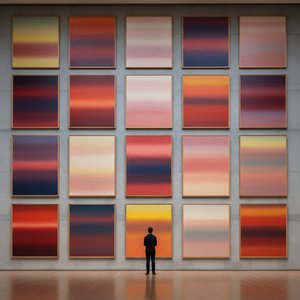
Mark Rothko: 25 Šedevrai, Apibūdinantys Spalvų Ir Jaustmo Gylį | ArtsDot
Atraskite 25 įspūdingiausius Mark Rothko kūrinius! Gilinkitės į abstraktaus meno spalvų laukus, ekspresionizmą ir jaustmingas tapybas. Meno reprodukcijos aukščiausia kokybe – ArtsDot.com

Sir Alfred Munnings' Masterpieces: 25 Paintings That Define Equine Art | ArtsDot
Explore 25 iconic Sir Alfred Munnings paintings! Discover the beauty of British Impressionism, equine art & rural England. Find museum-quality reproductions and elevate your home decor with ArtsDot. Explore the full collection online.

Top 10 Abstraktus Ekspresionizmas: Simboliai ir Grožio Paslaptys
Atraskite 10 legendinių abstraktus ekspresionizmo kūrinių! Pažinkite Pollocko, Rothko ir kitų genijų istorijas bei jų spalvingas meno interpretacijas. Puikios meninės reprodukcijos jūsų namams – ArtsDot.com

Kandinsky's Masterpieces: 25 Paintings That Define Abstract Art | ArtsDot
Journey through Wassily Kandinsky's 25 most iconic abstract paintings. Explore his revolutionary use of color, form & spiritual expressionism. Find museum-quality Kandinsky reproductions and elevate your home decor with ArtsDot.com. Discover all masterpieces on ArtsDot.com!

Geometrinės Abstrakcijos Šedevrai: 10 Kūrinių, Pakeitusių Meną | ArtsDot.com
Atraskite 10 geometrinės abstrakcijos šedevrų – nuo Mondriano iki Malevičiaus! Sužinokite apie Piet Mondrian, Kazimir Malevič ir kitus menininkus. Meno kūriniai jūsų interjerui | ArtsDot.com