


 Peržiūrėti realaus dydžio版
 Siųsti
 Dalintis
 Išsamiau
 Vadovas

 Atsisiųsti
 Panašūs eksponatai
 Rentgeno spindulių nuotrauka
 Diaporama
 Statistika
Object (Dinge)
 Neo-Expressionism
 1987
1987 50.0 x 50.0 cm
 Rodyti daugiau
Šiame puslapyje rodomas meno kūrinys yra saugomas autorių teisių įstatymais, todėl neturime teisės legaliai kurti ar parduoti jo identiškos reprodukcijos. Ši apsauga užtikrinama remiantis tokiais tarptautiniais susitarimais kaip Bernės konvencija ir pagal nacionalines įstatymų nuostatas, įskaitant tas, kurias nurodo JAV autoriškos teisės įstatymas – 17-asis skyrius.
Kaip pagarbią ir teisėtą alternatyvą, mes siūlome pagal užsakymą rankomis dažytus paveikslus, įkvėptus originalo. Mūsų įgudę ir profesionalūs menininkai kruopščiai tiria originalo stilių, nuotaiką ir meninę esmę, kad sukurtų naują, unikalią kūrinį, kuris sukelia tą paties jausmą – išlikdamas tuo tarciau originaliu, savarankišku kūrybiniu darbu.
Šis metodas visiškai atitinka autorių teises, nes jame nėra kūrinio kopijavimo ar dubliavimo. Tai yra kūrybinė reinterpretacija – naujas paveikslas, kurį įkvėpė originalas, tačiau kuris nėra jo identiškas.
Rankų darbo aliejinės reprodukcijos
Rankiniu būdu tapytas aliejus ant droblio jūsų pageidaujamame dydį ir rėmuose – mūsų menininkų darbas pagal užsakymą. ( Perjungti į spausdinimą Perejti prie skaitmeninių vaizdų)




































Pasirinkite iš mūsų nustatytų dydžių, atitinkančių originalaus meno kūrinio proporcijas.

Įveskite jums reikiamą plotį ir aukštį, kad paveikslas atitiktų jūsų rėmą ar sieną. Kadangi šis darbas yra rankinio darbo, siekiant išgauti kitokio formos dydį, paveikslas gali būti šiek tiek didesnis (nuo kraštų bus palikta daugiau erdvės) arba mažesnis – pasirinkite jums patogiausią variantą. Prieš pradedant tapyti, atsiųsime jums skaitmeninį maketą patvirtinimui. Šioje puslapio nuotraukoje matomas vaizdas nėra galutinis rezultatas – jį parodys tik sukurtas maketas.
Gavus užsakymą, ArtsDot.com komanda susisieks su klientu el. paštu dėl instrukcijų ir pateiks maketo pavyzdį
Pristatymas visame pasaulyje () per 3–4 savaites, o ne įprastai – per 5 savaites. (18 spalis). Kokybė lieka nepakeičiama.

Nemokamas greitasis pristatymas visame pasaulyje

Aukštos kokybės lininis drobė

Pilnas siuntimo draudimas

Muitinės mokesčių grąžinimo garantija

Tikro spalvų atitikimo garantija

100 dienų grąžinimo politika (tik esant įtaigoms)

100% pinigų grąžinimo garantija

Nuolaida dideliems užsakymams
 Stiklo variantas prieinamas tik pasirinkus dydį iki 110 cm

Object (Dinge)
Reprodukcijos technika
Reprodukcijos dydis
-


Visų pasirinktų variantų kaina
€ 229
Susiję kūriniai


Autoriaus biografija
The Radical Alchemy of Albert Oehlen
In the turbulent landscape of late twentieth-century German art, few figures command as much intellectual and visual authority as Albert Oehlen. Born in Krefeld in 1954, Oehlen emerged not merely as a painter, but as a provocateur who sought to dismantle the very sanctity of the canvas. His journey is one of deliberate disruption, a career defined by a refusal to settle into any single movement or aesthetic certainty. While his contemporaries often leaned into the emotional weight of Neo-Expressionism, Oehlen embarked on a more cerebral and rebellious path, treating the act of painting as a site of experimental collision where abstraction and figuration engage in a perpetual, restless struggle.
Oehlen’s formative years were steeped in the avant-garde energy of Berlin and Hamburg. Studying at the Hochschule für bildende Künste Hamburg between 1978 and 1981 under the legendary Sigmar Polke, he inherited a legacy of questioning the boundaries of medium and meaning. This period of academic rigor was balanced by a gritty, hands-on engagement with the art scene, where he worked as a decorator and waiter, absorbing the raw textures of urban life. Alongside figures like Martin Kippenberger and Georg Herold, Oehlen became a central pillar of the Neue Wilde movement, yet he always maintained a distance from its more predictable tropes, preferring instead to explore what he termed the "failures" of painting—finding beauty in discordance, error, and the breakdown of traditional composition.
A Symphony of Chaos and Control
The evolution of Oehlen’s technique is a testament to his fascination with the tension between the handmade and the mechanical. His oeuvre is famously categorized by several distinct, yet overlapping, stylistic phases that showcase an incredible breadth of vision. In the 1980s, he gained notoriety for his "Bad Paintings," works that intentionally embraced a sense of amateurism and aesthetic friction to challenge the polished standards of the art world. These pieces utilized brash juxtapositions of color and discordant symbols, suggesting that true innovation lies in the ability to break fundamental rules.
As his practice matured, Oehlen introduced even more complex layers of complexity through several groundbreaking series:
- The Gray Paintings: A period characterized by a more restrained, premeditated use of tone and texture, where form was explored within strict, almost architectural parameters.
- The Bionic/Computer Paintings: An era where Oehlen bridged the gap between the organic and the digital, incorporating computer-generated elements and electronic aesthetics into his canvases to explore the intersection of human gesture and machinic precision.
- The Fn Series: A collection that functions as a "footnote" to the history of painting, utilizing layered mixed media to create spatially complex works that act as annotations to the grander narrative of Western art.
In works such as Object (Dinge), one can witness his mastery of visual density, where elements of Dada and Constructivism are woven together with vibrant greens and geometric forms to create a provocative commentary on identity. His ability to blend the surrealist gesture with expressionist brushwork allows him to push the essential components of color, motion, and time to their absolute extremes.
Legacy and the Reimagined Canvas
Today, Albert Oehlen stands as a monumental figure whose influence stretches far beyond the borders of Germany. His significance lies in his ability to keep the medium of painting perpetually relevant by treating it as an evolving language rather than a static tradition. By embracing collage, digital motifs, and even "deliberate amateurism," he has provided a blueprint for how contemporary artists can engage with history without being imprisoned by it. His recent exhibitions, such as those at the Serpentine Galleries, continue to demonstrate his capacity to remix the past—appropriating elements from Modernist masters like John Graham to create something entirely new and startlingly contemporary.
Ultimately, Oehlen’s work is a celebration of process over product. He invites the viewer into a space where the collision of figuration and abstraction serves as a powerful reminder of the many forces that drive the resurgence of art in an increasingly digital age. Through his radical embrace of the unexpected, he has ensured that the act of painting remains a vital, breathing, and profoundly unpredictable force in the global art dialogue.

Albert Oehlen
1954 - , Germany
Trumpa informacija apie kūrėją
- Artistic Movement Or Style: Neue Wilde
- Artists Or Movements Influenced By This Artist: ['Berlin Neue Wilde']
- Artists Who Influenced This Artist:
- Georg Baselitz
- Sigmar Polke
- Gerhard Richter
- Date Of Birth: 1954
- Full Name: Albert Oehlen
- Nationality: German
- Notable Artworks:
- Loa
- Object (Dinge)
- Untitled (Albert himself with horse)
- Place Of Birth: Krefeld, Germany
Susiję straipsniai

The Magic of Collage: How to Layer Texture and Story into Your Home Decor
Elevate your interiors with the magic of collage. Discover expert tips on layering texture, 3D elements, and personal narratives through mixed media art to create a soulful, sophisticated home decor experience.

Anton von Werner: Imperial Painter, Historical Witness & Shifting German Identity
Explore the life & work of Anton von Werner, Imperial Germany's leading painter. Discover his dramatic depictions of war, unification, and court life – a fascinating insight into 19th-century German history & art.
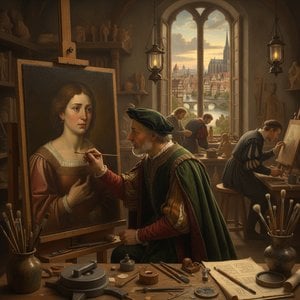
The Northern Awakening: Artistic Innovation & Cultural Transformation in the German Renaissance
Explore the artistic innovation of the German Renaissance! Discover Dürer, the Danube School & Reformation art. Learn about techniques, materials & lasting influence. Find museum-quality reproductions at ArtsDot.

Albert Kretschmer: Capturing 19th-Century Costume & the Seeds of Expressionism
Explore the exquisite costume studies of Albert Kretschmer (1825-1891). Discover his detailed illustrations, influence on art history & connection to early Expressionism. Learn about collecting this remarkable artist's work.

German Expressionism's 10 Defining Masterpieces | Art for Your Home
Explore 10 defining German Expressionism masterpieces – from Munch's 'The Scream' to Kandinsky’s abstracts. Discover the artists, stories & bold colors behind this powerful art movement. Find museum-quality reproductions at ArtsDot.com.