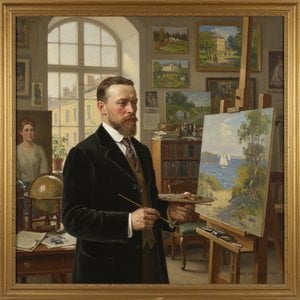
The Life and Training of Yngve Bäck
Born in the Finnish town of Vasa on November 21, 1904, Yngve Bäck began a life that would eventually lead him far from his northern roots. His early years in Finland provided the foundation for a career defined by a deep connection to the European tradition. He was a man of steady purpose, seeking out the light and the lessons of the great art capitals to refine his vision.
Paris became a recurring home for his development, acting as a guiding force through three distinct chapters of his life. He first arrived in the French capital between 1925 and 1926, a period of youthful discovery. Later, he returned for a much longer residency from 1933 to 1939, immersing himself in the atmosphere of the city during a transformative era. His final significant period of study in Paris took place much later, between 1957 and 1958, showing a lifelong commitment to his craft.
Throughout his years of study and practice, Bäck remained a significant figure within the Finnish art scene. He was a member of the Prisma artist group, a collective that sought to promote international modernism within his homeland. This involvement placed him alongside other notable figures of the time, as he worked to bring a sense of clarity and reflection to his paintings. He lived until July 30, 1990, passing away in Helsinki, Finland.
Artistic Style and Technique
Bäck’s brushwork often sought a sense of fragmentation, breaking the world into pieces that felt both light and airy. He favored a palette of pale, luminous colors that seemed to catch the light of a quiet afternoon. This approach was not a matter of mere whim, but a deliberate stance taken alongside his peers in the Prisma artist group. Within that circle, he helped articulate a rejection of the mystical and the purely emotion-driven. Instead of letting raw feeling dictate the hand, he pursued a clarity born from deep reflection and careful thought.
There was a certain grace in how he approached the mundane. He possessed a rare ability to take the most trivial, everyday scenes and transform them into something of decorative beauty. A simple moment between figures or a quiet interior was stripped of its heaviness, leaving behind a composition that felt balanced and intentional. His work did not rely on grand drama, but rather on the quiet elegance of form and the subtle interplay of light.
- Kontordamer
- Melody of War
Notable Artworks and Collections
The artist’s hand found expression in many forms, often turning the mundane into something of decorative beauty. In his painting Kontordamer, he captured a quiet, almost mysterious moment between two women. One figure appears as a white silhouette while the other is rendered in black, leaving the viewer to wonder about the nature of their interaction. This ability to transform the trivial into something visually compelling defined much of his output.
His personal reflections often appeared on the canvas, most notably in a Self-portrait from about 1946. This oil on canvas work is held within the Pro Artibus Foundation’s collection, offering a glimpse into the man behind the brush. During the darker years of 1944, he produced Melody of War, a work that emerged from the specific tensions of that era.
- Self-portrait, about 1946
- Melody of War, 1944
- Kontordamer
Q&A
Yngve Bäck 작가의 작품 관련 통계 정보는 어디에서 확인할 수 있나요?
이 사이트에서 Yngve Bäck의 작품에 관한 통계를 확인할 수 있는 방문 통계 페이지를 만나보세요.
Yngve Bäck의 작품을 연도순으로 어디에서 볼 수 있나요?
Yngve Bäck의 작품을 연도별로 정리하여 보여주는 작품 연대기 페이지입니다.
Yngve Bäck의 출생지와 출생 연도는 어떻게 되나요?
Yngve Bäck은(는) 1904년 Vaasa에서 태어났습니다.
미술 사조별로 분류된 Yngve Bäck의 작품은 어디에서 볼 수 있나요?
모든 미술 사조 페이지에서는 Yngve Bäck의 작품을 예술 사조별로 모아 볼 수 있습니다.