A Taoist Vision in Ink: The Life and Art of Wu Boli
Wu Boli, a name resonating with the quiet power of 14th-century China, stands as a compelling figure bridging the realms of religious devotion and artistic expression. Born in Beijing during a period of dynastic transition—the waning years of the Yuan dynasty and the dawn of the Ming—Wu Boli was not merely a painter but a Taoist priest deeply immersed in the spiritual currents of his time. His life, though shrouded in some historical distance, reveals a dedicated practitioner of the Shangqing school of Taoism, centered on Dragon Tiger Mountain in Jiangxi province. He wasn’t an isolated artist toiling in solitude; rather, he was a close disciple of Fang Congyi, a pivotal figure in revitalizing and codifying Taoist practices during this era. This connection profoundly shaped Wu Boli's artistic output, imbuing it with the philosophical underpinnings of longevity, harmony with nature, and the pursuit of *the Way*—Tao itself.
The Spiritual Foundation of Artistic Practice
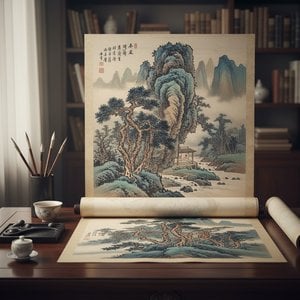
Wu Boli’s art wasn’t conceived as independent aesthetic creation but as an extension of his Taoist faith. He served at the Shangqing Temple, a significant center for alchemical studies and ritual practices. This environment fostered a unique worldview where observation of nature was not simply visual appreciation but a means to understand cosmic principles. The artist's dedication is beautifully exemplified in his most celebrated work, ‘Dragon Pine,’ commissioned by Zhang Yuchu, the forty-third patriarch of the Orthodox Unity School of Complete Perfection. This painting wasn’t merely a portrait of a tree; it was a visual embodiment of spiritual aspiration. The pine, revered for its resilience and evergreen nature, became a potent symbol of longevity—a core tenet of Taoist belief. The dragon, interwoven with the branches, represented power, transformation, and connection to the divine. The very act of painting, for Wu Boli, was likely considered a meditative practice, a way to channel *qi* (vital energy) into the artwork and imbue it with auspicious qualities.
Technique and Symbolism in ‘Dragon Pine’
‘Dragon Pine’ is a masterful example of Chinese nature imagery, executed with remarkable skill and subtlety. The painting eschews overly elaborate detail, instead focusing on capturing the essence of the pine's strength and vitality through expressive brushwork and carefully considered composition. The gnarled branches reach upwards, seemingly defying gravity, while the roots delve deep into the earth, symbolizing grounding and stability. The dragon itself is not depicted as a fearsome beast but as an integral part of the natural world, coiling around the tree in a harmonious embrace. This integration highlights the Taoist principle of interconnectedness—the idea that all things are fundamentally linked and interdependent. The use of ink washes creates a sense of depth and atmosphere, drawing the viewer into the scene and inviting contemplation. The painting’s power lies not just in its technical brilliance but in its ability to evoke a profound sense of peace and reverence for nature's enduring spirit.
Legacy and Historical Significance
While details about Wu Boli’s life remain scarce, his impact on Chinese art is undeniable. ‘Dragon Pine’ stands as a testament to the power of combining artistic skill with spiritual devotion. It exemplifies how Taoist philosophy could be translated into visual form, offering viewers a glimpse into the worldview of 14th-century China. His work represents a continuation of the literati painting tradition—emphasizing self-expression and philosophical contemplation—but infused with the unique perspective of a dedicated Taoist priest. Wu Boli’s art serves as a reminder that artistic creation can be more than just aesthetic beauty; it can be a powerful vehicle for spiritual exploration and a celebration of life's enduring mysteries. He remains a significant figure in understanding the intersection of religion, philosophy, and art within the rich tapestry of Chinese cultural history.
Explore the captivating world of Pu Xinyu (Puru), the last great literati painter. Discover his imperial heritage, masterful ink wash techniques & enduring legacy – a valuable addition to any discerning art collection.
Immerse yourself in the profound emotion of Rogier van der Weyden’s greatest works. From Northern Renaissance mastery to exquisite textures, explore 25 iconic Flemish paintings and find museum-quality reproductions for your collection. Discover all masterpieces on ArtsDot.com.