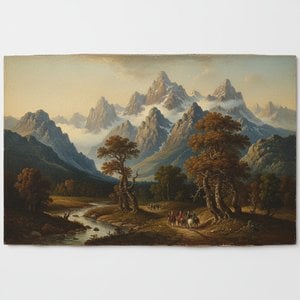
The Forest and the Academy
Before he ever held a brush to canvas, Willibald Wex walked the rugged paths of the German landscape as a forester. This early life among the trees and the quiet rhythms of the woods deeply informed his later vision. He possessed a natural understanding of the terrain, a knowledge born of physical presence within the wild. This intimate connection to nature eventually led him away from the woods and toward the formal discipline of the Royal Academy of Arts in Munich. There, under the guidance of Richard Zimmermann, he began to translate his observations of the natural world into the language of fine art.
His training in Munich provided the technical foundation necessary to capture the immense scale of the mountains. After completing his studies in 1858, he remained in the city, establishing himself within the local artistic community. He became a regular presence in the Munich Art Association and the Munich Glass Palace, where his works were displayed to the public. His life was deeply rooted in the Bavarian landscape, a fact reflected in the subjects he chose to immortalize on canvas.
The Alpine Vision
Wex found his true calling in the depiction of the Alps. His paintings often sought to capture the specific character of the mountains, from the jagged peaks to the quiet valleys. His work is characterized by a focus on the dramatic interplay of light and stone, seeking to render the physical reality of the high altitudes with precision. His son, Adalbert Wex, would also follow a path in painting, continuing a family legacy of visual expression.
His catalog includes several notable depictions of these mountain regions, including:
- Konigsee, painted in 1873
- Felsige Gebirgslandschaft
- Landscape: Karlstein Reichenhall
A Legacy of Landscape
The works of Willibald Wex remain tied to the specific geography of his home. His ability to translate the ruggedness of the mountains into a structured composition allowed him to capture the essence of the Bavarian wilderness. Through his eyes, the mountains were not merely background scenery but the primary protagonists of his compositions. His contribution to the tradition of German landscape painting lies in this dedicated observation of the Alpine terrain.
Q&A
Willibald Wex은(는) 어느 시대의 작품을 남겼나요?
Willibald Wex은(는) 19th Century 시대에 활동했습니다. 이 시기는 역사적 맥락 속에서 작가의 예술적 위치를 보여줍니다.
Willibald Wex 작가의 작품 관련 통계 정보는 어디에서 확인할 수 있나요?
Willibald Wex의 방문 통계 페이지에서는 이 사이트에 등록된 작가의 작품들을 바탕으로 산출된 통계 정보를 제공합니다.
미술 사조별로 분류된 Willibald Wex의 작품은 어디에서 볼 수 있나요?
Willibald Wex 작가의 작품을 예술 사조별로 모아둔 모든 미술 사조 페이지에서 해당 작가가 활동했던 사조를 확인하실 수 있습니다.
Willibald Wex 작가의 국적은 어디인가요?
Willibald Wex은(는) Germany 출신입니다.