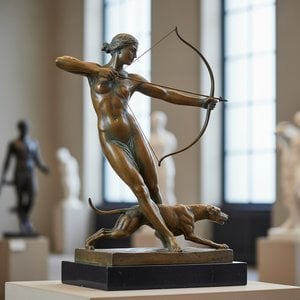
Early Life and Education
William Zorach, born Zorach Gorfinkel on February 28, 1889, in Jurbarkas, Lithuania (then part of the Russian Empire), was the eighth of ten children. His family emigrated to Cleveland, Ohio, in 1894. The Zorachs faced poverty and discrimination upon arrival in America. William left school after the seventh grade to support his family, working as a lithographer's apprentice. He later pursued artistic training at the Cleveland School of Art from 1905 to 1907, studying drawing and painting. In 1908, he moved to New York City and enrolled in the National Academy of Design. A pivotal moment arrived in 1910 when Zorach traveled to Paris, where he met Marguerite Thompson, who would become his wife and a fellow artist.Artistic Development and Influences
While in Paris, Zorach encountered European modern art movements like Fauvism and Cubism, significantly influencing his artistic direction. He exhibited at the Salon d’Automne, gaining early recognition. His return to America in 1912 coincided with the groundbreaking Armory Show of 1913, which introduced his work to a wider American audience. Zorach's paintings during this period reflected his embrace of these modernist styles. However, by 1922, he shifted his focus from painting to sculpture, a medium in which he would achieve lasting recognition. He pioneered the technique of direct carving, working directly with stone boulders and other materials without preliminary models. His sculptural style drew inspiration from Egyptian, Greek, and primitive art forms.Major Works and Artistic Style
Zorach's sculptures are characterized by their simplified geometric forms, expressive qualities, and depictions of family members, pets, and portraits. Notable works include *Spirit of Dance* for Radio City Music Hall, a large-scale bronze sculpture that exemplifies his ability to convey movement and emotion. His watercolors, often depicting the Maine coast where he lived, showcase his sensitivity to light, color, and atmosphere. Zorach's artistic style is marked by a directness and spontaneity in carving, emphasizing sculptural values while exploring themes of love, strength, and inner peace. He frequently used granite boulders, finding inspiration in their natural patterns and colors.Recognition and Legacy
Throughout his career, William Zorach received numerous accolades and commissions. In 1927, he was awarded the Logan Medal of the Arts. He became a member of the American Academy of Arts and Letters in 1953. For thirty-three years, he taught sculpture at the Art Students League of New York. His works are held in prestigious collections worldwide, including the Smithsonian American Art Museum, the Metropolitan Museum of Art, and the Brooklyn Museum. Zorach's legacy lies in his pioneering role in introducing European modernism to America, his innovative direct carving technique, and his ability to create emotionally resonant sculptures that celebrate human connection and the beauty of the natural world. He died on November 15, 1966, leaving behind a significant body of work that continues to inspire artists and art enthusiasts today.질의응답
William Zorach은(는) 어느 시대에 활동했나요?
William Zorach은(는) Modern 시대에 활동했습니다. 이 시기는 역사적 맥락에서 작가의 활동 위치를 보여줍니다.
William Zorach 작가 작품의 컬러 프로필은 어디에서 확인할 수 있나요?
본 웹사이트에 등록된 작품 전반에 나타나는 William Zorach의 색채 활용은 작가의 팔레트 지놈 페이지에서 확인하실 수 있습니다.
미술 사조별로 분류된 William Zorach의 작품은 어디에서 볼 수 있나요?
William Zorach 작가가 활동했던 예술 사조는 작품을 사조별로 분류하여 보여주는 작가의 모든 사조 페이지에서 확인하실 수 있습니다.