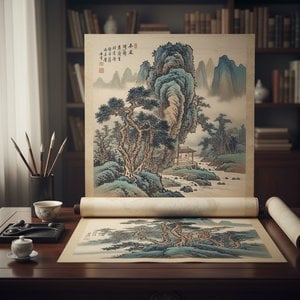
Wang Yuanqi: A Master of Qing Dynasty Landscape
Early Life and Education
- Wang Yuanqi (王原祁) was born in 1642 in Taicang, Jiangsu province, China.
- He came from a family with a strong artistic tradition; his grandfather, Wang Shimin, was a renowned painter of the early Qing dynasty.
- Yuanqi received rigorous training in painting from his grandfather, laying the foundation for his future artistic endeavors.
- His style name was 'Mao-ching' and his sobriquet was 'Lu-t’ai'.
Career as a Court Official
- Wang Yuanqi rose to prominence as a court official during the Qing dynasty, beginning shortly after its establishment in 1644.
- He served with distinction and was eventually appointed curator of the imperial collection under the Kangxi Emperor.
- This position granted him access to a vast array of artworks, further enriching his artistic knowledge and influencing his style.
- He remained a court official throughout his long career, balancing administrative duties with his passion for painting until his death in 1715 at age 73.
Artistic Style and Influences
- Wang Yuanqi is considered one of the “Six Masters of the early Qing period,” also known as the ‘Four Wangs, a Wu and a Yun’.
- He was a leading figure in the 'Orthodox School' (正统派) of Chinese landscape painting.
- His landscapes drew inspiration from Yuan dynasty artists who moved away from the highly realistic depictions favored during the Northern Song period.
- A key influence on his work was Huang Gongwang, particularly in the use of dry brush strokes, ink washes, and a sophisticated approach to color.
- He skillfully integrated color patterns into his compositions, complementing abstract designs with rhythmic color flows.
Major Works and Achievements
- Notable works include Landscape in the Style of Huang Gongwang (1711), currently held in Singapore’s Asian Civilisations Museum.
- His rendition of Wang Wei's eighth-century hand scroll, The Wang River Villa, is housed in the Metropolitan Museum of Art, New York City.
- Other significant paintings include “The Fuchun Mountains”, “Landscape for Zhanting” and numerous landscapes after the Four Great Yuan Masters.
- He excelled at recreating the styles of earlier masters while imbuing his works with a unique personal touch.
Historical Significance
- Wang Yuanqi played a crucial role in shaping the development of Chinese landscape painting during the Qing dynasty.
- His adherence to and refinement of the Orthodox School established a standard for generations of artists.
- He helped preserve and promote traditional artistic values while also demonstrating innovative techniques in composition and color usage.
- His work continues to be celebrated for its technical mastery, aesthetic beauty, and historical importance within the context of Chinese art history.
Q&A
주제별로 Wang Yuanqi의 작품을 찾아볼 수 있나요?
Wang Yuanqi의 주제별 작품 모음는 작가의 작품들을 주제별로 찾아볼 수 있는 페이지입니다.
Wang Yuanqi은(는) 어느 시대의 작품을 남겼나요?
Wang Yuanqi은(는) Early Modern 시대에 활동했습니다. 이 시기는 역사적 맥락 속에서 작가의 예술적 위치를 보여줍니다.
Wang Yuanqi의 활동 시기는 어떻게 구분되어 있나요?
Wang Yuanqi의 예술적 여정은 연대기 페이지에서 시기별로 펼쳐집니다. 이곳에서는 작가의 활동 시기를 장(chapter)으로 나누어 작품들을 연대순 타임라인 형태로 한눈에 확인할 수 있습니다.