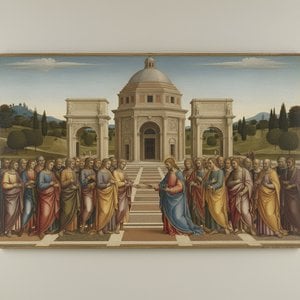
The Neapolitan Master of Narrative and Light
In the vibrant, sun-drenched landscape of nineteenth-century Italy, few artists captured the dramatic essence of history and the intimate nuances of daily life as skillfully as Vincenzo Pasquale Angelo Petrocelli. Born on July 6, 1823, in Cervaro, within the then-thriving Kingdom of the Two Sicilies, Petrocelli emerged from a lineage of talent that would deeply influence the Neapolitan art scene. His early years were marked by a profound connection to the academic traditions of his homeland, a journey that began in earnest when he entered the Reale Istituto di Belle Arti in Naples. Under the tutelage of the legendary Domenico Morelli, Petrocelli did not merely learn to paint; he learned to breathe life into canvas, mastering the art of the "Old Masters" through meticulous copying and a deep reverence for classical composition.
Petrocelli’s artistic evolution was a masterful dance between the grandiosity of history painting and the tender observation of genre scenes. His debut at the Royal Bourbon Exhibition in 1839 signaled the arrival of a significant new voice, one capable of navigating the complex emotional landscapes of historical tragedy and romanticism. As his career progressed through the mid-century, he became renowned for works that blended academic precision with a burgeoning Romantic sensibility. Whether depicting the solemnity of The Death of Galeazzo Sforza or the lively, anecdotal charm of his later genre pieces, Petrocelli possessed a rare technical dexterity. His compositions were so refined and his command of light so convincing that one of his works was even famously mistaken for a masterpiece by Rubens during an auction in Milan.
A Legacy Written in Fresco and Oil
The breadth of Petrocelli’s contribution to the Neapolitan school extends far beyond the confines of portable canvases. His talent for large-scale storytelling led him to significant commissions, most notably his involvement in the creation of breathtaking frescoes for the Temple of St. Francis in Gaeta. Though this monumental project remained unfinished, the ambition behind it speaks to his status as a premier painter of his era, entrusted with sacred spaces and historical narratives. His presence in the art world was marked by consistent excellence, evidenced by his regular contributions to the "Society for the Peopling of the Fine Arts" and his prestigious recognition as a Knight of the Order of the Crown of Italy in 1868.
Beyond his individual achievements, Petrocelli’s influence permeated his family and his pupils. His sons, Achille and Arturo, followed in his footsteps, becoming accomplished genre painters in their own right, thereby ensuring the continuity of his stylistic legacy. Even the sculptor Vincenzo Gemito honored him with a terracotta bust, a testament to the deep respect he commanded among his contemporaries. As he moved through the later decades of his life, exhibiting in major art hubs like Genoa and Milan, Petrocelli remained a steadfast pillar of the Neapolitan tradition. When he passed away in Naples on February 2, 1896, he left behind a body of work that serves as a window into the soul of nineteenth-century Italy—a period defined by the tension between classical heritage and the unfolding modern world.
Q&A
Vincenzo Petrocelli의 출생 도시와 국가는 어디인가요?
Vincenzo Petrocelli은(는) Italy Cervaro에서 태어났습니다.
Vincenzo Petrocelli의 다른 이름이나 별칭에는 무엇이 있나요?
Vincenzo Petrocelli은(는) Vincenzo Pasquale Angelo Petrocelli, V. Petroccelli, V. Petrocelli, Vincenzo Petroccelli, فينسينزو بتروتشيلي(으)로도 알려져 있습니다.
Vincenzo Petrocelli의 작품 전체 목록을 볼 수 있는 곳이 있나요?
이 사이트에 등록된 Vincenzo Petrocelli의 모든 작품은 작가의 전체 작품 보기 페이지에서 만나보실 수 있습니다.