The Life and Works of Viktor Karrus
Born in 1913, Viktor Karrus lived through a transformative era for Estonia, leaving behind a body of work that reflects the shifting tides of his time. His life spanned much of the twentieth century, concluding in 1991. Through his brush, he sought to capture the essence of the landscapes and scenes that surrounded him, often working with oil on canvas to give his subjects a sense of weight and presence.
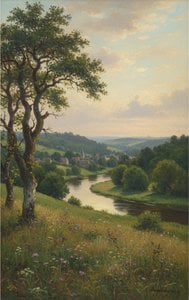
The years of his activity saw him navigating a complex cultural landscape. In 1955, he completed View of Moscow, a work that placed his perspective within a broader geopolitical context. His hand was equally steady when he turned his attention to the quietude of the morning; his 1957 oil painting, Hommik, captures a specific stillness, depicting a clearing framed by trees where red leaves rest in the foreground and rooftops peek through the branches in the distance.
Karrus moved between the grand and the intimate. While some of his compositions reached toward the monumental, others remained focused on the simple arrangement of objects or the subtle play of light on a water surface. He remained an active presence in the Estonian art scene until his death, leaving a legacy of painted observations that endure in various collections.
Notable Paintings and Artistic Subjects
Karrus found much of his inspiration in the quietude of everyday life and the shifting light of the Estonian landscape. In his 1963 work Natüürmort, he turned his attention to the stillness of a tabletop, arranging two vases filled with carnations alongside a blue plate, glassware, fruit, and a book. This study of domestic objects reveals a mind attuned to the subtle textures of the immediate world. He also captured the essence of movement and transit in On one's way home, a piece that reflects the simple, human rhythms of returning to one's place of rest.
The natural world offered him a broader canvas, where he sought to capture the specific character of the land. His 1976 painting Vääna maastik presents a view of a bay, where the artist focused on the interplay of tree crowns and pine needles in the foreground. This sense of place extended to the maritime atmosphere found in Sadamas, produced in 1973. In this work, he rendered the glassy, reflective surface of the water, where fishing boats and a white, mastless yacht rest near the silhouettes of factory chimneys.
- View of Moscow (1955)
- Hommik (1957)
Techniques and Visual Styles
In the quiet application of his craft, Karrus sought to capture the essence of the Estonian landscape through the medium of oil, often working upon board to achieve his desired textures. His hand moved with a certain deliberate freedom, sometimes employing an archaic handling that lent his compositions a sense of weight and history. This was particularly evident in his work Sadamas, where he utilized a wide brushstroke to build the scene. In that particular piece, he achieved a surface of water so transparent and mirror-smooth that it seemed to hold the very stillness of the harbor.
His approach to light and perspective allowed him to render the natural world with a keen, observant eye. When he turned his attention to the coast, as seen in Vääna maastik, he painted with a vivid and skillful view of the bay, capturing the interplay of light across the water and the surrounding greenery. There is a sense of careful observation in how he placed his subjects, whether they were the sprawling reaches of a landscape or the more intimate arrangements of a still life. He did not merely record what he saw; he sought to translate the atmosphere of a place into the physical language of paint.
Where to See the Works Today
Those who seek to encounter the physical presence of his brushwork may find much of his legacy preserved within the Estonian Art Museum. This institution serves as a primary guardian for his visual history, housing several significant pieces that allow the viewer to witness his hand. Within its walls, one can find the still life known as Natüürmort, a work that captures a quiet arrangement of objects. The museum also holds his landscape Vääna maastik, where the play of light upon the trees and needles reveals his specific way of seeing the natural world.
The collection further preserves the atmosphere of his compositions through works like Hommik. This piece, which depicts a clearing framed by trees and the distant outlines of houses, remains part of the museum's permanent holdings. Nearby, the maritime scenes of his imagination are kept safe, specifically the painting titled Sadamas. In this work, the artist sought to render the glassy surface of the water and the silhouettes of ships and factory chimneys with a particular, deliberate touch. Through these various holdings, the Estonian Art Museum maintains the continuity of his artistic presence for those who visit Tallinn.
Q&A
Viktor Karrus의 작품 중 몇 점을 둘러보실 수 있나요?
전체 작품 보기 페이지에서 Viktor Karrus의 작품 작품 19점점을 만나보실 수 있습니다.
Viktor Karrus의 전 작품에 걸친 색채 활용을 살펴볼 수 있을까요?
Viktor Karrus 작가 작품의 컬러 프로필은 작가의 팔레트 지놈 페이지에서 확인하실 수 있습니다.
특정 매체로 분류된 Viktor Karrus의 모든 작품을 어떻게 찾을 수 있나요?
Viktor Karrus의 작품은 작가 페이지인 모든 매체별에서 매체별로 둘러보실 수 있습니다.
Viktor Karrus의 예술 세계는 시간이 흐름에 따라 어떻게 진화했나요?
Viktor Karrus의 예술적 여정은 연대기 페이지에서 시기별로 펼쳐집니다. 이곳에서는 작가의 활동 시기를 장(chapter)으로 나누어 작품들을 연대순 타임라인 형태로 한눈에 확인할 수 있습니다.