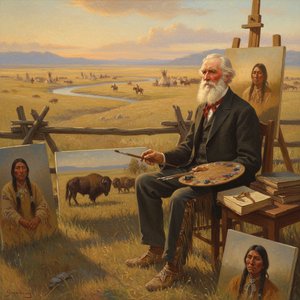
The Soul of the Southwest: The Artistic Journey of Victor Higgins
To wander through the canvases of William Victor Higgins is to embark on a spiritual pilgrimage across the rugged, sun-drenched landscapes of the American Southwest. A pivotal figure in the evolution of American Impressionism, Higgins possessed a rare ability to translate the raw, geological grandeur of New Mexico into a visual language that was both deeply personal and profoundly symbolic. Born in 1884, his artistic sensibilities were forged far from the mesas of Taos, beginning with formal training at the Pratt Institute in Brooklyn and later refined amidst the vibrant, cosmopolitan energy of Chicago. His early years were marked by a rigorous pursuit of technical mastery, yet even in these formative stages, one can detect a burgeoning desire to move beyond mere representation toward a more emotive, psychological depth.
The trajectory of Higgins’s career was irrevocably altered by his exposure to the European masters. During his time in Paris, he studied under luminaries such as Robert Henri, René Menary, and Lucien Simon, absorbing the lessons of light, color, and movement that defined the Impressionist movement. From Claude Monet and Camille Pissarro, he learned the art of capturing fleeting atmospheric shifts; however, Higgins was never content with simple optical observation. He sought to infuse his work with a sense of permanence and weight, a pursuit that would eventually lead him away from the delicate textures of French Impressionism toward a more robust, expressive style that resonated with the ancient, enduring spirit of the American West.
A Convergence of Culture and Color in Taos
In 1913, Higgins made the transformative decision to relocate to Taos, New Mexico, a move that would define his legacy. By joining the prestigious Taos Society of Artists, he found himself immersed in a landscape and a culture that demanded a new kind of visual vocabulary. The arid beauty of the mesas, the deep shadows of the canyons, and the vibrant presence of Native American traditions provided him with an inexhaustible well of inspiration. His work began to evolve, blending the fluid brushwork of his European training with the structured, symbolic iconography of the Navajo and Pueblo peoples. This period marked his transition from a painter of light to a painter of substance, where every stroke of oil served to communicate the profound relationship between humanity and the natural world.
Higgins’s mastery was particularly evident in his ability to balance the monumental with the intimate. While he is celebrated for his sweeping landscapes—such as his evocative moonrise scenes that blend nature with human innovation—he was equally adept at capturing the quiet dignity of the human spirit. His portraits, particularly those of Native American women and African Americans, are characterized by an empathetic gaze and a respectful rendering of character. Through his use of warm earth tones, textured brushwork, and a sophisticated command of tonal gradation, he elevated his subjects, imbuing them with a sense of timelessness and grace that transcended the boundaries of mere portraiture.
Legacy and Artistic Significance
The historical significance of Victor Higgins lies in his role as a bridge between traditions. He successfully synthesized the fleeting light of Impressionism with the bold, structural elements of Expressionism and Neue Sachlichkeit. His later works often displayed a more modern, almost sculptural quality, utilizing vibrant colors and heavy textures to create compositions that felt both ancient and avant-garde. This versatility allowed him to remain relevant as the art world shifted through the early 20th century, moving from the romanticism of the Taos pioneers to a more stylized, symbolic approach.
Beyond his individual canvases, Higgins contributed significantly to the cultural fabric of the American West. His involvement in the founding of the Harwood Foundation and his commissioned works, such as the mural Moises, El Legislador for the Taos County Courthouse, demonstrate his commitment to the community that inspired him. Today, the works of Victor Higgins remain essential touchstones for anyone seeking to understand the American West—not merely as a geographic location, but as a profound psychological landscape where light, earth, and human dignity converge in an eternal dance of color.
Q&A
Victor Higgins은(는) 어느 시대의 작품을 남겼나요?
Victor Higgins은(는) Modern 시대에 활동했습니다. 이 시기는 역사적 맥락 속에서 작가의 예술적 위치를 보여줍니다.
Victor Higgins의 작품은 얼마나 인기가 있나요?
이 사이트에서 Victor Higgins의 작품에 관한 통계를 확인할 수 있는 방문 통계 페이지를 만나보세요.
Victor Higgins의 작품을 분위기별로 찾아볼 수 있나요?
아티스트의 무드 룸 페이지에서는 Victor Higgins의 작품들을 분위기에 따라 큐레이션된 형태로 만나보실 수 있습니다.