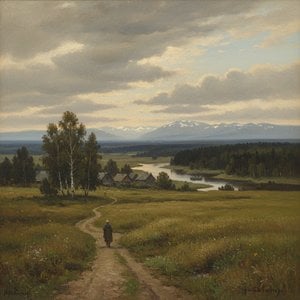
The Alpine Soul of Bohinj
The air in Stari Fužini carries a specific weight, a stillness that defined the early years of Valentin Hodnik. Born on 18 February 1896, he grew up in the shadow of the mountains that would eventually dominate his visual language. He was a man of many hands—a painter, an illustrator, and a sculptor—whose work sought to capture the rugged essence of the Slovenian landscape. His output was prolific, a body of approximately 230 works that moved between the heavy presence of oil on canvas and the delicate precision of watercolors and drawings.
His gaze often turned toward the peaks. In his depictions of mountain landscapes and winter scenes, there is a sense of the cold, quiet permanence of the terrain. He did not merely observe the mountains; he lived among them, becoming a co-founder of the Bohinj branch of the Tourist Club "Skala." This connection to the land was more than professional; it was foundational. He even designed the club's emblem, a small but significant mark featuring a mountain peak.
A Dual Vision of Nature and Humor
There is a tension in Hodnik’s repertoire between the solemnity of the landscape and the lightness of human interaction. While he captured the starkness of winter, he also found a different rhythm in the creation of humorous postcards. These illustrations reflected the burgeoning winter-sports tourism of the pre-war era, showing a side of the region that was less about the eternal stone and more about the fleeting, joyful movements of people. This duality allowed him to navigate both the serious demands of fine art and the popular, communicative art of the postcard.
His technical range allowed him to tackle various subjects with distinct methods:
- Oil on canvas: Used for substantial works like his depiction of Triglav.
- Watercolors and drawings: Employed for more fluid, immediate expressions of his surroundings.
- Sculpture: A dimension of his artistry that speaks to his understanding of form and volume.
The Final Landscape
The trajectory of his life remained closely tied to the geography of his birth. He remained a fixture of the Bohinj region until his death on 6 December 1935. His legacy is found in the quiet corners of private collections and in the visual history of the Slovenian mountains. He remains a figure of the landscape, an artist whose work is inseparable from the high, snowy ridges and the human life that unfolds beneath them.
Q&A
Valentin Hodnik 작가 작품의 컬러 프로필은 어디에서 확인할 수 있나요?
이 사이트에 등록된 작품 전반에 나타나는 Valentin Hodnik의 색채 활용은 작가의 팔레트 지놈 페이지에서 자세히 살펴보실 수 있습니다.
Valentin Hodnik의 작품을 색상별로 모아둔 곳은 어디인가요?
Valentin Hodnik의 작품은 작가의 컬러 인덱스 페이지에서 색상별로 감상하실 수 있습니다.
특정 색상 팔레트의 Valentin Hodnik 작품은 어디에서 찾아볼 수 있나요?
특정 색상 팔레트의 Valentin Hodnik 작품을 찾으시려면, 작가의 컬러 팔레트별로 보기 페이지를 이용해 보세요.
Valentin Hodnik의 활동 시기는 어떻게 구분되어 있나요?
Valentin Hodnik의 예술적 여정은 연대기 페이지에서 시기별로 펼쳐집니다. 이곳에서는 작가의 활동 시기를 장(chapter)으로 나누어 작품들을 연대순 타임라인 형태로 한눈에 확인할 수 있습니다.