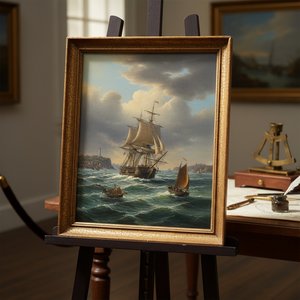
The Maritime Soul of Thomas Dove
Thomas Dove’s paintings, primarily depicting the bustling harbors and treacherous seas of 19th-century Liverpool Bay and beyond, aren't merely records of ships; they are profound meditations on human endeavor, the relentless power of nature, and the precarious balance between ambition and fate. Born in 1811, Dove emerged during a period of immense maritime expansion – the height of the Industrial Revolution’s impact on global trade – and his art reflects this era's dynamism and anxieties with remarkable sensitivity. His career spanned nearly seven decades, witnessing significant shifts in shipbuilding technology, naval strategy, and the very perception of the sea itself, all meticulously rendered within his distinctive watercolor style.
Dove’s early life remains somewhat shrouded in mystery, though he was clearly influenced by the artistic traditions of his family. His father, a prominent figure in Barton-on-the-Heath, fostered an appreciation for art and craftsmanship. However, it's Dove’s connection to Bristol that truly shaped his artistic trajectory. The city’s thriving port – one of Britain’s largest – provided him with endless subject matter: towering ships battling the elements, the intricate dance of dockworkers, and the ever-present drama of coastal life. Unlike many contemporary marine artists who focused on idealized depictions of naval glory, Dove often presented a more gritty, realistic view, capturing the sweat, grime, and occasional peril inherent in maritime work. His palette leaned towards muted blues, grays, and ochres, creating an atmosphere of atmospheric depth and emphasizing the scale of his subjects – ships dwarfed by the vastness of the ocean.
A Painter of Ships and Storms
Dove’s technique is characterized by a remarkable attention to detail combined with a loose, expressive brushwork. He wasn't interested in photographic accuracy; instead, he sought to convey the *feeling* of being at sea – the dampness, the wind, the shifting light. His compositions are often dynamic and asymmetrical, reflecting the turbulent nature of his subjects. Consider “West Derby” off Egremont, Entering the Mersey,” a pivotal work showcasing his ability to capture both the grandeur of a sailing vessel and the ominous presence of an approaching storm. The ship’s silhouette is powerfully rendered against a bruised sky, conveying a sense of vulnerability amidst overwhelming forces. Similarly, "Combatant" Entering the Mersey” demonstrates his skill in depicting the chaotic energy of a naval engagement, with billowing sails and churning water creating a palpable sense of movement.
His fascination with ships extended beyond mere documentation; Dove seemed to imbue them with symbolic weight. Many scholars believe he was deeply interested in the history and mythology surrounding seafaring traditions. His paintings frequently evoke a romanticized vision of maritime adventure, hinting at tales of exploration, hardship, and heroism. The inclusion of specific ship names – such as the SS Whitehall launches – suggests a personal connection to the shipping industry and a desire to immortalize these vessels within his art.
Beyond the Canvas: A Bristolian Life
While Dove’s artistic legacy is firmly established through his paintings, little is known about his personal life. He was a prominent figure in Bristol society, involved in philanthropic endeavors and contributing to the city's cultural scene. Notably, he played a crucial role in establishing tennis and horse-racing in the Gold Coast (now Ghana), demonstrating a commitment to fostering sporting activities beyond Britain’s shores. His involvement with the Bristol Corporation of the Poor highlights his dedication to social welfare and his understanding of the challenges faced by the city's working class.
Interestingly, Dove’s background is linked to another notable figure – Thomas of Dover, a 13th-century monk who was martyred for refusing to reveal the location of valuables during a French raid. This connection suggests a shared sense of loyalty and resistance against oppression, themes that may have subtly influenced Dove's artistic perspective. Furthermore, his later involvement with privateering – specifically, his participation in the expedition that rescued Alexander Selkirk from Robinson Crusoe’s island – speaks to a spirit of adventure and a willingness to confront danger.
Legacy and Influence
Thomas Dove’s work represents a significant contribution to British maritime art. His paintings offer a unique blend of realism, romanticism, and symbolic depth, capturing the essence of a pivotal era in maritime history. While he may not be as widely celebrated as some of his contemporaries, his paintings continue to resonate with viewers today, evoking a powerful sense of nostalgia for a time when ships ruled the waves and the sea held both promise and peril. His legacy endures through the preservation of his art and the ongoing study of his life and work – a testament to the enduring power of a painter who truly understood the soul of the sea.
질의응답
Thomas Dove의 작품 중 조회수가 가장 높은 것은 무엇인가요?
Thomas Dove의 통계 페이지에서는 본 웹사이트에 등록된 작가의 작품들을 바탕으로 산출된 통계 정보를 제공합니다.
Thomas Dove가 그린 모든 주제를 한눈에 볼 수 있는 개요가 있나요?
Thomas Dove의 주제별 아틀라스는 작가의 작품들을 주제별로 분류하여 보여주는 페이지입니다.
Thomas Dove 작가의 작품을 감상할 수 있는 3D 가상 투어가 있나요?
Thomas Dove의 3D 뮤지엄는 작가의 작품들을 가상 3D 갤러리로 선보이는 페이지입니다.