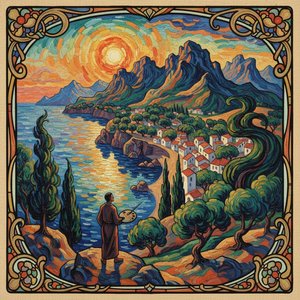
A Life Shaped by Displacement
Sopheap Pich was born in 1971 in Battambang, Cambodia. His early years were defined by the upheaval of the Khmer Rouge regime and the subsequent Vietnamese invasion, events that forced his family to flee to Thailand in 1979. For four years, he lived in refugee camps before eventually immigrating to the United States at age thirteen. These formative experiences—witnessing broken landscapes and the physical toll of war—became the quiet foundation of his later creative work. He carried with him memories of traveling vast distances on foot, a weight that would later manifest in his sculptural forms.
His formal training took place far from the Cambodian countryside, beginning in Massachusetts at the University of Massachusetts, Amherst, where he earned a BFA in 1995. He continued his studies at the School of the Art Institute of Chicago, receiving an MFA in 1999. While these years were spent mastering the techniques of painting, a different impulse began to take hold. He found himself drawn toward the tactile and the three-dimensional, seeking a way to engage more directly with the physical world.
The Return to Materiality
In 2002, Pich returned to Cambodia, a move that fundamentally altered his artistic direction. Settling in Phnom Penh, he faced the challenge of reconciling Western academic methodologies with the local realities of a country in post-war recovery. He moved away from the canvas and toward the organic materials of his childhood: bamboo, rattan, and burlap. These were not merely aesthetic choices but connections to the functional objects of Khmer rural life, such as fish traps and baskets.
His process is one of meticulous labor. He manipulates natural fibers through boiling, cutting, bending, and dyeing, treating the rigid stalks of bamboo like lines in a drawing. His sculptures often take on biomorphic shapes, echoing human anatomy or plant life. Some works resemble lungs or seed pods, specifically inspired by the endangered Beng tree. By using materials that are both sturdy and fragile, he explores the tension between the resilience of the Cambodian people and the vulnerability of their ecosystem.
His sculptural language expanded to include more complex textures and found objects:
- Rattan and Bamboo: The primary medium for his organic, open-weave forms.
- Burlap: Used in wall reliefs to create textured, abstract compositions.
- Repurposed Aluminum: Collected from recycling depots to address environmental and social themes.
- Detritus: Salvaged materials from Phnom Penh's trash heaps used to create mottled, layered structures.
Recognition and Presence
Pich’s work has moved from the local landscape of Phnom Penh to major international institutions. His sculptures have been included in collections at the Metropolitan Museum of Art, the Guggenheim Museums, and the Mori Art Museum. He was also a participant in Documenta 13 in 2012, a significant moment for his standing in contemporary art. Through exhibitions like Cambodian Rattan at the Met, his ability to bridge the gap between traditional craft and modern sculpture gained widespread attention.
Beyond his individual practice, he contributed to the development of the Cambodian art scene. In 2003, he helped establish the artist group Saklapel and later cofounded Sala Artspace in Phnom Penh. These initiatives provided spaces for residency and interdisciplinary learning for a new generation of artists. His work remains a study of memory, using the physical remnants of a specific place to address universal themes of identity and survival.
Q&A
Sopheap Pich 작가의 작품에서 가장 자주 나타나는 색상은 무엇인가요?
Sopheap Pich의 팔레트 지놈에서는 작가의 작품 세계를 구성하는 컬러 프로필을 확인하실 수 있습니다.
Sopheap Pich의 작품 중 몇 점을 둘러보실 수 있나요?
전체 작품 보기 페이지에서 Sopheap Pich의 작품 작품 2점점을 만나보실 수 있습니다.
특정 주제별로 Sopheap Pich의 작품을 어떻게 찾아볼 수 있나요?
Sopheap Pich의 작품은 아티스트의 키워드별 탐색 페이지에서 키워드별로 찾아보실 수 있습니다. 각 키워드를 통해 관련 작품들을 모아 감상하실 수 있습니다.
Sopheap Pich의 출생 도시와 국가는 어디인가요?
Sopheap Pich은(는) Cambodia Battambang에서 태어났습니다.