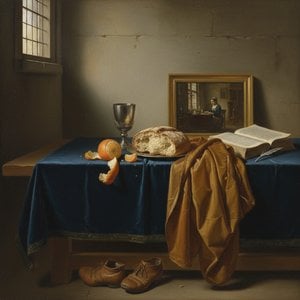
The Hague to Amsterdam
The Hague, 1873. Simon Willem Maris enters the world as the son of Willem Maris, a man already established within the landscape traditions of the Hague School. The early years are defined by the shadow of his father’s brush. He begins his training under that very same hand, learning the mechanics of paint and light through direct lineage. However, the heavy, realistic landscapes of his father do not hold him. A different pull exists elsewhere.
The path leads away from the familiar soil of The Hague toward the Royal Academy of Fine Arts in Antwerp. In 1895, he enrolls there, following a family pattern established by his uncles, Matthijs and Jacob. This period in Belgium introduces a shift in his visual language. He moves through Brussels, Paris, and Italy, absorbing the light of the Mediterranean and the atmosphere of the French capital. By 1900, the transition is complete. He settles in Amsterdam.
Amsterdam becomes the center of his orbit. His studio on the Spui and his home on Keizersgracht transform into meeting points for a new generation of creators. In 1903, he travels to Spain alongside his friend Piet Mondrian. They are part of a circle that finds solace in painting along the Gein River. It is a time of shared sketches and shared meals at the De Vink restaurant.
A Refined Impressionism
The work changes. The heavy textures of the Hague School give way to a light, colorful palette. He moves toward portraiture, finding success with the fashionable women of Amsterdam society. These are not mere likenesses; they are studies in character and sunlight. He captures the texture of a silk gown or the way light hits a fan. His style settles into a refined impressionistic mode, focusing on the interplay of sun and shadow.
Personal life and professional subject matter merge. After marrying Cornelia den Breejen in 1908, his family becomes his primary muses. He paints her, along with their children Mies and Thijs, in intimate scenes of reading or motherhood. These works possess a warmth that contrasts with the formal commissions he receives from theater and university circles. Even when painting cityscapes, beach scenes, or still lifes, the focus remains on the atmosphere.
Notable works emerge from this period:
- Isabella (1906): A portrait of a young girl featuring a fan, now held in the Rijksmuseum Amsterdam.
- Portrait of Piet Mondrian (1906): A capture of his contemporary and friend.
- Lady With Cigarette (circa 1920–1930): An elegant study of a woman in a blue gown.
Legacy and the Art Trade
Beyond the easel, Maris operates as a bon vivant and an art dealer. He runs an antiques business, trading works by his contemporaries and collecting pieces that reflect his own aesthetic. His studio is a place of commerce and culture, where a client might receive a Japanese kimono or a Delft plate alongside a portrait commission. He holds leadership roles within the Amsterdam art scene, serving as president of Sint Lucas and as vice-chairman of Arti et Amicitiae.
The end comes in Amsterdam, 1935. He leaves behind a body of work that bridges the gap between the traditional Dutch realism of his father and a more modern, light-filled impressionism. His paintings reside now in the permanent collections of the Rijksmuseum Amsterdam, the Dordrechts Museum, and the Groninger Museum, marking his place in the evolution of Dutch art.
Q&A
Simon Maris의 작품 전체 목록을 볼 수 있는 곳이 있나요?
이 사이트에 등록된 Simon Maris의 모든 작품은 작가의 전체 작품 보기 페이지에서 만나보실 수 있습니다.
키워드로 Simon Maris의 작품을 찾아볼 수 있나요?
특정 주제의 Simon Maris 작품을 찾으려면 키워드별로 작품이 분류된 작가의 키워드별 탐색 페이지를 이용해 보세요.
Simon Maris 작가 작품의 컬러 프로필은 어디에서 확인할 수 있나요?
이 사이트에 등록된 작품 전반에 나타나는 Simon Maris의 색채 활용은 작가의 팔레트 지놈 페이지에서 자세히 살펴보실 수 있습니다.
Simon Maris은(는) 어느 시대의 작품을 남겼나요?
Simon Maris은(는) Modern 시대에 활동했습니다. 이 시기는 역사적 맥락 속에서 작가의 예술적 위치를 보여줍니다.