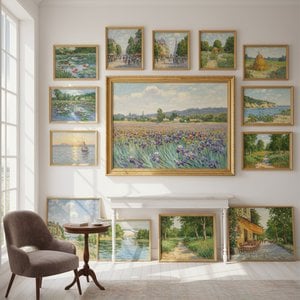
Roderic O’Conor: Bridging Impressionism and Breton Mysticism
The story of Roderic O’Conor is one of a profound artistic pilgrimage, a journey that began in the verdant landscapes of Ireland and found its spiritual destination amidst the mist-shagged coasts of Brittany. Born in 1860 in Milltown, County Roscommon, O’Conor carried with him an innate sensitivity to the natural world, a quality nurtured during his early studies at the Metropolitan School of Art and the Royal Hibernian Academy. However, it was his departure for Paris in 1887 that would irrevocably alter the course of his life and vision. In the vibrant, pulsating atmosphere of the French capital, O’Conor encountered the revolutionary light of Impressionism, a movement that taught him to see not just objects, but the very air that surrounds them, capturing the fleeting dance of sunlight and shadow with a newfound, breathless intensity.
As his artistry matured, O’Conor’s gaze drifted from the immediate sensations of light toward something more enduring and psychologically resonant. He found himself drawn to the deeper currents of Symbolism, finding inspiration in the evocative and often haunting works of masters like Gustave Moreau and Edvard Munch. This period of his life was marked by an increasing fascination with expressive imagery and a desire to imbende his canvases with a sense of mystery and internal depth. His work began to transcend mere observation, moving toward a realm where the landscape served as a mirror for the human soul, blending the external reality of the world with an internal, spiritual landscape.
The Spirit of Pont-Aven and the Breton Landscape
Perhaps the most defining chapter of O’Conor’s career was his deep immersion in the Pont-Aven School. In the rugged, atmospheric environs of Brittany, he found a sanctuary where his Impressionistic foundations could merge with the bold, simplified forms of Post-Impressionism. Alongside contemporaries such as Maurice Denis, O’Conor embraced a style heavily influenced by Paul Gauguin, characterized by a deliberate reduction of detail and a reliance on muted, earthy palettes that echoed the somber beauty of the Breton countryside. This was not an art of superficial decoration, but one of profound connection; his paintings became meditations on the landscape, utilizing atmospheric perspective to create a sense of quiet, contemplative communion with nature.
In works such as Field of Corn and The Garden, one can witness this mastery of tone and mood. He moved away from the frantic energy of early Impressionism toward a more stabilized, rhythmic composition that emphasized the permanence of the earth. His technique involved a meticulous observation of the terrain, translating the textures of stone, leaf, and soil into subtle tonal harmonies that evoke a sense of timelessness. Through this lens, the Breton landscape was transformed into a sacred space, where the boundaries between the physical world and the spiritual realm seemed to dissolve in the soft, pervasive light.
Legacy and Artistic Significance
Roderic O’Conor remains a pivotal figure in the narrative of European modernism, representing a unique bridge between the fleeting observations of the 19th century and the expressive depth of the 20th. His ability to synthesize the light-centric approach of Monet with the symbolic weight of the Pont-Aven movement allowed him to create a body of work that is both visually serene and emotionally complex. He did not merely paint what he saw; he painted the feeling of being present within the landscape, capturing the very essence of a world that feels deeply rooted in its natural splendor.
His historical significance lies in this very synthesis—the way he navigated the transition from the external focus of Impressionism to the internal exploration of Symbolism. Today, his legacy is preserved through works that continue to resonate with art lovers, offering a window into a period of intense artistic experimentation and spiritual searching. His life’s work stands as a testament to the transformative power of art, reminding us that through the careful observation of nature, one may ultimately discover the profound mysteries of the human experience.
Q&A
특정 주제별로 Roderic O'Connor의 작품을 어떻게 찾아볼 수 있나요?
특정 주제의 Roderic O'Connor 작품을 찾으려면 키워드별로 작품이 분류된 작가의 키워드별 탐색 페이지를 이용해 보세요.
Roderic O'Connor의 작품을 색상별로 모아둔 곳은 어디인가요?
Roderic O'Connor의 작품은 작가의 컬러 인덱스 페이지에서 색상별로 감상하실 수 있습니다.
Roderic O'Connor의 모든 작품을 어디에서 볼 수 있나요?
이 사이트에 등록된 Roderic O'Connor의 모든 작품은 작가의 전체 작품 보기 페이지에서 만나보실 수 있습니다.