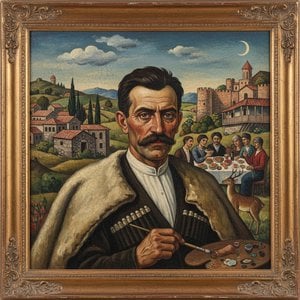
A Life Shaped by the Silver Screen
In the heart of Tbilisi, Georgia, the life of Revaz Ivanovich Mirzashvili began with a deep connection to the traditions of his homeland. Born in 1901, he grew up in an era where the visual language of Georgia was undergoing profound changes. His formal training led him to the Tbilisi Academy of Arts, from which he graduated in 1931. This education provided him with a foundation in fine arts that would later inform his work far beyond the canvas. While many remember the painters of his era, Mirzashvili found his true calling in the shadows and lights of the cinema.
His career unfolded across several decades, stretching from the 1930s into the 1980s. He did not merely paint; he built worlds. As a production designer and art director, he possessed the rare ability to translate historical Georgian aesthetics into tangible, cinematic realities. His early work in the mid-1930s on films such as Argonavtebi (Kolkheti) and First Day established his presence within the Soviet Georgian film industry. He moved from directing art for short films to designing the expansive, detailed environments required for feature-length epics.
The Art of the Costume
Mirzashvili’s most enduring contributions often resided in the very fabric of the characters he helped create. He understood that a single garment could communicate a character's social standing and history without a single word of dialogue. His work in the 1950s and 1960s showcased a meticulous attention to texture and material. He utilized heavy silks, intricate gold and silver embroidery, and dense beadwork to bring historical figures to life.
One might look at his designs for a 1959 production and see the deep crimson of a bolero, where geometric stars and floral motifs were meticulously hand-sewn into the cloth. In other works, such as the costume for the character Mahmud, he employed black fabrics contrasted with gilded trimmings to suggest weight and authority. His technical skill involved:
- The use of appliqué and intricate beadwork to create depth.
- A mastery of light through the placement of metallic threads.
- The integration of traditional Georgian folk patterns into cinematic attire.
- The careful selection of color palettes, such as deep reds and golds, to evoke specific historical moods.
A Legacy in Film and Thread
By the time he was named a People's Artist of the Georgian SSR in 1979, Mirzashvili had contributed to over thirty feature films. His filmography included significant works like Giorgi Saakadze in 1942 and later collaborations such as Natvris Khe (The Wishing Tree) in 1976. Through these projects, he helped define the visual identity of Georgian cinema during the mid-twentieth century. He worked to ensure that the settings and costumes felt grounded in a specific cultural reality, often drawing on medieval or 19th-century inspirations.
His passing in 1988 marked the end of a long period of creative activity that bridged the gap between traditional craftsmanship and modern mass media. The artifacts he left behind, now held in places like the Art Palace of Georgia - Museum of Cultural History, remain as physical remnants of the worlds he constructed. These pieces of textile art and photography serve as windows into a vanished era of filmmaking, where the designer's hand was essential to the storytelling process.
질의응답
Revaz Ivanovich Mirzashvili 작가는 어떤 사조에 참여했나요?
Revaz Ivanovich Mirzashvili 작가가 활동했던 예술 사조는 작품을 사조별로 분류하여 보여주는 작가의 모든 사조 페이지에서 확인하실 수 있습니다.
Revaz Ivanovich Mirzashvili은(는) 어느 시대에 활동했나요?
Revaz Ivanovich Mirzashvili은(는) Modern 시대에 활동했습니다. 이 시기는 역사적 맥락에서 작가의 활동 위치를 보여줍니다.
특정 팔레트의 Revaz Ivanovich Mirzashvili 작품은 어떻게 찾을 수 있나요?
Revaz Ivanovich Mirzashvili의 작품은 작가의 컬러 팔레트별 페이지에서 컬러 팔레트별로 둘러보실 수 있습니다.