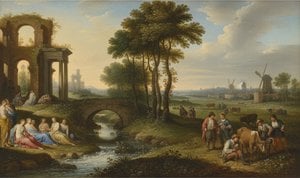
A Legacy of Light and Landscape
Born into a distinguished lineage of Dutch talent in The Hague, Pieter Gerardus van Os emerged as a vital figure in the continuation of the Netherlandish tradition. As the son of Jan van Os, his artistic journey was deeply rooted in the familial workshop, where the nuances of light and form were passed down through generations. His early education at the Tekenakademie in The Hague provided him with a rigorous foundation, yet it was his intimate study under his father that truly shaped his eye for detail. During these formative years, he found profound inspiration in the works of masters like Paulus Potter and Charles Dujardin, meticulously copying their compositions to master the art of capturing the natural world.
The early triumphs of his career were marked by a remarkable ability to breathe life into animal subjects. His talent was so pronounced that a copy of a work by Potter, titled Young Bull, earned the admiration of William V, Prince of Orange. This early recognition set the stage for a career defined by a deep affection for the pastoral and the animate. While he initially supported himself in Amsterdam through portrait miniatures and drawing lessons, his artistic soul truly found its voice around 1805, when he began to dedicate himself to expansive landscape paintings. These works, often populated by his favorite subject of cattle, reflected a profound reverence for the 17th-century Dutch masters, blending classical influence with a fresh, contemporary sensibility.
Mastery of the Pastoral and the Military
The evolution of Van Os's oeuvre is a fascinating study in shifting perspectives. While he is most celebrated for his serene landscapes, his life was not without periods of intense drama and movement. His experiences as a captain of volunteers during the turbulent years of 1813 and 1814 introduced a new dimension to his artistry. The grit and energy of military engagements left an indelible mark on his brush, leading him to explore military themes with a precision that caught the attention of international royalty. It is a testament to his skill that Emperor Alexander I of Russia sought out his work, placing a painting of this theme within the grand halls of his palace in St. Petersburg.
His technical prowess was not limited to the oil medium; he was also a gifted engraver and etcher, capable of translating the soft textures of a meadow or the heavy musculature of a beast into the stark, precise lines of printmaking. Whether rendering a monochromatic etching of a quiet wood or a vibrant scene of cattle by a lake, his work consistently achieved a sense of atmospheric depth. His achievements were formally recognized by the Royal Institute of the Netherlands, where he became a fourth-class member in 1820, cementing his status among the elite of his era.
An Enduring Artistic Lineage
The significance of Pieter Gerardus van Os extends far beyond his individual canvases; he was a cornerstone of a broader artistic dynasty. His influence flowed through his family, most notably through his son, Pieter Frederik van Os, who continued the tradition of landscape painting and served as a teacher to future generations of Dutch artists. The Van Os name became synonymous with a specific kind of pastoral excellence, characterized by:
- The Pastoral Tradition: A profound connection to the Dutch landscape, specifically focusing on cattle, sheep, and the tranquil rhythms of rural life.
- Classical Influence: A sophisticated synthesis of 17th-century techniques with the evolving needs of early 19th-century aesthetics.
- Versatility of Medium: An ability to move seamlessly between the delicate precision of etching and the rich, textured layers of oil painting.
- International Reach: A reputation that transcended the borders of the Netherlands, reaching the royal courts of Europe.
Through his dedication to capturing the essence of the natural world—from the quiet grazing of a goat in a thicket to the majestic presence of a lion—Van Os ensured that the spirit of the Dutch masters remained vibrant and relevant in a changing world.
Q&A
Pieter Gerardus Van Os의 작품을 매체별로 찾아볼 수 있나요?
모든 매체별 페이지에서는 Pieter Gerardus Van Os의 작품을 기법별로 모아볼 수 있습니다.
Pieter Gerardus Van Os의 작품을 색상별로 모아둔 곳은 어디인가요?
컬러 인덱스 페이지에서는 Pieter Gerardus Van Os의 작품들을 색상별로 모아 보실 수 있습니다.
Pieter Gerardus Van Os가 그린 모든 주제를 한눈에 볼 수 있는 개요가 있나요?
Pieter Gerardus Van Os의 작품은 작가의 주제별 작품 모음 페이지에서 주제별로 찾아보실 수 있습니다.