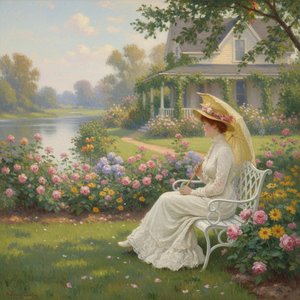
The Hand and the Brush
Born in Troyes, France, Paul Steck began his life as Paul Albert Dugas. He spent his early years absorbing the discipline of the Ecole des Beaux-Arts in Paris, where he studied under Jean-Léon Gérôme. His work moved between the quietude of landscapes and the weight of historical scenes. He also turned his attention to the human face, capturing portraits from life that sought to pin down a specific presence. There was a certain pull toward the Symbolist style in his later years, a way of looking at the world that favored the mood of a scene over mere physical accuracy.
His hands were as active in the theater as they were at the easel. Beyond the canvas, he worked as a playwright and a librettist, finding ways to structure stories through both words and images. This dual nature of his life—the visual and the spoken—informed the way he approached a composition. He understood how a scene could be staged, whether it was a landscape or a moment from literature.
Recognition and Accolades
The progression of his career was marked by steady, quiet successes within the French art establishment. He did not merely participate in the salons; he became a fixture within them. His development followed a path of increasing responsibility and formal recognition:
- Member of the Société des Artistes Français in 1896.
- Exhibitor in the fifth Salon de la Rose + Croix in 1896.
- Recipient of an honourable mention at the Salons in 1895.
- Recipient of a third-class medal at the Salon in 1896.
- Winner of a bronze medal at the Exposition Universelle in 1900.
- Appointed deputy director of the École nationale supérieure des arts décoratifs in 1911.
A Life in Paris
By the time he reached his later years, Steck was deeply embedded in the institutional life of Paris. His appointment to the École nationale supérieure des arts décoratifs placed him at the center of French artistic instruction. He lived through a period of significant change in the art world, yet his own work remained rooted in the traditions he had mastered in his youth. He died in Paris, leaving behind a body of work that found its way into the collections of museums in Dieppe, Montauban, and Rouen.
Q&A
Paul Steck 작가의 작품 관련 통계 정보는 어디에서 확인할 수 있나요?
Paul Steck 작가의 작품 통계 정보는 방문 통계 페이지에서 확인하실 수 있습니다.
Paul Steck의 출생 도시와 국가는 어디인가요?
Paul Steck은(는) France Troyes에서 태어났습니다.
Paul Steck은(는) 어느 시대의 작품을 남겼나요?
Paul Steck은(는) 19th Century 시대에 활동했습니다. 이 시기는 역사적 맥락 속에서 작가의 예술적 위치를 보여줍니다.
Paul Steck의 출생지와 출생 연도는 어떻게 되나요?
Paul Steck은(는) 1866년 Troyes에서 태어났습니다.