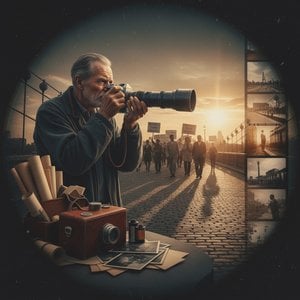
Paul Almásy: A Pioneer of Documentary Photography
Paul Almásy (29 May 1906 in Budapest – 23 September 2003 in Jouars-Pontchartrain) stands as a monumental figure in the history of twentieth-century photography, recognized primarily for his groundbreaking contributions to documentary and portraiture. Born into an artistic family—his father a painter and his mother a writer—Almásy’s formative years instilled within him a profound appreciation for visual storytelling and observation. This early exposure would prove instrumental in shaping his distinctive artistic vision.- Early Years & Artistic Influences: Almásy's upbringing nurtured by the vibrant Hungarian Art Nouveau movement profoundly impacted his aesthetic sensibilities. He absorbed the stylistic principles championed by artists like Gustav Klimt and Alphonse Mucha, recognizing the power of decorative art to convey emotion and narrative complexity.
- Formal Training & Initial Career: Following his studies in Vienna, Munich and Heidelberg, Almásy embarked on a diplomatic career but swiftly abandoned it for journalism—a path that would ultimately prove more rewarding for his artistic pursuits. He honed his skills as a photojournalist, capturing pivotal moments of the era with unwavering dedication.
Documentary Journalism & The Spanish Civil War
Almásy’s journalistic endeavors propelled him to the forefront of visual documentation during turbulent times. His assignments took him across Europe, documenting the unfolding drama of the Spanish Civil War (1936-1939). Armed with his Leica camera—a revolutionary instrument for its time—he tirelessly pursued compelling images that conveyed the human cost of conflict. These photographs weren’t merely records; they were visceral testimonies to suffering and resilience, capturing the faces of ordinary people caught in extraordinary circumstances. His work during this period established him as a fearless chronicler of history.- World War II & Artistic Exploration: As World War II raged across Europe, Almásy continued his photographic explorations, documenting the hardships endured by civilians under Nazi occupation. Simultaneously, he cultivated his artistic interests, experimenting with landscapes and travel photography—a practice that allowed him to synthesize observation and creative expression.
- Portraiture & Artistic Collaborations: Beyond journalistic endeavors, Almásy distinguished himself as a portrait photographer, capturing the essence of influential figures in art, literature and intellectual circles. He collaborated closely with luminaries such as Pablo Picasso, Salvador Dalí, Jean-Paul Sartre, and Albert Camus—artists whose visions he sought to portray authentically.
Swiss Citizenship & Legacy
In 1956, Almásy embraced Swiss citizenship, marking a significant chapter in his personal life. He remained active as a photographer until his death in 2003, continuing to refine his craft and explore new artistic horizons. His photographs—characterized by meticulous composition and evocative tonal palettes—are held in prestigious museums worldwide, cementing his place among the most respected photographers of the twentieth century. Almásy’s enduring legacy resides not only in his stunning images but also in his unwavering commitment to capturing the human experience with sensitivity and integrity.- Notable Achievements: Almásy's photographic work garnered international acclaim, earning him recognition as a pioneer of documentary photography and establishing him as one of Switzerland’s foremost visual artists. His images continue to inspire admiration for their artistic merit and historical significance.
Influences & Artistic Style
Almásy's photographic style was deeply rooted in the principles of Impressionism and Expressionism, reflecting his fascination with capturing fleeting moments of emotion and atmosphere. He skillfully employed natural light—often favoring overcast conditions—to illuminate his subjects with a soft, diffused glow. His compositions were carefully crafted to guide the viewer’s gaze and convey a sense of immediacy, mirroring the spirit of journalistic observation.Q&A
Paul Gross Almásy 작가의 작품을 감상할 수 있는 가상 박물관에 방문할 수 있나요?
Paul Gross Almásy의 3D 갤러리는 작가의 작품들을 가상 3D 갤러리로 감상할 수 있는 페이지입니다.
Paul Gross Almásy의 다른 이름이나 별칭에는 무엇이 있나요?
Paul Gross Almásy은(는) Paul Almasy, Paul Gross Almasy라는 이름으로도 활동하고 있습니다.
키워드별로 분류된 Paul Gross Almásy의 작품은 어디에서 볼 수 있나요?
특정 주제의 Paul Gross Almásy 작품을 찾으려면 키워드별로 작품이 분류된 작가의 키워드별 탐색 페이지를 이용해 보세요.