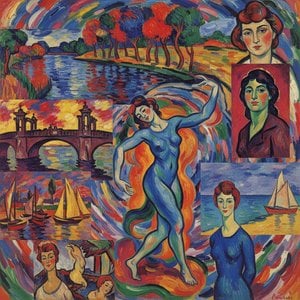
A Bridge Between Worlds
The artistic journey of Pang Hiun-Kin represents a profound and fascinating confluence of Western modernism and deeply rooted Chinese traditions. Born in Changshu, China, his path to becoming a pivotal figure in early 20th-century art was unexpectedly preceded by studies in medicine in Shanghai. This scientific foundation perhaps informed the meticulous precision found in his later explorations of form and pattern. His life took a transformative turn when he traveled to Paris to study oil painting at the prestigious Académie Julian and Grande Chaumière. Immersed in the epicenter of global artistic trends, he was exposed to the burgeoning movements of Cubism, Fauvism, and the flowing elegance of Art Nouveau, all of which would eventually weave into his unique visual language.
Upon returning to China, Pang became a vital architect of the nation's modern art identity. He was a co-founding member of the Storm Society (Juelanshe) in Shanghai, an innovative association that sought to bring a Parisian-style modernity to the Chinese art world. His work during this era functioned as a historical anchor, serving as a documented bridge between European modernist techniques and traditional Chinese subject matter. He possessed a rare ability to give traditional decoration art a modern context, ensuring that the heritage of his homeland could breathe within the framework of contemporary experimentation.
The Synthesis of Tradition and Modernity
Pang’s artistic evolution was marked by a tireless exploration across diverse domains, ranging from fine painting to decorative arts and folk crafts. His stylistic development is particularly noted for its masterful blend of Impressionistic principles and traditional Chinese floral painting. In works such as Chrysanthemums in Vase, one can observe the loose brushwork and the emphasis on capturing fleeting moments of light and color characteristic of Impressionism. Yet, this is harmoniously balanced by a careful consideration of arrangement and the deep symbolic significance attached to the blooms, reflecting the enduring power of nature and themes of longevity embedded within Chinese culture.
Beyond the canvas, his research into the soul of Chinese aesthetics led him on significant journeys, such as his travels to Guizhou. There, he immersed himself in the study of ethnic minority art, creating the Guizhou Mountain Folk Paintings series and systematically compiling decorative patterns from various dynasties. This dedication to preserving and reimagining China's rich artistic heritage extended into the realm of industrial design, where he integrated Art Deco influences with historical Chinese motifs. His educational philosophy, which emphasized both painting fundamentals and professional design, left a lasting legacy on the institutions he served, including his role as a professor and First Vice President at the Central Academy of Arts and Design.
The enduring significance of Pang Hiun-Kin lies in his role as a polymathic creator who dared to bridge the gap between disparate worlds. His life's work remains a testament to the possibility of innovation through integration, proving that the most profound modernism can be found by looking deeply into the patterns of the past.
Q&A
Pang Hiun-Kin의 활동 시기는 어떻게 구분되어 있나요?
Pang Hiun-Kin의 예술적 여정은 연대기 페이지에서 시기별로 펼쳐집니다. 이곳에서는 작가의 활동 시기를 장(chapter)으로 나누어 작품들을 연대순 타임라인 형태로 한눈에 확인할 수 있습니다.
Pang Hiun-Kin의 모든 작품을 어디에서 볼 수 있나요?
이 사이트에 등록된 Pang Hiun-Kin의 모든 작품은 작가의 전체 작품 보기 페이지에서 만나보실 수 있습니다.
Pang Hiun-Kin의 작품을 분위기별로 모아둔 곳은 어디인가요?
Pang Hiun-Kin의 작품은 각 작품이 지닌 분위기에 따라 분류된 무드 룸 페이지에서 무드별로 감상하실 수 있습니다.