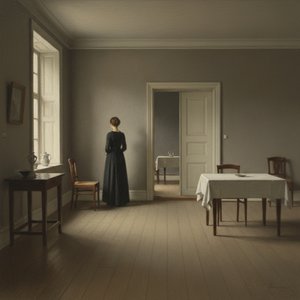
A Life of Light and Shadow
Osip Emmanuilovich Braz lived a life defined by the shifting borders of Europe and the heavy hand of history. Born in Odessa, his early years were shaped by the rigorous training of the Odessa Art School, where he earned a Grand Bronze Medal upon completing his course. His education was not confined to one corner of the continent; he sought out the Academy of Fine Arts in Munich to study under Sandor Kholloshi and later moved through Paris and the Netherlands. In these travels, he encountered the works of the Dutch masters, an encounter that would leave a permanent mark on his approach to light and composition.
The artist eventually found himself in St. Petersburg, entering the workshop of Ilya Repin at the Academy of Arts. This period brought him into the orbit of the most significant figures of Russian culture. He became a regular participant in the exhibitions of the Mir Iskusstva association, serving as both a member of its committee and its treasurer. His ability to capture the likeness of his contemporaries brought him a specific kind of recognition within the Russian art community.
The Art of Observation
Braz possessed a versatile hand, moving between genres with a quiet, disciplined skill. He was particularly noted for his portraits, including notable works such as his 1898 portrait of Anton Chekhov and depictions of E. M. Martynova and A. P. Sokolov. These paintings were not mere records of faces but studies in character. His later work reflected the influence of French art, where his compositions grew simpler and his use of color became more intensive and decorative.
Beyond the human face, he found deep satisfaction in the stillness of objects and landscapes. He produced a series of still lifes that drew heavily from the tradition of the "small Dutchmen," focusing on items like copper mortars, blue jugs, and samovars. His landscapes, painted during travels through Crimea and Finland, captured the atmosphere of these regions with broad, expressive brushstrokes. In his interiors, he often rendered spaces filled with a sense of twilight or subdued light, using earthy tones to create an atmosphere of quietude.
Hardship and Exile
The trajectory of Braz's life took a dark turn in 1924. Following an arrest on charges of espionage and illegal art trade, he was sent to the Solovetsky prison camp. For three years, his personal collections were confiscated by the state, and his professional standing was thrown into uncertainty. Although he was released in late 1926 at the request of Leningrad artistic societies, the stability of his former life had vanished. He lived briefly in exile in Novgorod before eventually moving to Germany in 1928.
The final chapter of his life unfolded in Paris. While he continued to paint and engaged in the antiques trade, the era of his prominence in the Russian imperial institutions had passed. He died in Lis-Shantilie, near Paris, leaving behind a body of work that bridged the gap between the classical traditions of the old masters and the evolving sensibilities of the Modernist period.
Q&A
Osip Braz은(는) 어느 시대의 작품을 남겼나요?
Osip Braz은(는) Modern 시대에 활동했습니다. 이 시기는 역사적 맥락 속에서 작가의 예술적 위치를 보여줍니다.
Osip Braz 작가의 작품을 감상할 수 있는 3D 가상 투어가 있나요?
Osip Braz의 작품은 작가의 3D 갤러리 페이지 내 3D 갤러리에서 감상하실 수 있습니다.
Osip Braz의 작품을 사조별로 둘러볼 수 있나요?
Osip Braz 작가의 작품을 예술 사조별로 모아둔 모든 미술 사조 페이지에서 해당 작가가 활동했던 사조를 확인하실 수 있습니다.