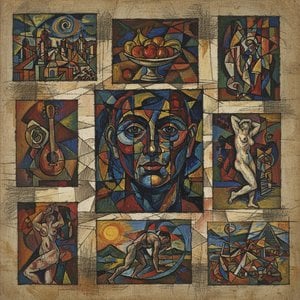
The Soul of the Plains: The Visionary Journey of Oscar Howe
Born into the quiet strength of the Crow Creek Sioux Reservation in 1915, Oscar Howe—known in his native Yanktonai Nakota tongue as Mazuha Hokshina or "Trader Boy"—carried within him a visual language far older than the modern era. His early years were shaped by the profound spiritual and aesthetic traditions of his people, most notably through the teachings of his maternal grandmother, Shell Face. It was from her that he inherited a deep reverence for the sacred symbols and intricate geometric patterns of the Sioux tribes, elements that would later serve as the foundational DNA of his revolutionary paintings. Though his youth was marked by the hardships of poverty and the physical struggle against tuberculosis, these early trials only served to sharpen his focus, eventually leading him to the Santa Fe Indian School where his destiny as a pioneer of Native American modernism began to take shape.
The evolution of Howe’s artistry is a breathtaking narrative of cultural synthesis. Under the mentorship of Dorothy Dunn at the Studio School, he mastered formal painting techniques, yet he refused to be confined by the era's expectations of "authentic" Indigenous art. While many contemporaries felt pressured to produce representational, static depictions of traditional life to satisfy Western collectors, Howe looked toward the global avant-garde. His exposure to Cubism and Surrealism—further refined during his service in the U.S. Army during World War II—allowed him to fracture and reconstruct reality. He began to weave the ancestral motifs of the Black Hills and ceremonial belts into a dynamic, abstract framework, creating a style that utilized planar space and bold, rhythmic lines to evoke the very essence of Dakota cosmology.
A Revolution in Color and Form
To look upon a Howe masterpiece is to witness a dance of energy and motion. His technique was characterized by an extraordinary use of casein and tempera, mediums that allowed for the vibrant, saturated colors and pristine, sharp lines that became his signature. He moved away from the literal depiction of Sioux dances and ceremonies, choosing instead to capture their spiritual vibration through geometric abstraction. In his work, a single line could represent the movement of a dancer or the flow of a sacred wind; a jagged shape might echo the rugged landscape of South Dakota. This approach was not merely an aesthetic choice but a profound political statement—a rejection of the "primitive" label and an assertion that Native American art could be contemporary, experimental, and intellectually rigorous.
His contributions to the art world extended far beyond the canvas. As an educator at the University of South Dakota, Howe mentored generations of artists, instilling in them the courage to pursue individual expression over cultural conformity. His legacy is defined by several monumental achievements:
- Breaking Stereotypes: He successfully challenged the Western art establishment's tendency to categorize Indigenous work as static or "antimodern," proving that tradition and innovation are not mutually exclusive.
- Mastery of Abstraction: By integrating Sioux symbolism with the principles of modernism, he created a unique visual dialect that bridged the gap between ancestral heritage and the global contemporary art movement.
- Cultural Advocacy: Through his murals and teaching, he acted as a vital bridge, ensuring that the spiritual depth of the Yanktonai Sioux remained visible within the broader American art canon.
Today, the name Oscar Howe resonates as a symbol of artistic independence. He remains a towering figure whose work continues to inspire a global dialogue on identity, much of which is celebrated in major exhibitions from the Smithsonian’s National Museum of the American Indian to the Portland Art Museum. His life's work stands as a testament to the power of perseverance, proving that even when faced with the pressures of assimilation, the spirit of one's heritage can be transformed into a universal language of beauty and truth.
Q&A
Oscar Howe의 출생 도시와 국가는 어디인가요?
Oscar Howe은(는) United States Crow Creek Indian Reservation에서 태어났습니다.
Oscar Howe의 예술 세계는 시간이 흐름에 따라 어떻게 진화했나요?
Oscar Howe의 연대기는 작가의 활동 시기별로 분류된 작품들을 연대순으로 보여주는 스크롤 방식의 타임라인입니다.
Oscar Howe의 작품들은 어떤 분위기를 담고 있나요?
Oscar Howe의 작품은 각 작품이 지닌 분위기에 따라 분류된 무드 룸 페이지에서 무드별로 감상하실 수 있습니다.
특정 색상 팔레트의 Oscar Howe 작품은 어디에서 찾아볼 수 있나요?
컬러 팔레트별로 보기 페이지에서는 Oscar Howe의 작품들을 색상 팔레트별로 모아볼 수 있습니다.