The Lithographer’s Son and the Gateway to Art
In the bustling streets of Saint Louis, Missouri, where the industrial pulse of the late nineteenth century met the expanding spirit of the American frontier, Oscar Edmund Berninghaus began a journey that would forever alter the visual vocabulary of the West. Born into a world saturated with the vibrant imagery of his father’s lithography business, young Oscar was immersed in a sea of colorful prints and technical precision from his earliest years. This early exposure to the art of reproduction—the meticulous layering of color and the sharp clarity of engraved lines—provided a foundational discipline that would later inform his masterful handling of light and form. While spending his days working within the ink-stained walls of local printing firms like Compton & Sons, Berninghaus sought refinement under the cover of night, attending the Saint Louis School of Fine Arts to cultivate a painterly sensibility that transcended mere commercial utility.A Journey into the Golden Light of Taos
The trajectory of Berninghaus’s life shifted irrevocably in 1899, when a commission from the Denver & Rio Grande Railway beckoned him westward. This expedition was far more than a professional assignment; it was a spiritual pilgrimage into the heart of a landscape that would become his eternal muse. As he traversed the rugged terrain, the stark, sun-drenched vistas of New Mexico began to dissolve the industrial shadows of his youth, replacing them with an intoxicating palette of ochre, crimson, and brilliant gold. It was during this transformative period that he encountered Taos, a place of profound cultural depth and breathtaking natural beauty. The arid climate, characterized by its intense luminosity and sweeping horizons, demanded a new way of seeing—a way that embraced the fleeting nuances of light and the atmospheric haze of the high desert.The Impressionist Spirit and the Taos Legacy
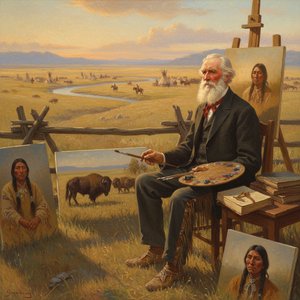
As a founding member of the prestigious Taos Society of Artists, Berninghaus played a vital role in establishing the region as a premier American art colony. His work became a bridge between the classical traditions of his training and the burgeoning movement of Southwestern Impressionism. He did not merely document the landscape; he captured its very soul through a technique that favored loose, expressive brushstrokes and a sophisticated layering of color. His canvases pulsate with life, portraying the ceremonies, daily rhythms, and quiet dignity of Native American tribes with an empathy that avoided mere exoticism. Through his eyes, the viewer witnesses:- The shimmering heat rising from the New Mexican plains;
- The profound serenity found in the portraits of indigenous peoples;
- A masterful synthesis of Impressionist light and Western grit.
Q&A
Oscar E. Berninghaus의 작품을 매체별로 찾아볼 수 있나요?
Oscar E. Berninghaus의 작품은 작가 페이지인 모든 매체별에서 매체별로 둘러보실 수 있습니다.
Oscar E. Berninghaus 작품의 연도별 타임라인이 있나요?
Oscar E. Berninghaus의 작품을 연도별로 정리하여 보여주는 작품 연대기 페이지입니다.
Oscar E. Berninghaus 작가는 어떤 사조의 작품 활동을 했나요?
Oscar E. Berninghaus의 작품은 작가의 모든 미술 사조 페이지에서 사조별로 만나보실 수 있습니다.
Oscar E. Berninghaus은(는) 어느 시대의 작품을 남겼나요?
Oscar E. Berninghaus은(는) Modern 시대에 활동했습니다. 이 시기는 역사적 맥락 속에서 작가의 예술적 위치를 보여줍니다.