Early Life and Artistic Beginnings
Micius Stephane was born in Bainet, Haiti, in 1912—a village nestled on Haiti’s southern coast—into a family of cobblers. This humble profession would profoundly shape his formative years, instilling a meticulous attention to detail and an appreciation for tactile craftsmanship that would later translate into his distinctive artistic style. Despite lacking formal artistic training, Stephane possessed an innate sensitivity to color and form, qualities nurtured by the vibrant landscapes and traditions of Haitian culture. His early life was marked by hardship and resilience—experiences that undoubtedly fueled his creative spirit and informed his worldview.The Influence of Dewitt Peters and the Centre d’Art
A pivotal moment in Stephane's artistic journey arrived in 1946 when he encountered Dewitt Peters, a prominent American anthropologist and art collector who established the Centre d’Art in Port-au-Prince. Peters recognized Stephane’s extraordinary talent and championed his work, providing him with invaluable guidance and fostering connections within the international art community. This collaboration proved instrumental in elevating Stephane's reputation and propelling him toward greater recognition as a visionary artist of Haitian primitive art. The Centre d’Art became not only a platform for showcasing his paintings but also a crucible for refining his technique and deepening his understanding of artistic expression rooted in folk traditions.Style and Technique: Vibrant Color and Simplified Forms
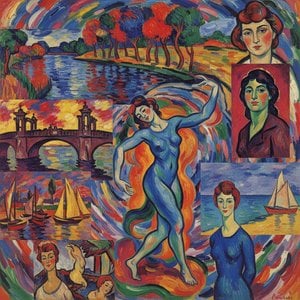
Stephane's artistic style is characterized by bold, luminous colors—often reds, yellows, and blues—applied with broad strokes onto wooden panels. He eschewed complex compositions and intricate details, favoring instead simplified forms that convey emotion and immediacy. This approach aligns perfectly with the principles of naïve art, a genre distinguished by its lack of academic training and its reliance on intuitive observation. Stephane’s canvases depict scenes from everyday Haitian life—rural landscapes, portraits of villagers, depictions of religious rituals—rendered with remarkable clarity and vibrancy. His technique is remarkably consistent across his oeuvre, demonstrating an unwavering commitment to capturing the essence of Haitian culture through a uniquely expressive visual language.Notable Works and Recognition
Stephane’s paintings have garnered acclaim from critics and collectors alike, securing their place in prestigious collections worldwide. Among his most celebrated pieces are “Wedding Couple,” a captivating portrayal of Haitian marital customs—a testament to Stephane's ability to distill complex cultural narratives into evocative visual representations. Furthermore, "Bourgeois Family," commissioned by Jonathan Demme for the Bryant Digital Repository, exemplifies his masterful use of color and form to convey profound human emotion. His work has been featured in publications such as “Island on Fire” (Demme, 1997) and “Where Art is Joy” (Rodman, 1988), cementing his legacy as one of Haiti’s foremost artists. The Milwaukee Museum of Art holds several significant pieces by Stephane, underscoring the enduring impact of his artistic vision.Legacy and Historical Significance
Micius Stephane died in 1996, leaving behind a remarkable body of work that embodies the spirit of Haitian primitive art—a genre celebrated for its authenticity and its uncompromising devotion to capturing the beauty and vitality of rural life. His paintings serve as invaluable documents of Haitian culture during the mid-20th century, offering insights into traditions, beliefs, and social dynamics. Stephane’s unwavering commitment to his craft and his profound connection to Haiti's heritage continue to inspire artists and scholars alike—solidifying his place as a pivotal figure in Haitian art history and ensuring that his vibrant canvases endure as emblems of artistic innovation rooted in tradition.Q&A
Micius Stephane 작가의 작품을 감상할 수 있는 3D 가상 투어가 있나요?
Micius Stephane의 작품은 작가의 3D 갤러리 페이지 내 3D 갤러리에서 감상하실 수 있습니다.
Micius Stephane의 작품을 분위기별로 모아둔 곳은 어디인가요?
아티스트의 무드 룸 페이지에서는 Micius Stephane의 작품들을 분위기에 따라 큐레이션된 형태로 만나보실 수 있습니다.
Micius Stephane 작가 작품의 컬러 프로필은 어디에서 확인할 수 있나요?
이 사이트에 등록된 작품 전반에 나타나는 Micius Stephane의 색채 활용은 작가의 팔레트 지놈 페이지에서 자세히 살펴보실 수 있습니다.
Micius Stephane의 출생 도시와 국가는 어디인가요?
Micius Stephane은(는) Haiti Bainet에서 태어났습니다.