The Genesis of a Botanical Vision
Born amidst the vibrant cultural landscape of Philadelphia in 1873, Maud H. Purdy possessed an innate sensitivity to the natural world that would eventually define her legacy. Her early training at the Philadelphia Institute of Art provided the technical foundation—the steady hand and keen eye—necessary for the rigorous demands of botanical illustration. As she moved to Brooklyn in 1908, her spirit of creativity expanded far beyond the canvas; she established a salon dedicated to nurturing the talents of young women, fostering a community where art and empowerment could bloom side by side. Her early years were not merely about personal growth but about creating a sanctuary for artistic exploration, imbuing textiles and tapestries with intricate botanical motifs that celebrated the splendor of the natural world.
A Symbiosis of Science and Art
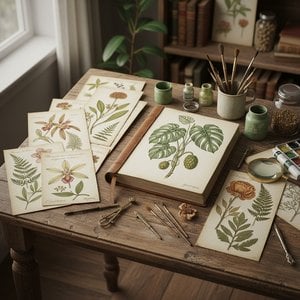
The year 1913 marked a transformative era in Purdy’s life when she was recruited by the Brooklyn Botanic Garden, initiating a profound collaboration with the scientific community that would span over three decades. In this unique intersection of disciplines, Purdy became more than an illustrator; she became a visual chronicler of life itself. Working closely with botanists, she translated complex biological structures into stunning watercolor paintings for seminal texts on botany and houseplants. Her work, such as the exquisite Trumpet Creeper study from 1932, showcased a rare ability to maintain absolute scientific precision while imbuing each specimen with an ethereal, lifelike beauty. Through her brush, the rigid requirements of botanical documentation were softened by an artist's touch, making the study of flora an experience of pure aesthetic delight.
Global Expeditions and Enduring Legacies
Purdy’s artistic journey was one of constant movement and discovery, often taking her far beyond the manicured gardens of Brooklyn. Her adventurous spirit led her to participate in the 1930 Astor expedition to the Galapagos Islands, where she captured the rugged, unique flora through evocative pen-and-ink drawings that documented species rarely seen by the wider world. Perhaps her most celebrated achievement was the creation of a magnificent series of forty canvases depicting Japanese irises, a monumental project that graced the 1933 Chicago World's Fair and cemented her status among the artistic luminaries of her age. Her life’s work remains a testament to the power of observation, leaving behind a legacy where:
- The precision of scientific record meets the soul of fine art.
- Botanical illustration serves as both a tool for knowledge and a medium for beauty.
- The delicate details of the natural world are preserved through a master's hand.
Through her meticulous studies, Maud H. Purdy ensured that the fleeting beauty of a blossom or the intricate structure of a leaf would endure long after the specimen itself had faded.
질의응답
Maud H. Purdy의 다른 이름이나 별칭에는 무엇이 있나요?
Maud H. Purdy은(는) Maude Purdy라는 다른 이름으로도 알려져 있습니다.
Maud H. Purdy의 작품 중 몇 점을 둘러보실 수 있나요?
모든 작품 보기 페이지에서 Maud H. Purdy의 작품 작품 11점점을 만나보실 수 있습니다.
Maud H. Purdy의 경력은 어떻게 시기별로 구분되어 있나요?
Maud H. Purdy의 연대기는 작가의 활동 시기별로 분류된 작품들을 연대순으로 보여주는 스크롤 방식의 타임라인입니다.