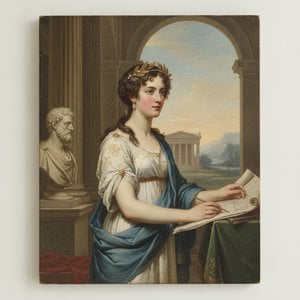
Marie Constance Mayer: Life and Artistic Journey
Born in France around 1774, Marie Constance Mayer lived a life marked by artistic talent, personal struggles, and complex relationships within the Neoclassical art world. Her career, often described as "brilliant but bitter," reflects both her successes as a woman artist in post-Revolutionary France and the challenges she faced due to gender bias and dependence on male colleagues.
Early Training and Influences
Mayer's artistic training began with established artists of the time. She initially studied under Jean-Baptiste Greuze, known for his genre scenes and portraits. This early instruction provided her with a foundation in traditional painting techniques and an understanding of popular subject matter. Her style was influenced by the Neoclassical movement, characterized by its emphasis on clarity, order, and idealized forms.
Collaboration and Dependence on Pierre-Paul Prud'hon
A significant portion of Mayer’s artistic development occurred through her long association with Pierre-Paul Prud'hon, a leading French painter. Their relationship was complex, involving both collaboration and dependence. He sketched designs and compositions, while she executed the paintings. Many works were exhibited under her name, but later attributed to Prud'hon when they entered public collections. This practice blurred the lines of authorship and contributed to confusion regarding their individual contributions.
- Collaborative Process: Prud’hon sketched designs; Mayer painted them.
- Attribution Issues: Works initially exhibited under Mayer's name were later attributed to Prud'hon in public collections.
Major Achievements and Artistic Style
Despite the challenges of attribution, Mayer achieved recognition for her artistic skill. Her style was characterized by Neoclassical principles, with a focus on clarity, idealized forms, and refined execution. She excelled in portraiture, genre scenes, and miniature paintings.
- Portraiture: She created portraits of individuals from various social backgrounds.
- Genre Scenes: Mayer painted scenes depicting everyday life and popular activities.
- Miniature Paintings: She was skilled in creating small-scale paintings with intricate detail.
Later Years, Personal Struggles, and Historical Significance
Mayer’s later years were marked by personal struggles and a sense of unfulfilled potential. Her dependence on Prud'hon and the subsequent attribution issues hindered her recognition as an independent artist. She died in 1821, leaving behind a legacy complicated by questions of authorship and gender bias.
- Unrecognized Contributions: Her individual contributions were often overshadowed by Prud’hon's reputation.
- Historical Significance: Mayer represents the challenges faced by women artists in post-Revolutionary France, who sought to make progress despite gender bias and limited opportunities.
Legacy and Recognition
In recent years, there has been renewed interest in Mayer’s life and work. Art historians are reevaluating her contributions and seeking to clarify the complex relationship between her and Prud'hon. Her story serves as a reminder of the importance of recognizing the achievements of women artists throughout history.
질의응답
Marie Constance Mayer의 작품 세계는 시간이 흐름에 따라 어떻게 변화했나요?
Marie Constance Mayer의 작품 세계를 시간순으로 정리한 기록은 아티스트 연대기 페이지에서 확인하실 수 있으며, 이곳에서는 각 시기별로 분류된 챕터를 따라 작품들을 제작 순서대로 만나보실 수 있습니다.
주제별로 Marie Constance Mayer의 작품을 탐색할 수 있나요?
Marie Constance Mayer의 주제별 아틀라스는 작가의 작품들을 주제별로 분류하여 보여주는 페이지입니다.
Marie Constance Mayer의 출생 도시와 국가는 어디인가요?
Marie Constance Mayer은(는) France의 Paris에서 태어났습니다.