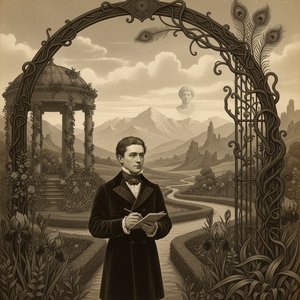
The Master of the Mane: The Life and Legacy of Ludwig Koch
In the grand tapestry of nineteenth-century European art, few figures captured the kinetic elegance of the equine world as vividly as Ludwig Koch. Born in December 1866, this Austrian virtuoso emerged from the prestigious Academy of Fine Arts in Vienna, where he refined his craft under the watchful eyes of masters such as Siegmund L'Allemand and August Eisenmenger. Koch was not merely a painter of animals; he was a chronicler of movement, a storyteller of the saddle, and a meticulous observer of the aristocratic traditions that defined an era. His early years in Vienna provided him with a front-row seat to the splendor of the imperial court, an influence that would later permeate every brushstroke of his work.
Koch’s artistic identity was inextricably linked to the rhythmic pulse of the Spanish Riding School. As a long-standing guest of this legendary institution, he possessed a rare intimacy with the Lipizzaner stallions, capturing the precise moment of a leap or the controlled tension of a dressage maneuver. His ability to translate the muscular power and spirited grace of these magnificent creatures earned him international acclaim, eventually leading to his reputation as one of the finest horse painters in the world. This expertise was not limited to the canvas; he also became a respected illustrator of hippological works, bridging the gap between fine art and scientific documentation.
A Tapestry of Military History and Imperial Splendor
Beyond the stable, Koch’s imagination wandered through the corridors of military history. He possessed a profound fascination with the uniforms, heraldry, and dramatic skirmishes of the Austro-Hungarian Army. His paintings often served as vibrant historical records, capturing the pride of regiments and the solemnity of military tradition. One of his most celebrated early achievements was receiving the special school prize for his depiction of General Pappenheim in 1889, a work that signaled his arrival as a significant talent in historical genre painting. His canvases frequently featured the intricate details of cavalry charges and the disciplined beauty of imperial parades, often reproduced on postcards that brought his vision to the masses.
The scope of his work extended into the intimate spheres of Viennese high society and the imperial house. He delighted in depicting scenes such as the Ride of the Archduke, blending the grandeur of state functions with the naturalistic beauty of equestrian sport. Even during the tumultuous years of the First World War, when he served briefly as a war painter on the Italian front, his dedication to capturing the essence of his subjects remained unshakable. Though illness eventually forced his retirement from the battlefield, his spirit continued to celebrate the old traditions of the empire, even as the political landscape of Europe underwent seismic shifts.
Artistic Evolution and Global Recognition
The later years of Koch’s life were marked by a remarkable expansion of his artistic reach. In the 1920s, his reputation preceded him across the Atlantic, leading to an invitation from the U.S. Polo Association. This journey to the United States allowed him to share his uniquely European perspective on equestrianism with a new audience, further cementing his status as a global authority on the subject. His work during this period continued to reflect a deep respect for the classical arts of riding and the enduring bond between human and horse.
As we look back on the career of Ludwig Koch, we see an artist who successfully navigated the transition from the romanticism of the nineteenth century to the complexities of the twentieth. His legacy is found in:
- Technical Mastery: An unparalleled ability to render the anatomy and motion of horses with both accuracy and soul.
- Historical Preservation: The preservation of the visual splendor of the Austro-Hungarian military and imperial traditions.
- Cultural Impact: His role in elevating equestrian art from mere illustration to a profound medium of historical and emotional expression.
When he passed away on November 26, 1934, Koch left behind a body of work that remains a window into a vanished world—a world of polished brass, flowing manes, and the timeless dignity of the imperial era.
Q&A
Ludwig Koch의 작품 중 몇 점을 둘러보실 수 있나요?
전체 작품 보기 페이지에서 Ludwig Koch의 작품 작품 2점점을 만나보실 수 있습니다.
키워드별로 분류된 Ludwig Koch의 작품은 어디에서 볼 수 있나요?
Ludwig Koch의 키워드별 탐색 페이지에서는 작가의 작품들을 키워드별로 모아볼 수 있습니다.
Ludwig Koch의 작품을 팔레트별로 모아둔 곳은 어디인가요?
특정 색상 팔레트의 Ludwig Koch 작품을 찾으시려면, 작가의 컬러 팔레트별로 보기 페이지를 이용해 보세요.
Ludwig Koch의 작품을 색상별로 모아둔 곳은 어디인가요?
Ludwig Koch의 작품은 작가의 컬러 인덱스 페이지에서 색상별로 감상하실 수 있습니다.