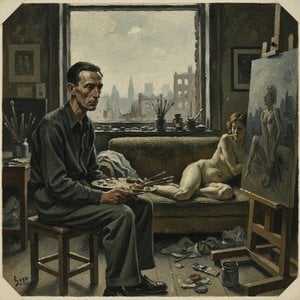
The Luminous Landscapes of Lucy Jones
Born in London in 1955, Lucy Jones has emerged as a profound voice in contemporary British art, weaving together the tactile precision of printmaking with the emotive depth of landscape painting. Her journey is one marked by both immense technical discipline and a deeply personal connection to the natural world. Educated at the King Alfred School and later refining her craft at the Byam Shaw School of Art and the Royal College of Arts, Jones developed a sensibility that balances meticulous detail with atmospheric grandeur. A defining chapter in her early career arrived in 1982 when she was awarded the prestigious Prix de Rome prize, an opportunity that transported her to the British School in Rome. This period of immersion among European Old Master traditions profoundly shaped her compositional eye, instilling in her a reverence for light and shadow that would become a hallmark of her later works.
The essence of Jones’s artistry lies in her ability to translate the ephemeral qualities of nature into enduring visual narratives. Her landscapes are rarely mere topographical records; instead, they are windows into a state of contemplation. Through a masterful use of bold color palettes and an acute sensitivity to light, she captures scenes that feel both grounded in reality and elevated by emotion. Whether depicting serene vistas or more textured, intimate studies, her work often evokes a sense of tranquility and quietude, inviting the viewer to linger within the atmospheric layers of her compositions. This approach reflects a sophisticated dialogue with the traditions of British landscape painting, particularly the Pre-Raphaelite aesthetics she explored through her engagement with The Royal Birmingham Society of Artists.
A Legacy of Resilience and Recognition
Beyond her technical prowess, Jones’s life and work are characterized by a remarkable strength of spirit. Born with cerebral palsy, her navigation of the artistic world is a testament to her dedication and vision, adding a layer of profound personal meaning to her explorations of the physical environment. Her career reached a significant milestone in 1987 with her first solo exhibition at the Flowers Gallery, marking the beginning of an international presence that continues to grow. The breadth of her impact is evidenced by the prestigious institutions that house her work, ensuring her place in the canon of modern British art.
Her achievements are punctuated by both critical acclaim and significant accolades, including:
- The Prix de Rome Prize: A foundational achievement that allowed for deep study of classical European art.
- Ruth Borchard Self-Portraiture Prize: Awarded in 2021 for her evocative self-portrait, Being 66.
- Global Collections: Her artworks are held in esteemed institutions such as The Metropolitan Museum of Art in New York and The National Portrait Gallery in London.
Today, living in Ludlow, Shropshire, Jones continues to contribute to the vibrant tapestry of the contemporary art scene. Her ability to bridge the gap between the historical weight of the Old Masters and the emotive needs of a modern audience ensures that her landscapes remain as relevant as they are beautiful, offering a sanctuary of light and reflection in an ever-changing world.
Q&A
Lucy Jones의 작품들은 어떤 분위기를 담고 있나요?
Lucy Jones의 작품은 각 작품이 지닌 분위기에 따라 분류된 무드 룸 페이지에서 무드별로 감상하실 수 있습니다.
Lucy Jones의 작품을 연도순으로 어디에서 볼 수 있나요?
Lucy Jones의 작품은 작품 연대기 페이지에서 연도순으로 확인하실 수 있습니다.
주제별로 분류된 Lucy Jones의 작품들은 어디에서 확인할 수 있나요?
Lucy Jones의 작품은 작가의 주제별 작품 모음 페이지에서 주제별로 찾아보실 수 있습니다.
Lucy Jones의 예술 세계는 시간이 흐름에 따라 어떻게 진화했나요?
Lucy Jones의 예술적 여정은 연대기 페이지에서 시기별로 펼쳐집니다. 이곳에서는 작가의 활동 시기를 장(chapter)으로 나누어 작품들을 연대순 타임라인 형태로 한눈에 확인할 수 있습니다.