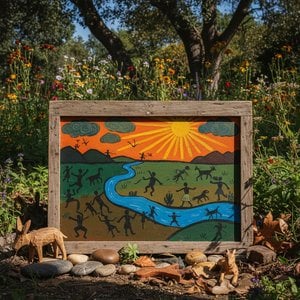
The Soul of Silesia: The Vibrant World of Wladyslaw Lucinski
Born in 1933 amidst the industrial and cultural heart of Ruda Śląska, Poland, Wladyslaw Lucinski emerged as a profound voice within the realm of Polish Naïve art. His journey was not one of academic corridors or formal studios, but rather a self-taught odyssey driven by an innate sensitivity to the world around him. As an autodidact, Lucinski developed a visual language that bypassed traditional realism in favor of a deeply personal, metaphysical truth. His early years, steeped in the traditions and heritage of his homeland, provided the fertile soil from which his unique perspective grew—a perspective that sought to find the extraordinary within the ordinary, and the spiritual within the mundane landscapes of Upper Silesia.
The artistry of Lucinski is characterized by a breathtaking use of color and a rhythmic, simplified composition that prioritizes emotional resonance over anatomical or architectural precision. His palette often vibrates with intense reds, brilliant yellows, and deep, soulful blues, creating scenes that feel both nostalgic and strikingly modern. In his hands, the landscapes of Silesian cities are transformed; he populates these settings with tiny, delicate figures, underground creatures from local legends, and a sense of cosmic wonder. This ability to saturate a canvas with both earthiness and spiritual aspiration allows his work to transcend mere folk art, entering a realm where reality and folklore dissolve into a singular, dreamlike experience.
A Tapestry of Folklore and Everyday Life
Lucinski’s oeuvre serves as a vibrant chronicle of Polish life, blending the grit of industrial existence with the whimsy of myth. His paintings often act as windows into a community, capturing the collective spirit through scenes that range from the somber to the celebratory. One can feel the weight of history and tradition in works such as Miner’s Funeral (1978), where the bustling urban crowd is rendered with a poignant, rhythmic energy. Conversely, his more whimsical pieces, like Cat the Olympian, showcase his ability to infuse the animal kingdom with human-like grandeur, bridging the gap between the domestic and the heroic.
The artist’s fascination with movement and the natural world is perhaps most exquisitely captured in his depictions of flight and the heavens. In masterpieces like Alek Flying Away, the viewer is invited into a nocturnal dance where birds soar through a starlit sunset, their silhouettes cutting through amber and indigo skies. This mastery of color temperature—balancing the cool depths of twilight against the fiery glow of a departing sun—demonstrates a sophisticated control that belies his self-taught origins. Through these works, Lucinski does not merely paint nature; he paints the very essence of life in motion, capturing the kinetic energy of a universe that is simultaneously grounded in Polish soil and reaching for the stars.
Legacy and Artistic Significance
The historical significance of Wladyslaw Lucinski lies in his ability to elevate the Naïve tradition into a medium of profound metaphysical inquiry. He did not simply replicate folk motifs; he reinterpreted them through a lens of modern sensibility, ensuring that the cultural identity of his region remained vibrant and relevant. His works have found permanent homes in prestigious institutions, such as The State Ethnographic Museum in Warsaw, securing his place in the canon of Polish art history.
As we reflect on his life and contributions, several key elements of his legacy become clear:
- Mastery of Color: His use of saturated, bold pigments to evoke emotional and spiritual depth.
- Cultural Preservation: The seamless integration of Upper Silesian legends and local traditions into a contemporary aesthetic.
- The Naïve Perspective: A unique ability to find the cosmic and the magical within the everyday lives of common people.
- Technical Innovation: An exceptional command over oil on fibreboard, achieving textures that feel both tactile and ethereal.
Wladyslaw Lucinski remains a pioneer whose work continues to invite viewers into a world where the boundaries between the seen and the unseen are beautifully blurred, leaving an indelible mark on the landscape of European folk art.
질의응답
Lucinski, Wladyslaw 작가의 작품을 감상할 수 있는 가상 박물관에 방문할 수 있나요?
Lucinski, Wladyslaw의 3D 뮤지엄는 작가의 작품들을 가상 3D 갤러리로 선보이는 페이지입니다.
주제별로 분류된 Lucinski, Wladyslaw의 작품들은 어디에서 확인할 수 있나요?
Lucinski, Wladyslaw의 작품은 작가의 주제별 아틀라스 페이지에서 주제별로 찾아보실 수 있습니다.
Lucinski, Wladyslaw의 작품들은 어떤 분위기를 담고 있나요?
Lucinski, Wladyslaw의 작품은 각 작품에 담긴 분위기에 따라 분류된 아티스트의 무드 룸 페이지에서 무드별로 감상하실 수 있습니다.