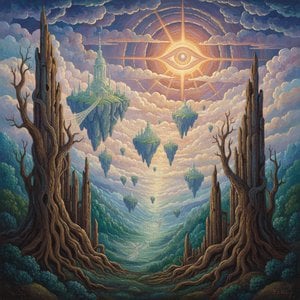
The Celestial Visionary: The Life and Legacy of Louis Ferdinand Cruls
To gaze upon the works inspired by Louis Ferdinand Cruls is to witness a rare intersection where the cold, precise calculations of science meet the boundless wonder of the human spirit. Born in 1848 in Diest, Belgium, Cruls was a man whose life was defined by the pursuit of the unseen and the mapping of the infinite. While history primarily remembers him as a titan of Brazilian astronomy and a geodesist of immense skill, his true essence lies in his ability to translate the mathematical rhythms of the cosmos into a visual language that resonates with profound beauty. His journey from the rigorous academic halls of Ghent and Saint Petersburg to the heart of the Brazilian Empire is a narrative of intellectual migration and scientific devotion.
Cruls’s early years were steeped in the disciplined traditions of European science. After studying civil engineering at Ghent University, he pursued a doctorate in astronomy at the prestigious Saint Petersburg Imperial University. This period of intense academic rigor provided him with more than just technical expertise; it instilled in him a methodical way of seeing, a way to observe the heavens not merely as a collection of lights, but as a complex, mechanical masterpiece governed by laws of motion and gravity. His early fascination with heliocentric cosmology—the revolutionary ideas of Copernicus and Galileo—served as the foundation for a lifelong quest to understand our place within the solar system.
A Journey to the Southern Cross
The trajectory of Cruls’s life changed irrevocably in 1874 when, driven by connections with Brazilian intellectuals, he resigned his commission in the Belgian army and set sail for South America. This transition from the structured military life of Europe to the burgeoning scientific frontier of Brazil allowed him to merge his engineering precision with astronomical exploration. Upon arrival, his talents were immediately recognized by the highest echel렷s of Brazilian society, leading to his appointment within the Geodesy section of the Empire’s Commission. It was here that Cruls began to bridge the gap between the terrestrial and the celestial, applying his knowledge of the earth's dimensions to the study of the stars above.
His career in Brazil was marked by monumental achievements that left an indelible mark on the scientific community. As the Director of the Brazilian National Observatory from 1881 to 1908, he steered the institution through a golden age of discovery. His name is forever etched in the annals of astronomy as the co-discoverer of the Great Comet of 1882, a celestial event that captured the imagination of the world. Furthermore, his leadership during the 1882 Transit of Venus observations in Chile demonstrated his ability to coordinate international scientific efforts, seeking to measure the solar parallax and refine our understanding of the very scale of our universe.
The Art of Scientific Observation
What distinguishes Cruls from a mere cataloger of stars is the poetic dimension of his work. His contributions were never purely clinical; he possessed an innate ability to use visual documentation as a conduit for complex scientific concepts. In his explorations of the Central Plateau, tasked with surveying the future site of Brazil's capital, his observations blended the topographical accuracy of a surveyor with the evocative detail of a landscape artist. He understood that to truly comprehend the cosmos, one must be able to visualize its majesty.
The legacy of Louis Ferdinand Cruls remains a testament to the harmony between the analytical and the aesthetic. His life’s work reminds us that science and art are not opposing forces, but rather two different lenses through which we view the same magnificent reality. Through his eyes, the movement of a comet or the transit of a planet becomes more than data—it becomes a profound expression of the universe's enduring mystery. Today, his influence persists in every artwork that seeks to capture the breathtaking scale of our solar system, celebrating a man who saw the poetry written in the stars.
Q&A
Louis Ferdinand Cruls 작품의 연도별 타임라인이 있나요?
Louis Ferdinand Cruls의 작품을 연도별로 정리하여 보여주는 작품 연대기 페이지입니다.
Louis Ferdinand Cruls의 작품을 컬러 팔레트별로 둘러볼 수 있나요?
특정 색상 팔레트의 Louis Ferdinand Cruls 작품을 찾으시려면, 작가의 컬러 팔레트별로 보기 페이지를 이용해 보세요.
Louis Ferdinand Cruls의 활동 시기는 어떻게 구분되어 있나요?
Louis Ferdinand Cruls의 연대기는 작가의 활동 시기별로 분류된 작품들을 연대순으로 보여주는 스크롤 방식의 타임라인입니다.