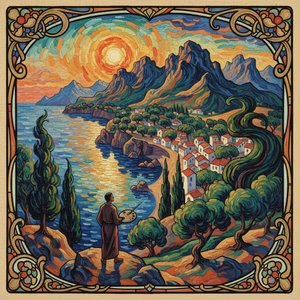
A Visionary of Catalan Modernism
Born into the vibrant cultural atmosphere of Barcelona, Spain, Lluïsa Vidal Puig emerged as a singular and pioneering force within the late-nineteenth-century Catalan Modernisme movement. Raised in an affluent family closely connected to the intellectual and artistic circles of her era, she grew up in an environment that nurtured her creative inclinations from a very young age. Her father, Francesc Vidal i Jevellí, played a foundational role in her development, providing her first lessons in art alongside other notable instructors such as Joan González and Arcadi Mas i Fondevola. This early exposure to diverse artistic perspectives allowed her to cultivate a style that was both deeply rooted in her local heritage and enriched by broader European influences.
Her artistic journey was marked by an extraordinary determination to pursue painting as a professional vocation, a feat that was remarkably rare for women of her time. Unlike many of her female contemporaries who were relegated to amateur pursuits, Vidal Puig sought rigorous training and even ventured abroad to refine her craft. During her time in Paris, she attended the lessons of Eugène Carrière, an experience that undoubtedly deepened her understanding of light and form. Her work often reflects a sophisticated blend of influences, drawing from the compositional mastery of Santiago Rusiñol and the portraiture techniques of Ramon Casas, while also demonstrating a keen sensitivity to the nuances of Impressionism and Post-Impressionism.
Mastery of Light and Intimacy
The essence of Vidal Puig’s oeuvre lies in her ability to capture the quiet, profound moments of everyday life with an exquisite sense of grace and introspection. She possessed a masterful understanding of light and color, using them to breathe life into her subjects and create atmospheres that feel both immediate and timeless. Her portraits are particularly noted for their psychological depth; she did not merely record a likeness but sought to reveal the inner character and emotional state of her sitters. In works such as Portrait of Francesca Vidal, one can observe how she utilizes soft light and carefully constructed settings—featuring elements like grand pianos or scattered books—to weave a narrative of cultural refinement and intellectual pursuit.
Her technical skill allowed her to navigate various themes with ease, from the delicate rendering of textures in clothing to the atmospheric depiction of interior spaces. This ability to balance detail with emotional resonance made her a significant figure in the Spanish artistic landscape. While her career was tragically short, her contributions were profound:
- Professional Pioneer: She holds the distinction of being the only professional woman painter associated with the Catalan Modernisme movement.
- Exhibition Milestone: In 1898, she became a notable figure in the Barcelona art scene, exhibiting works at the 4th Exhibition of Fine Arts and Artistic Industries.
- Cultural Bridge: Her training in Paris allowed her to bridge the gap between Spanish traditions and the burgeoning international movements of the era.
Through her dedication to portraying the human condition and the elegance of her society, Lluïsa Vidal Puig left an indelible mark on the history of Catalan art. Her legacy remains a testament to the strength of a female voice navigating a male-dominated profession, offering a poignant glimpse into the soul of Barcelona at the turn of the century.
질의응답
키워드로 Lluïsa Vidal Puig의 작품을 찾아볼 수 있나요?
Lluïsa Vidal Puig의 작품은 아티스트의 키워드별로 페이지에서 키워드별로 찾아보실 수 있습니다. 각 키워드는 관련 작품들을 그룹화하여 보여줍니다.
Lluïsa Vidal Puig의 작품 세계는 시간이 흐름에 따라 어떻게 변화했나요?
Lluïsa Vidal Puig의 연대기는 작가의 활동 시기별로 분류된 작품들을 연대순으로 보여주는 스크롤 방식의 타임라인입니다.
Lluïsa Vidal Puig 작가의 출신 국가는 어디인가요?
Lluïsa Vidal Puig은(는) Spain에서 태어났습니다.