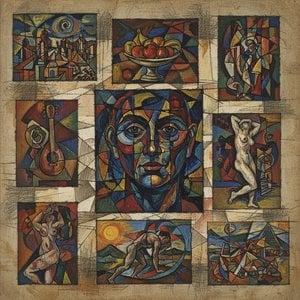
Leroy Livingstone de Maistre: A Pioneer of Australian Modern Art
Early Life and Education
- Born: March 27, 1894, in Bowral, New South Wales, Australia as Leroy Livingstone de Mestre.
- De Maistre came from a prominent family; his father was a renowned racehorse trainer and his grandfather a successful businessman.
- He received a private education through tutors and governesses before pursuing formal studies in art and music in Sydney in 1913.
- He studied violin and viola at the New South Wales State Conservatorium of Music, even playing viola in the Sydney Orchestra.
- His artistic training began at the Royal Art Society of New South Wales under Antonio Dattilo-Rubbo, alongside future notable artists like Grace Cossington Smith and Roland Wakelin. He was encouraged to explore Post-Impressionism.
World War I and Early Artistic Development
- De Maistre attempted to enlist in the First Australian Imperial Force multiple times, facing initial rejections due to health concerns. He eventually served as a medical orderly.
- Tuberculosis, which he had concealed from army doctors, significantly impacted his physical condition and ultimately led to his discharge.
- His illness prompted him to focus solely on painting, abandoning his musical aspirations.
- Early works (1916) reflected Impressionistic influences, focusing on the effects of light.
The Colour-Music Experiments
- De Maistre’s most groundbreaking work began with his exploration of “colour-music” in 1917. He collaborated with Dr. Charles Gordon Moffit on colour therapy for shell-shocked soldiers.
- He developed a theory harmonizing colours and musical notes, believing they shared fundamental relationships.
- Working with Adrian Verbrugghen and later Roland Wakelin, he created a “colour-music” scale where colours corresponded to notes in major and minor scales.
- The 1919 joint exhibition with Wakelin, titled ‘Colour in Art’, showcased this concept – an attempt to orchestrate colour like music.
- Rhythmic composition in yellow green minor (1919) remains a key example of this experimental period.
Artistic Transition and Later Works
- De Maistre is recognized as the first Australian artist to embrace pure abstraction, stemming from his colour-music investigations.
- However, he later shifted towards a figurative style heavily influenced by Cubism. This demonstrates his versatility and evolving artistic vision.
- The Stations of the Cross, commissioned for Westminster Cathedral, is arguably his most celebrated achievement – a significant religious artwork.
- Other notable works include A painted picture of the universe (1960).
Legacy and Historical Significance
- De Maistre’s pioneering work in colour-music and abstraction profoundly impacted Australian art, challenging conventional approaches.
- His innovative ideas influenced generations of artists both within Australia and internationally.
- His works are held in prestigious collections including the Tate Gallery (London), the Art Gallery of New South Wales (Sydney), and the National Gallery of Victoria (Melbourne).
- He died on March 1, 1968, leaving behind a legacy as a visionary artist who bridged the gap between visual art and music.
Q&A
Leroy Livingstone De Mestre의 출생 도시와 국가는 어디인가요?
Leroy Livingstone De Mestre은(는) Australia Bowral에서 태어났습니다.
Leroy Livingstone De Mestre 작가의 다른 활동명이나 알려진 이름이 있나요?
Leroy Livingstone De Mestre은(는) Roy De Maistre(으)로도 알려져 있습니다.
Leroy Livingstone De Mestre의 작품을 색상별로 찾아볼 수 있나요?
Leroy Livingstone De Mestre의 컬러 인덱스에서는 작가의 작품들을 색상별로 모아 보실 수 있습니다.