Patrons, Workshop and Commissions
Rottmann’s life was closely tied to the Bavarian court. He spent much of his time teaching drawing to those within the royal circle, including his cousin, Princess Therese of Bavaria. His influence extended to the education of Crown Prince Ludwig, who would later become King Ludwig II of Bavaria. This connection led to a specific commission in 1861, when the Crown Prince asked him to design the scenery and costumes for a production of Lohengrin by Richard Wagner. His teaching also reached beyond Munich, as he served as the drawing teacher for King Otto of Greece and Prince Luitpold.
The Bavarian court provided significant work for him through large-scale watercolor cycles. In 1854 and 1858, he received two major commissions to produce these works, which focused on the hunting grounds of Maximilian II and views of the Tyrolean, Swiss, and Bavarian Alps. These pieces were eventually acquired by the royal copperplate engraving collection, known today as the Graphic Collection in Munich. His long-standing relationship with the monarchy was formalized in 1868 when he was named court painter.
Technique and Style
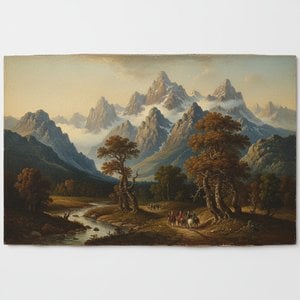
Leopold Rottmann found his most natural expression in watercolors. While his approach was rooted in Naturalism, his hand often followed the patterns of Classically trained painters. The influence of Joseph Anton Koch and Friedrich Preller the Elder is visible in how he structured his landscapes. He did not seek the sharp, rigid lines found in the work of his brother, Carl. Instead, he rendered the textures of rocks and the edges of trees with a softer, more blurred quality. This choice allowed for a gentler transition between the elements of the landscape.
As his practice evolved, his focus shifted toward the way light moves across a scene. His later watercolors show a growing preoccupation with the natural appearance of light and how it settles on the land. This change in observation brought a shift in his palette. His earlier works leaned heavily on greens, blues, and yellow-green tones. In his later years, these colors gave way to a predominance of brown tones, creating a different atmosphere in his compositions.
Key Works
His early output often focused on the rugged terrain of the Alps. In 1834, he produced Der Untersberg von Berchtesgaden aus gesehen, a work that emerged from his studies of the Bavarian and Salzburg mountains. Around 1830, he painted Königssee mit dem Einschiffungsplatz, capturing the specific atmosphere of the lakeside landing area. This interest in the water and the surrounding peaks continued in later compositions such as Am Königssee and Am Vierwaldstätter See.
The artist also turned his attention to different landscapes and specific geological features. His 1837 work Dalmatinische Küstenlandschaft shows a departure from the alpine settings toward the coastal views of the Adriatic. Other notable pieces include Aus dem Inntal and Barmsee mit der Zugspitze, which reflect his continued engagement with the natural forms of the mountains and the way light settles upon them.
Q&A
미술 사조별로 분류된 Leopold Rottmann의 작품은 어디에서 볼 수 있나요?
Leopold Rottmann 작가의 작품을 예술 사조별로 모아둔 모든 미술 사조 페이지에서 해당 작가가 활동했던 사조를 확인하실 수 있습니다.
Leopold Rottmann 작가의 작품에서 가장 자주 나타나는 색상은 무엇인가요?
Leopold Rottmann 작가 작품의 컬러 프로필은 작가의 팔레트 지놈 페이지에서 확인하실 수 있습니다.
Leopold Rottmann의 출생 도시와 국가는 어디인가요?
Leopold Rottmann은(는) Germany Heidelberg에서 태어났습니다.