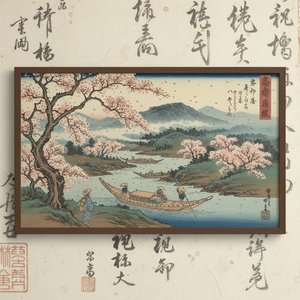
The Poet Painter of Edo Japan
Katō Bunrei (1706–1782) stands as a singular figure in the annals of Edo period Japanese art, a master whose brush captured not merely the physical world, but the very breath of the landscape. Born Yasuto in Tokyo, he eventually adopted the artistic moniker Bunrei, a name signifying “pine spirit.” This choice was far more than a mere pseudonym; it served as a profound reflection of his personal philosophy and the recurring motif that would come to dominate his entire oeuvre. His life’s work became an enduring meditation on the resilience and spiritual essence of the pine, rendered through a lens of poetic contemplation.
The foundation of Bunrei’s mastery was laid during his formative years under the tutelage of Sessai Hiroaki, a prominent Sumi-e master. From Hiroaki, Bunrei inherited a profound appreciation for the subtle power of ink wash painting, learning to capture the ephemeral essence of nature through delicate brushstrokes and nuanced tonal variations. This training instilled in him the belief that true art lies not in the meticulous documentation of detail, but in the ability to evoke the soul of a subject through the strategic use of light, shadow, and space.
The Ethereal Mastery of Buncho Tani
Bunrei’s most significant contribution to art history resides in his pioneering exploration of buncho tani—a genre of "pine grove" landscapes that emphasizes atmospheric depth. While many of his contemporaries sought to impress viewers with intricate, highly detailed representations, Bunrei moved in a different direction. He sought to convey profound moods and deep-seated emotions through layered washes of ink, creating ethereal vistas that seemed to shimmer with the mist of dawn or the quietude of twilight. His landscapes often evoke feelings of solitude, tranquility, and spiritual reflection, inviting the viewer into a state of meditative stillness.
His technical innovation was centered on the meticulous layering of ink washes. By employing multiple shades of black and grey, Bunrei achieved a remarkable sense of depth and luminosity that felt almost three-dimensional. He possessed a rare ability to manipulate the brushstroke itself, utilizing delicate flicks and subtle gradations to convey the rough texture of bark or the soft movement of wind through needles without ever resorting to excessive or distracting detail. This understated, sophisticated approach allowed his work to breathe, leaving room for the viewer's own imagination to inhabit the misty groves he created.
Symbolism and Lasting Legacy
Beyond the technical brilliance of his landscapes, Bunrei’s work is deeply imbued with symbolic meaning, often bridging the gap between the natural world and spiritual truth. His celebrated masterpiece, ‘Misty Landscape with Rainbow,’ serves as a testament to his command of tonal harmony, capturing the fleeting, miraculous beauty of a rainbow emerging from the morning fog. In other works, such as ‘Hotei and Chinese Children,’ he demonstrated an ability to weave complex Buddhist concepts—such as compassion and enlightenment—into serene natural settings, using symbolic figures to ground his atmospheric landscapes in a deeper moral and spiritual context.
The legacy of Katō Bunrei is one of quiet revolution. By prioritizing the spirit of the landscape over its literal form, he helped define a specific aesthetic of atmospheric beauty that continues to resonate within the tradition of Japanese literati art. His ability to transform simple ink and paper into vast, breathing worlds ensures his place as one of the most evocative painters of the Edo period, leaving behind a body of work that remains a sanctuary for those seeking peace in the presence of nature.
Q&A
Katō Bunrei의 활동 시기는 어떻게 구분되어 있나요?
Katō Bunrei의 작품 세계를 시간순으로 정리한 기록은 아티스트 연대기 페이지에서 확인하실 수 있으며, 이곳에서는 각 시기별로 분류된 챕터를 따라 작품들을 제작 순서대로 만나보실 수 있습니다.
Katō Bunrei의 출생 도시와 국가는 어디인가요?
Katō Bunrei은(는) Japan Tokyo에서 태어났습니다.
특정 매체로 분류된 Katō Bunrei의 모든 작품을 어떻게 찾을 수 있나요?
모든 매체별 페이지에서는 Katō Bunrei의 작품을 기법별로 모아볼 수 있습니다.