The Vanguard of Hungarian Modernism
Born in the vibrant heart of Budapest in 1873, Károly Kernstok emerged as a transformative force in the landscape of early twentieth-century European art. His journey was one of constant movement and intellectual expansion, beginning with his formative studies at the School of Applied Arts before venturing into the great artistic hubs of Europe. In 1892, he sought the mentorship of Simon Hollósy in Munich, a period that laid the groundwork for his technical mastery. However, it was his time at the prestigious Académie Julian in Paris between 1893 and 1896 that truly ignited his creative spirit. Immersed in the shifting currents of French art, Kernstok absorbed the radical innovations that were beginning to dismantle traditional naturalism, preparing him to return to Hungary not merely as a painter, but as a revolutionary.
Upon his return to his homeland, Kernstok found himself at the center of a profound aesthetic struggle. He became a leading figure among the "Neos," a group of radical painters determined to break away from the conservative, naturalistic traditions of the Nagybánya artists' colony. This period of his life was marked by an intense search for a new visual language that could capture the energy of a changing world. His early works, such as the politically charged Agitátor, demonstrated a burgeoning interest in social implications and bold, expressive themes. As he matured, his style evolved from these initial genre scenes into something far more monumental and structurally profound.
A Symphony of Form and Color
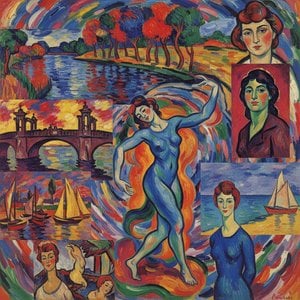
The evolution of Kernstok’s technique is a fascinating study of the transition from late nineteenth-century naturalism to the avant-garde. Heavily influenced by the luminous palettes of Henri Matisse and the structural integrity of Paul Cézanne, his work began to exhibit a unique synthesis of Fauvist color and proto-Cubist form. He moved away from delicate textures toward a style where figures appeared almost sculptural, defined by powerful outlines and solid, rhythmic shapes. This approach is perhaps most breathtakingly realized in his masterpiece, Riders at the Waterside (1910), a painting that captures a sense of dynamic, sweeping movement through its bold use of color and monumental composition.
His artistic development was characterized by several key stylistic pillars:
- Structural Solidity: A move toward heavy, defined contours that gave his subjects a physical, architectural presence.
- Chromatic Intensity: The adoption of glowing, often non-naturalistic colors to evoke emotional and symbolic depth.
- Dynamic Composition: An emphasis on rhythm and movement, often utilizing sweeping lines to guide the viewer's eye across the canvas.
- Symbolic Expression: Using the human form as a vessel for broader social and spiritual themes.
Legacy and Historical Significance
Kernstok’s role in history extends far beyond the canvas; he was a pivotal organizer of the Hungarian avant-garde. As a founding member of The Eight (1909–1918), he helped establish a movement that would define the aesthetic identity of Hungary during a period of immense political upheaval. His leadership reached its zenith when he served as the head of the Art Policy and Fine Arts Free School of the Hungarian Soviet Republic in 1919. This period of intense political engagement, however, was followed by profound personal and professional shifts. The fall of the republic forced him into exile in Berlin, where he lived and worked until 1926, further absorbing the international currents of modernism before eventually returning to Budapest.
Though his later years were marked by the complexities of a changing Europe, Kernstok’s contribution to the trajectory of modern art remains indisputable. He bridged the gap between the provincial traditions of Central Europe and the radical innovations of Paris, creating a uniquely Hungarian expression of modernism. Today, his works, held in prestigious institutions such as the Hungarian National Gallery, serve as enduring testaments to a man who dared to reimagine the boundaries of sight, form, and social purpose.
Q&A
키워드로 Károly Kernstok의 작품을 찾아볼 수 있나요?
특정 주제의 Károly Kernstok 작품을 찾으려면 키워드별로 작품이 분류된 작가의 키워드별 탐색 페이지를 이용해 보세요.
Károly Kernstok의 출생 도시와 국가는 어디인가요?
Károly Kernstok은(는) Hungary Budapest에서 태어났습니다.
Károly Kernstok 작가는 어떤 사조의 작품 활동을 했나요?
모든 미술 사조 페이지에서는 Károly Kernstok의 작품을 예술 사조별로 모아 볼 수 있습니다.