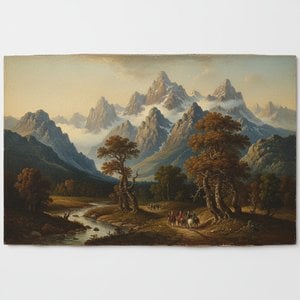
The Quiet Presence of Karol Vandrák
To look at the work of Karol Vandrák is to encounter a specific, localized moment in nineteenth-century painting. He does not command the space with grandiosity, but rather occupies it through a disciplined application of oil on canvas. His output is modest, yet it provides a necessary window into the aesthetic preferences of his era. We see him most clearly in his 1840 work, Romantic Landscape with Figural Staffage, a piece held by the Slovak National Gallery in Bratislava. It is a work that prioritizes the relationship between the human figure and the natural environment, a hallmark of the Romantic sensibility.
His technical approach suggests a painter deeply concerned with the structural integrity of his compositions. There is no wasted motion in his brushwork. Instead, there is a deliberate placement of elements to guide the eye through the landscape. This focus on the landscape as a setting for human presence defines his contribution to the period's visual language.
Technical Focus and Subject Matter
Vandrák’s output is characterized by a specific set of interests that align him with the landscape traditions of the mid-1800s. His work avoids the chaotic for the sake of the dramatic, opting instead for a controlled representation of nature. His catalog is defined by several key attributes:
- A preference for the Romantic landscape genre.
- The use of figural staffage to provide scale and narrative to natural settings.
- A reliance on oil on canvas as his primary medium.
The presence of his work in the Slovak National Gallery confirms his standing within the regional art history of Central Europe. He was not a painter of fleeting sketches, but one of finished, intentional compositions. His ability to integrate figures into a landscape without disrupting the naturalistic logic of the scene shows a high level of compositional control.
Historical Placement
Vandrák operated during a transformative period in European art, yet he remained anchored to the specific demands of his time. He lived through the shifts of the nineteenth century, from 1803 until 1882, witnessing the evolution of landscape painting from its more rigid roots into the more emotive Romanticism. His work remains a concrete piece of evidence from this transition. He does not attempt to reinvent the wheel; he simply executes his vision with a clarity that survives the passage of time. His legacy is found in the specific, tangible reality of his canvases, which remain preserved in institutional collections.
Q&A
Karol Vandrák의 다른 이름이나 별칭에는 무엇이 있나요?
Karol Vandrák은(는) Károly Vandrák라는 이름으로도 활동하고 있습니다.
Karol Vandrák의 연도별 활동 기록이 있나요?
Karol Vandrák의 작품 세계를 시간순으로 정리한 기록은 아티스트 연대기 페이지에서 확인하실 수 있으며, 이곳에서는 각 시기별로 분류된 챕터를 따라 작품들을 제작 순서대로 만나보실 수 있습니다.
Karol Vandrák의 작품 중 몇 점을 둘러보실 수 있나요?
전체 작품 보기 페이지에서 Karol Vandrák의 작품 작품 1점점을 만나보실 수 있습니다.
Karol Vandrák 작가의 작품을 연도별로 어떻게 확인할 수 있나요?
Karol Vandrák의 작품은 작품 연대기 페이지에서 연도순으로 확인하실 수 있습니다.