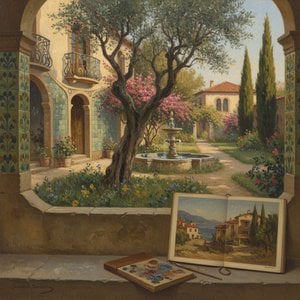
Juan Miguel Sánchez Fernández: A Voice of Femininity and Seville’s Soul
Born in El Puerto de Santa María, Spain, in 1900, Juan Miguel Sánchez Fernández emerged as a significant figure in the vibrant artistic landscape of early to mid-20th century Spain. His life was one of quiet dedication, marked by a relentless pursuit of his craft and a unique ability to capture the essence of Spanish culture, particularly its women, through his distinctive style. Though often overshadowed during his lifetime, Sánchez Fernández’s legacy endures through his evocative posters, poignant paintings, and contributions to the visual identity of institutions like the Instituto Mexicano de Seguro Social (IMSS), where his iconic “La Maternidad” logo remains instantly recognizable.
Sánchez Fernández's artistic journey began at a young age. Receiving his initial training at the Santa Cecilia School of Fine Arts in his hometown, he quickly demonstrated an aptitude for visual representation. At seventeen, he relocated to Seville, seeking further education at the prestigious School of Arts and Crafts under the tutelage of influential masters such as Virgilio Mattoni, Gonzalo Bilbao, and Manuel González Santos. His time there was enriched by mentorship from Gustavo Bacarisas, a Gibraltarian painter who exposed him to new perspectives and techniques. This formative period laid the foundation for his distinctive style, characterized by a sensitive observation of human form and an acute awareness of regional identity.
Early Struggles and the Rise of Poster Design
The early years of Sánchez Fernández’s career were marked by challenges. He initially found work in a ceramics workshop, a practical necessity that provided a means to support himself while nurturing his artistic aspirations. However, it was his foray into poster design that truly propelled him to recognition. Seville's bustling streets and cultural events demanded visually arresting advertisements, and Sánchez Fernández quickly established himself as a leading innovator in this field. He moved beyond the prevalent “costumbrista” style—characterized by stereotypical depictions of Spanish life—introducing fresh perspectives and technical advancements. His posters weren’t merely functional; they were miniature works of art, imbued with a sense of dynamism and capturing the spirit of the moment.
His innovative approach to poster design wasn't solely about aesthetics; it was also deeply rooted in his understanding of Spanish culture. He skillfully blended traditional motifs with modern techniques, creating images that resonated with audiences while simultaneously reflecting the evolving social landscape of Spain. This period saw him experimenting with bold colors, dynamic compositions, and a keen eye for detail – elements that would later define his painting style.
A Painter of Women: ‘La Maternidad’ and Beyond
Sánchez Fernández's most enduring legacy lies in his paintings, particularly those depicting women. He possessed an extraordinary ability to capture the vulnerability, strength, and inherent grace of the female form. His masterpiece, “La Maternidad” (Motherhood), exemplifies this talent perfectly. The painting’s simple yet profoundly moving portrayal of a mother and child resonated deeply with audiences, ultimately becoming the iconic logo for the Instituto Mexicano de Seguro Social (IMSS). This success cemented his reputation as an artist capable of conveying complex emotions through subtle gestures and evocative imagery.
Beyond “La Maternidad,” Sánchez Fernández’s oeuvre encompasses a diverse range of subjects – portraits, landscapes, and scenes from everyday life. His work is characterized by a delicate brushwork, a muted color palette, and an intimate perspective that draws the viewer into his world. He frequently employed a technique reminiscent of Spanish Realism, but infused with a distinctly personal sensibility.
Recognition and Legacy
Following the tumultuous years of the Spanish Civil War, Sánchez Fernández’s career experienced a period of consolidation. In 1939, he held his first solo exhibition in San Sebastián, marking a significant milestone in his artistic journey. In 1943, he was awarded a chair of procedures and techniques at the School of Arts and Crafts, further solidifying his position as an influential figure in Spanish art education. His work is now recognized within collections such as the colección Andrés Blaisten (Mexico), showcasing the breadth of Latin American artistic talent throughout history.
Juan Miguel Sánchez Fernández’s life and career represent a testament to the power of perseverance, artistic vision, and a deep connection to one's cultural heritage. His paintings continue to captivate viewers with their poignant beauty and enduring relevance, ensuring that his voice—a voice dedicated to portraying the essence of femininity and the soul of Seville—will be heard for generations to come.
Q&A
Juan Miguel Sánchez Fernández의 작품을 사조별로 둘러볼 수 있나요?
Juan Miguel Sánchez Fernández 작가의 작품을 예술 사조별로 모아둔 모든 미술 사조 페이지에서 해당 작가가 활동했던 사조를 확인하실 수 있습니다.
Juan Miguel Sánchez Fernández의 작품을 매체별로 찾아볼 수 있나요?
Juan Miguel Sánchez Fernández의 작품은 작가 페이지인 모든 매체별에서 매체별로 둘러보실 수 있습니다.
키워드로 Juan Miguel Sánchez Fernández의 작품을 찾아볼 수 있나요?
특정 주제의 Juan Miguel Sánchez Fernández 작품을 찾으려면 키워드별로 작품이 분류된 작가의 키워드별 탐색 페이지를 이용해 보세요.