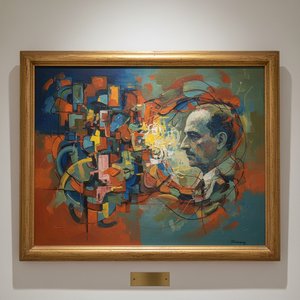
The Soul of Form: The Artistic Journey of Jorge Damiani
Born in the serene landscape of Nervi, Italy, in 1931, but deeply rooted in the vibrant cultural soil of Uruguay, Jorge Damiani emerged as a transformative force in mid-century modernism. Though his physical beginnings were European, his artistic spirit was forged in Montevideo, where he moved as an infant. This unique duality—a Mediterranean heritage blended with a South American sensibility—allowed him to navigate the complexities of 20-century art with a profound, cosmopolitan perspective. His early training at the Escuela Nacional de Bellas Artes provided the technical foundation upon which he would build a career defined by formal experimentation and an unwavering commitment to the expressive power of the line.
The trajectory of Damiani’s development was significantly shaped by his time in Milan during the early 1950s. Studying at the prestigious Accademia di Belle Arti di Brera under masters such as Pompeo Borra and Enzo Morelli, he absorbed the nuances of Italian metaphysical realism and classicism. This period of intense academic rigor introduced him to a world where structure and mystery coexisted, an influence that would later manifest in his ability to balance geometric precision with emotional depth. As he returned to Uruguay, he became more than just a painter; he became a pillar of the national art scene, serving as a professor and academic who helped modernize and professionalize visual arts education in his homeland.
A Language of Geometry and Light
Damiani’s mature style is a captivating dialogue between abstraction and structure. Moving away from the purely figurative, he embraced a visual language composed of meticulous shapes—squares, rectangles, and circles—that functioned as meditations on spatial relationships. His canvases often feel like architectural blueprints for the soul, where vibrant hues and rhythmic patterns create a sense of balanced tension. He frequently utilized motifs such as spirals and grids, reflecting a fascination with mathematical harmony and the organic rhythms found in nature. Through his work in painting, drawing, and engraving, he sought to distill complex human emotions into simplified, potent visual symbols.
The texture and technique of his work reveal a deep commitment to formal experimentation. Whether through the delicate precision of an etching or the bold, sweeping strokes of a large-scale canvas, Damiani maintained a focus on the expressive line. His ability to manipulate color allowed him to evoke atmospheres ranging from the somber tones of metaphysical stillness to the energetic pulse of geometric abstraction. This versatility ensured that his work remained intellectually stimulating, inviting viewers to look beyond the surface and contemplate the underlying order of the universe.
Legacy and International Recognition
The significance of Jorge Damiani’s contribution to art extends far beyond the borders of Uruguay. His talent earned him a place on the global stage, with his work being featured in some of the most prestigious exhibitions of the 20th century. His career was marked by several monumental achievements that solidified his reputation as a master of modern abstraction:
- Global Exhibition Milestones: He participated in the renowned Venice Biennale (1964), the Paris Biennale of Young Artists (1963), and the Sao Paulo Biennial, showcasing Uruguayan modernism to an international audience.
- Prestigious Accolades: His excellence was recognized through multiple First Prizes at the National Fine Arts Salon in Uruguay and a prestigious Guggenheim Grant, which facilitated his influential period living and working in New York City.
- Institutional Impact: Beyond his personal canvases, he co-founded the Instituto de Bellas Artes "San Francisco de Asis," contributing to the institutional growth of Latin American art education.
- Permanent Collections: His legacy is preserved in esteemed institutions such as the Museum of Modern Art (MoMA) in New York, which acquired his work during a period of intense international scrutiny, and the Museo Nacional de Artes Visuales (MNAV) in Montevideo.
When Jorge Damiani passed away in 2017, he left behind a body of work that serves as a bridge between traditions. He successfully synthesized the classical discipline of his Italian training with the avant-garde spirit of the Uruguayan movement. Today, his paintings and prints remain vital touchstones for anyone seeking to understand the evolution of Latin American abstraction, standing as enduring monuments to the beauty of form, color, and the infinite possibilities of the geometric imagination.
Q&A
Jorge Damiani의 작품을 분위기별로 모아둔 곳은 어디인가요?
아티스트의 무드 룸 페이지에서는 Jorge Damiani의 작품들을 분위기에 따라 큐레이션된 형태로 만나보실 수 있습니다.
Jorge Damiani 작품의 연도별 타임라인이 있나요?
Jorge Damiani의 작품은 작품 연대기 페이지에서 연도순으로 확인하실 수 있습니다.
Jorge Damiani 작가 작품의 컬러 프로필은 어디에서 확인할 수 있나요?
Jorge Damiani의 팔레트 지놈에서는 작가의 작품 세계를 구성하는 컬러 프로필을 확인하실 수 있습니다.
Jorge Damiani의 작품을 컬러 팔레트별로 둘러볼 수 있나요?
컬러 팔레트별로 보기 페이지에서는 Jorge Damiani의 작품들을 색상 팔레트별로 모아볼 수 있습니다.