The Birmingham Impressionist
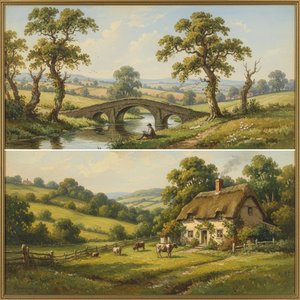
To look at the works of John Keeley is to see the English landscape through a lens of disciplined observation rather than romanticized myth. Born in 1849 in Moreton in Marsh, Gloucestershire, Keeley did not rely on inherited prestige but on the rigorous training he received at the Birmingham School of Art under Edward Watson. This technical foundation allowed him to move beyond mere sketching into a sophisticated application of Impressionism. His focus remained fixed on the atmospheric shifts of the British countryside, capturing the precise way light interacts with water and earth.
His career was defined by a deep connection to the Midlands. While his origins lay in Gloucestershire, he spent much of his adult life in Birmingham, a city that provided both his professional community and his primary subject matter. His presence in the local art scene was substantial and documented through decades of exhibition. He did not merely participate; he became an integral part of the institutional fabric of the region.
Technical Precision and Professional Standing
Keeley’s mastery of watercolour allowed him to document the changing weather and light with a directness that avoids unnecessary flourish. He often utilized white body colour to heighten specific details, a technique that gave his landscapes a structural clarity. His subject matter was grounded in the tangible: cattle in a landscape, rural cottages, and the specific topography of places like Trent Vale, Hall Green, and Yardley Wood. These were not generic scenes but specific studies of terrain and atmosphere.
His professional credentials reflect a man who earned his place through consistent output and peer recognition. His standing within the British art establishment is evidenced by several key affiliations:
- Associate of the Royal Birmingham Society of Artists, elected in 1898.
- Full member of the Royal Birmingham Society of Artists, achieved in 1902.
- Member of the Birmingham Art Circle.
- Member of the Royal Institute of Painters in Water Colours (RI).
The sheer volume of his contributions to the Royal Birmingham Society of Artists is notable, with over 300 works exhibited there across four decades. This level of activity demonstrates a sustained commitment to the medium and the local exhibition circuit.
A Legacy of Observation
Keeley’s importance lies in his ability to translate the specificities of the Birmingham landscape into a cohesive visual language. He exhibited widely, taking his work to the Walker Art Gallery in Liverpool, the Dudley Gallery, and even the Royal Academy of Arts. His reach extended to the New Watercolour Society and the Royal Society of British Artists, proving that his localized focus possessed a broader appeal. He captured the essence of the English landscape—from the wet roads of Worcestershire to the misty marshes—without retreating into abstraction.
By the time of his death in 1930, Keeley had left behind a body of work that serves as a factual record of the British landscape during a period of significant transition. His paintings remain focused on the physical reality of the land, stripped of sentimentality, leaving only the honest interaction of light, water, and terrain.
Q&A
John Keeley의 모든 작품은 어디에서 볼 수 있나요?
이 사이트에 등록된 John Keeley의 모든 작품은 작가의 전체 작품 보기 페이지에서 만나보실 수 있습니다.
John Keeley의 작품을 컬러 팔레트별로 둘러볼 수 있나요?
특정 색상 팔레트의 John Keeley 작품을 찾으시려면, 작가의 컬러 팔레트별로 보기 페이지를 이용해 보세요.
John Keeley 작가의 국적은 어디인가요?
John Keeley은(는) United Kingdom 출신입니다.
키워드로 John Keeley의 작품을 찾아볼 수 있나요?
John Keeley의 작품은 아티스트의 키워드별 탐색 페이지에서 키워드별로 찾아보실 수 있습니다. 각 키워드를 통해 관련 작품들을 모아 감상하실 수 있습니다.